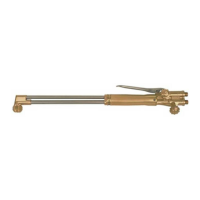
5-30
SET-UP AND SAFE OPERATING PROCEDURES
0056-0114
WARNING
There must always be two O-rings on the cone end. The absence or damage of either of
these O-rings allows premixing of the oxygen and fuel gases. This can lead to a sustained
backfire within the torch handle.
2. Connect the welding nozzle to the torch handle. Tighten the coupling nut HAND-TIGHT only.
Using a wrench could damage the O-rings and create a faulty seal.
Multi-Flame Heating Nozzles (Rosebuds)
Multi-flame heating nozzles are set up exactly as the welding nozzle. Follow the safety and operation
procedures described above for the welding nozzle.
CAUTION
Never starve or choke a welding nozzle or multi-flame heating nozzle. This causes
overheating of the nozzle and a backfire or sustained backfire may result. Should a
sustained backfire occur (flame pops and disappears and/or a hissing sound is heard,
the flame is burning inside the nozzle), immediately turn off the oxygen valve on the torch
handle. Then, turn off the fuel valve. Allow the nozzle to cool before using it. If a backfire
reoccurs, have the apparatus checked by a qualified technician before using again.
Leak Testing the System
The system MUST be tested for leaks before lighting the torch. To leak test the system perform the
following steps.
Be sure that both the oxygen and fuel control valves on the torch handle are closed.1.
With the oxygen cylinder valve open, adjust the oxygen regulator to deliver 20 PSIG.2.
With the fuel cylinder valve open, adjust the fuel regulator to deliver 10 PSIG.3.
Close both the oxygen and fuel cylinder valves.4.
Turn the adjusting screws counterclockwise ½ turn.5.
Observe the gauges on both regulators for five minutes. If the gauge readings do not change, 6.
then the system is leak tight. If there is a leak, use an approved leak detection solution to
locate it. If the inlet gauge reading decreases, there is a leak at the cylinder valve or inlet
connection. Tighten the inlet connection after the pressure has been released from the
regulator. If the inlet connection still leaks try another cylinder. If the same leak develops, take
the regulator to a qualified repair technician. Never tighten a cylinder valve. If the cylinder
valve is leaking, remove the regulator from the cylinder, place the cylinder outdoors and notify
your gas supplier immediately. If the delivery gauge reading decreases, there is a leak at the
regulator outlet connection, within the hose, at the torch inlet connection or at the control
valves on the torch handle. Tighten the regulator outlet connection and the torch handle
inlet connection after the pressure has been released from the system. If the connections
are still leaking, take the regulator or torch handle to a qualified repair technician. If the
hoses are leaking, replace them. If the high pressure gauge drops and at the same time the
Setting Up Equipment for Welding


 To Next Page
 Loading...