Victron product Remarks
VE.Bus Inverter/Charger The inverter and charger part can be controlled separately (on/off) from RV-C.
Also shore input current limit can be set.
Phoenix Smart IP43 Charger 120-240V Can be activated/deactivated (on/off) via RV-C. Also shore input current limit
can be set.
Phoenix Smart IP43 Charger 230V The Phoenix Smart IP43 Charger 230V cannot be controlled and is read-only.
Skylla-i and Skylla-IP44/IP65 Note that this requires two fully functional CAN-bus interfaces. For the time
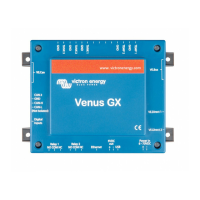
being, only the Venus GX and the Ekrano GX has these two interfaces.
Phoenix VE.Direct Inverter
Phoenix Inverter Smart and Inverter RS
Solar chargers incl. MPPT RS
Batteries:
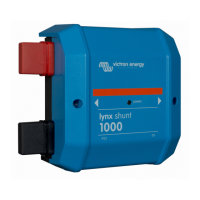
BMV, SmartShunt, Lynx Shunt, Lynx Ion
BMS, Lynx Smart BMS
Tanks; Tank level senders connected to:
the tank level input of the GX device
a GX Tank 140
the VE.Can and/or NMEA 2000 port of
the GX device
VenusOS also support RV-C in data for:
• RV-C tank sensors
Please note that the Garnet SeeLeveL II 709 does not have absolute tank level and tank capacity. Therefore we only show
relative level. Tanks from another GX device will have absolute level and capacity, but cannot be configured through RV-C.
• RV-C batteries: Lithionics is the only supported RV-C battery (including DVCC support)
See Appendix [116] for advanced parameters and RV-C programming.
15.4. RV-C Configuration
The configuration for RV-C is done via the GX device:
1. Open the remote console and go to Settings → Services → VE.Can ports → CAN-bus profile.
2. Open the CAN-bus profile and select the RV-C (250 kbit/s) profile.
The RV-C profile will start working and the previously selected profile will shut down (associated equipment like VE.Can
devices become unavailable in the GUI).
Color Control GX Manual
Page 97 RV-C Support



 To Next Page
 Loading...