This is what Limit managed battery charge voltage is designed for. Enabling this makes it possible to lower the maximum charge
voltage until cells have balanced.
Do not use it for any other purpose as it may have unwanted side effects, for example, balancing can fail or not start at all if the
charge voltage is set too low, causing the battery cells to become severely imbalanced over time. It is also not possible to set the
value above the charge voltage limit (CVL) sent by the battery.
11.4.3. Shared Voltage Sense (SVS)
Works with VE.Bus devices, VE.Direct and VE.Can MPPT solar chargers as well as Inverter RS and Multi RS.
The system automatically selects the best available voltage measurement. It will use the voltage from the BMS or a BMV battery
monitor, if possible, otherwise it will use the battery voltage reported by the VE.Bus system.
The voltage displayed on the GUI reflects the same voltage measurement.
Shared Voltage Sense (SVS) is by default enabled when DVCC is enabled. It can be disabled with a switch in Settings → DVCC.
SVS (and DVCC) is force enabled for the Lynx Smart BMS and cannot be changed.
Note that SVS is force-disabled for some batteries. Please see the compatibility page for your battery.
11.4.4. Shared Temperature Sense (STS)
Select the temperature sensor to use; and the GX device will send the measured battery temperature to the inverter/charger
system as well as all connected solar chargers.
Selectable sources for the battery temperature are:
• BMV-702 battery monitor
• BMV-712 battery monitor
• SmartShunt
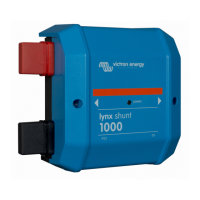
• Lynx Shunt VE.Can battery monitors
• Multi/Quattro inverter/charger
• Solar chargers (if fitted with a temperature sensor)
Note that STS is forced disabled for the Lynx Smart BMS and some batteries. Please see the compatibility page for your battery.
Color Control GX Manual
Page 62
DVCC - Distributed Voltage and Current
Control



 To Next Page
 Loading...