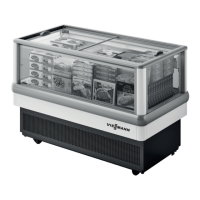
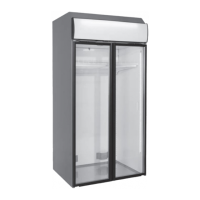
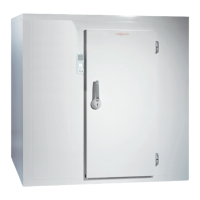
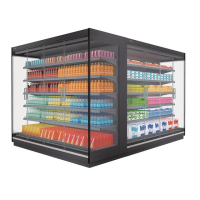
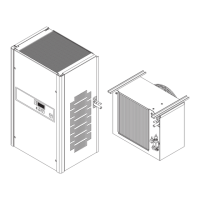
The Viessmann CS and FS refrigeration units with electronic control, Typ SE, are designed for cooling refrigeration rooms, with specific models catering to different temperature ranges. The FS series (FS0900SE, FS1200SE, FS1400SE, FS1800SE, FS2400SE, and their Split variants) are intended for goods stored between -25°C and -1°C, making them suitable for deep-freezing applications. The CS series (CS0500SE, CS0900SE, CS1300SE, CS2000SE, CS2800SE, and their Split variants) are designed for refrigeration rooms where goods are stored between +19°C and -2°C, suitable for general cold storage.
Function Description:
These refrigeration units are equipped with an electronic regulator that controls and monitors the coldroom temperature, defrosting cycles, and evaporator fan operation. The regulator features a display (B) and light diodes (A) for status indication, along with operating buttons for user interaction: a Standby button (C), an Increase Value button (D), and a Decrease Value button (E).
The core function involves maintaining a desired coldroom temperature. Users can set this temperature by briefly pressing either the Increase (D) or Decrease (E) button to view the current setting, then holding the button for at least three seconds to enter programming mode and adjust the value. The setting is saved upon release of the button.
The units also incorporate automatic defrosting, which occurs above +3°C. The defrosting cycle, time, and evaporator fan running time (related to relative humidity) can be programmed. This is achieved by simultaneously pressing the Increase (D) and Decrease (E) buttons to enter programming mode. In this mode, the light diode for "defrost cycle (h)" flashes, allowing adjustment of the cycle time (1 to 24 hours) using the Increase (D) or Decrease (E) buttons. Subsequently, the "defrosting time (min)" light diode flashes, enabling adjustment of the defrost duration (5 to 60 minutes). Finally, the "relative humidity" light diode flashes, allowing selection of the evaporator fan running time (H1 for low relative humidity, fan runs with compressor; H2 for high relative humidity, fan runs constantly). Settings are saved by pressing both buttons simultaneously or automatically after 8 seconds of inactivity. A manual defrost can also be initiated by switching the unit to standby, then pressing and holding both Increase (D) and Decrease (E) buttons, and finally switching the unit back on.
In case of regulator malfunction, an emergency operation mode is available. By removing the front panel and activating a flip switch, the compressor and ventilators are bridged, allowing continuous operation. However, this mode requires manual monitoring and adjustment of the coldroom temperature by switching the power supply at intervals, as the temperature is no longer regulated. The pressostat safety device remains active in this mode.
Important Technical Specifications:
The units are manufactured and inspected according to valid standards and regulations, including BGR 500 Kapitel 2.35, DIN EN 378, and DIN EN 50178. They are tested in the plant for proper sealing of the cold circulation system.
The regulator features a 9-pole D-Sub plug on the back for a serial interface (RS 232), allowing connection to an optional remote control or a central control unit.
An optional door contact switch can be connected. If connected, a sliding switch on the regulator (accessible after removing the front cover) must be set to the "with door contact switch" position.
Usage Features:
- Temperature Control: Precise electronic control for maintaining desired coldroom temperatures within specified ranges.
- Programmable Defrosting: Customizable defrosting cycles and durations to optimize performance and prevent ice buildup.
- Evaporator Fan Control: Settings for evaporator fan operation linked to relative humidity, allowing for either synchronized operation with the compressor (low humidity) or continuous operation (high humidity).
- Emergency Operation: A fallback mode for continued operation in case of regulator failure, ensuring critical cooling functions are maintained, albeit with manual oversight.
- Serial Interface: Connectivity for remote control and integration into central control systems, enhancing operational flexibility and monitoring capabilities.
- Door Contact Switch Compatibility: Option to integrate a door contact switch for improved energy efficiency and operational safety, triggering an error code (F5) if the door is open for too long.
- Error Code Display: The unit provides error codes (F1-F5) on the display to indicate specific problems such as sensor short circuits or breaks, high pressure pressostat activation, temperature deviations, or prolonged door opening, facilitating quick troubleshooting.
Maintenance Features:
- Regular Cleaning: The manual emphasizes the importance of periodic cleaning of the cooling unit, including the condenser and evaporator, using a soft brush, compressed air, or a high-pressure cleaner for oil residues. This prolongs product life and saves energy.
- Cleaning Intervals: The frequency of cleaning depends on the environmental conditions.
- Safety during Maintenance: Crucially, all work on the refrigeration unit, including cleaning, must be performed with the power plug removed and appropriate warnings posted to prevent accidental restart.
- Troubleshooting Guide: A comprehensive troubleshooting section provides common problems, their causes, and recommended remedies, empowering users to address minor issues independently.
- Refrigerant Disposal: Guidelines for environmentally responsible disposal of refrigerant and defective cooling units, emphasizing the importance of not damaging pipes to prevent coolant release.
- Surface Cleaning: Specific instructions are provided for cleaning SilverProtec surfaces that may develop discolorations due to contamination with solvents or outgassing synthetics, recommending oxygen-based purifiers or bleaching agents.
Installation Requirements:
- Ventilation: The installation area must be well-ventilated and not heated.
- Clearance: A minimum clearance of 250 mm in front of all suction and exhaust openings is required to ensure proper ventilation.
- Ambient Temperature: For economical operation, the ambient temperature should ideally be between +5°C and +25°C.
- Heat Sources: Direct heat radiation on the cooling unit must be avoided to prevent higher energy consumption.
Guarantee Conditions:
The guarantee is valid for one year from the delivery date. It covers defects resulting from poor workmanship or material problems. However, it excludes follow-up damages, issues caused by improper handling or non-observance of operating instructions, and is invalidated if the cooling circulation system is opened by unauthorized personnel, if there is interference with the system, or if the serial number is altered or unreadable.



 To Next Page
 General