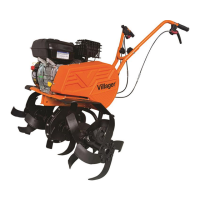
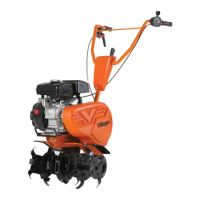
The Villager VTB 375 is a petrol tiller designed for private use, not for professional purposes. It is a robust machine intended for cultivating soil.
Technical Specifications
The tiller is powered by an engine with a displacement of 120.7 cm³ and an output of 1.9 kW. The engine speed is 2800 revolutions per minute. It has a fuel tank capacity of 0.8 liters and an oil volume of 0.45 liters, using SAE 30 oil. The fuel recommended is unleaded petrol. The transmission is gear-driven, and the cultivation width is 360 mm.
In terms of noise and vibration, the sound pressure level (LpA) is 81.6 dB(A) with a K-value of 3 dB, and the sound power level (LwA) is 93 dB(A) with a K-value of 3 dB. The vibration value (ahv) is 4.23 m/s² with a K-value of 1.5 m/s². Users are advised to always wear ear protection due to the noise levels. The actual vibration levels may vary depending on usage, so safety precautions should be determined based on real operating conditions, considering all phases of the work cycle, including idle and start-up times.
Usage Features
Assembly:
The assembly process involves several steps:
- Fasten the bracket on the cover (A), without fully tightening the screws initially.
- Pull the throttle wire (A) through the back of the bracket.
- Fit the handlebars onto the bracket (B).
- Ensure the handlebars are at the correct angle, then fully tighten the bracket screws.
- Fit the spur (C) and secure it with a pin.
- Insert the throttle wire into the retainer on the handlebar (D).
- Fasten the throttle wire into the clutch handle (E).
- Adjust the tension of the throttle wire (F) using the adjusting screw, aiming for a maximum pressure of 27.5 N on the clutch handle.
- Secure the throttle wire to the handlebar with cable ties.
- Release the engine cover to access the starter handle (G).
- Pull the starter handle through the cover.
- Fasten the cover back onto the engine.
Engine Oil:
The engine is delivered without oil. Before use, the oil reservoir must be filled.
- Remove the oil filler cap and add oil.
- Check the oil level using the dipstick. Wipe the dipstick, insert it without screwing, remove it, and check the level. The correct level should be at the MAX mark.
Refuelling:
- Clean around the fuel cap.
- Unscrew the fuel cap.
- Refuel using a funnel or a filler can with a spout to prevent spills.
- Screw on the fuel cap securely.
- Move the tiller at least 3 meters away from the refuelling point before starting.
Starting the Machine:
Before starting, always check the oil level to prevent engine damage.
- Fold up the transport wheel by pulling it forward, lifting it, and locking it with the pin in the top position.
- Set the throttle control to full throttle.
- Ensure the blades are at a safe distance from any onlookers.
- Hold the handlebars with one hand and slowly pull the starter handle with the other. Once the starter engages, pull quickly and firmly until the engine starts. Avoid pulling the cord roughly to its end position or letting it snap back, as this can damage the starter.
- Set the throttle control to the desired position.
- Adjust the spur to the required depth by pulling out the pin, setting the depth, and replacing the pin.
- To engage the drive, press down the clutch handle. Pull down the safety pin and turn it to another angle before pressing the clutch handle to activate the clutch system. The blades will start rotating when the engine is running and the lever is pressed down, moving the machine forward and cultivating the ground.
- To stop the machine, set the throttle control to the "stop" position.
Cultivating:
Set the engine to a convenient speed, as the highest speed is not always the best choice. The working depth should be chosen based on how easily the work can be done and the soil conditions. Optimal results are achieved by running the tiller 3-4 times in different directions. Avoid working in wet soil, as this creates hard clumps. Hard and dry soil may require a second pass at right angles to the first.
Maintenance Features
Safety Precautions:
Before any maintenance, cleaning, or repairs, always switch off the engine, allow it to cool, and disconnect the spark plug lead to prevent serious personal injury or death.
Adjusting the Clutch Wire:
- Undo nuts (B and C).
- Adjust the clutch engagement with screw (A). When the gear shift is not activated, the blades should be still. When activated, the blades should rotate at full power.
- Tighten nuts (B and C).
Changing the Oil:
It is important to change the engine oil every year.
- Remove the oil filler cap and fill with oil.
- Check the oil level by screwing in the oil plug with the dipstick, removing it again, and checking the level. The correct level should be at the MAX mark on the dipstick.
Cleaning:
Never use high-pressure washers or running water for cleaning, as water can penetrate seals and damage the engine.
- Brush off all loose debris first.
- Wipe the tiller with a damp cloth.
- Wash the blades and the underframe with water.
- Allow the tiller to dry completely.
Storage:
Store the tiller in a cool, dry place. Before storing, drain the petrol from the tank and carburetor.
Safety Warnings
The manual emphasizes several critical safety warnings:
- Always use the tiller according to instructions to prevent injury and damage.
- Only qualified adults should operate or maintain the tiller.
- Wear appropriate safety gear: sturdy boots (never barefoot), safety glasses, and ear protection. Avoid loose clothing or jewelry.
- Keep hands, hair, feet, and loose clothing away from moving parts.
- Never allow children or untrained adults to use the tiller.
- Do not operate under the influence of alcohol or drugs.
- Ensure all nuts, bolts, and screws are properly tightened, and use only original spare parts.
- Stop the tiller, allow it to cool, and disconnect the spark plug lead before any repairs or adjustments.
- The muffler and surrounding areas can reach over 65°C; avoid touching them and allow the engine to cool.
- The engine produces carbon monoxide, which is colorless, odorless, and tasteless. Never run the tiller indoors or in unventilated areas, as carbon monoxide can be fatal. If symptoms of carbon monoxide poisoning occur (tiredness, headache, nausea, dizziness), seek fresh air and medical attention immediately.
- Always operate the tiller with the exhaust pipe directed away from the user and ensure onlookers maintain a safe distance.
- Never attempt to siphon petrol by mouth.
- Handle fuel outdoors in a well-ventilated area, away from sparks, flames, or other ignition sources. Fuel and its fumes are highly flammable and explosive.
- Do not start the engine if petrol has spilled; wipe it up, allow it to dry, and move the tiller away from the spill area.
- Never store the tiller indoors with fuel in the tank.
- Use only approved fuel containers.
- Never refuel while the engine is running; allow it to cool first.
- Ensure the fuel filler cap is properly tightened before starting.
- Do not smoke while using the tiller.
- Avoid static discharge by using non-metallic portable fuel containers.
- Never allow children to fill the fuel tank or use the tiller.
- The clutch may slip during initial use but will transfer maximum power after about two hours of normal use. Keep the clutch free from oil and moisture.
- Be aware of potential kickback if blades hit hard objects.
- Never modify the engine or tiller from its factory state.
- Clear the work area of any foreign objects before use. Do not operate over buried conduits or pipes.
- Avoid using the tiller in soil with large stones or other impediments that could damage it.

 Need help?

 To Next Page
 General