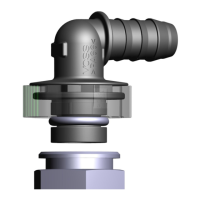
The VOSS quick connect system 232 is designed for rapid and safe connection of nylon tubes to components in pneumatic systems, particularly in commercial vehicles. These assembly instructions are intended for qualified fitters.
Function Description:
The system consists of two main assemblies: the plug with its fir-tree and the coupling element. The plug features a broad retaining groove, inclined at 45°, which protects the retaining clips from excess tension during assembly. It also has two additional grooves for o-rings: an inner o-ring (3) for sealing against the transported medium and an exterior o-ring (2) to prevent contamination. The unique groove geometry exerts an axial pre-tensioning force on the plug once the clips are in place. A reduced plug diameter above the exterior o-ring (2) stabilizes the coupling element and aids visual alignment during assembly.
The coupling element is screwed tightly into the component, with a thread-sealing o-ring (5) providing a seal in the threaded port. A two-step retaining element, clipped to the male nut (4) by a fixing ring (6), contains a retaining ring (8) and two metal clips (7). These clips lock into the plug's retaining groove when the plug is fully inserted. The connection is secured in two stages: the first clip provides initial retention against unintentional loosening, but the connection is not fully sealed until the second clip snaps into place.
Important Technical Specifications:
- Material: Connecting fittings are made from brass, die-cast aluminum, die-cast zinc, or nylon, depending on general conditions. Plugs are available in brass or nylon (PA 11-GF30) and are mutually replaceable.
- O-ring Materials: Dirt-protection and pretension o-ring (2) is NBR 60 or EPDM 60. O-ring seal (3) is NBR 60 or EPDM 60. Thread-sealing o-ring (5) is NBR 70.
- Retaining Element Materials: Retaining clips (7) are spring steel. Retaining ring (8) is POM.
- Temperature Range: -40°C to +100°C.
- Rated Operating Pressure: 15.5 bar, limited by the compressive strength of the nylon tubing.
- Nylon Tubing: Only nylon tubing conforming to DIN 74324 part 1, made of polyamide 11 or polyamide 12, may be used.
- Tightening Torques: For M 16 x 1.5 thread size, 10-17 Nm. For M 22 x 1.5 thread size, 10-17 Nm. These values apply to both metal and nylon casings with VOSS V-thread.
Usage Features:
- Assembly:
- Cutting Nylon Tubing: Tubing must be cut off square. VOSS cutting pliers are recommended to ensure a clean cut without burrs, eliminating the need for deburring.
- Fir-tree Insertion (Nylon Tube Collet): Insert the nylon tube into opened pliers, extending approx. 2 mm for brass plugs or 6 mm for nylon plugs beyond the serration. Fix the tube with the grip mechanism (clamping force adjustable). Manually press the fir-tree into the tube end, then use a plastic hammer to drive the plug fully into the tube until the fir-tree is covered. A plastic cap protects the plug during this process.
- Fir-tree Insertion (Manual Assembly Tool): The tool's clamping jaws should match the tube's outer diameter. A tool insert corresponding to the plug (NS 8 or NS 12) is placed in the fixture. The fir-tree diameter (d3) must match the nylon tube's internal diameter to achieve the required pretension. Place the nylon tube in the jaws, allowing it to protrude by length L (a+2 mm), and secure it. Place the plug with its protective cap into the tool insert and pre-center it in the tube end. Use the insert lever to press the nylon tube onto the plug until it reaches the end of the fir-tree.
- Connecting Line to Component: Remove the protective cap from the plug and any paint protection sticker from the coupling element. Slide the plug with the nylon tube into the coupling element's port, overcoming the axial force of the dirt-protection and pretension o-ring. Ensure both clips snap into place. Verify correct fitting by pulling back on the connector; it should not be possible to pull it back if correctly fitted. The connection is correct if the plug's shoulder above the exterior o-ring is below the coupling element's top face, making the o-ring invisible. Incorrect connections (first stop position) can be reconnected to the second stop position even under pressure (< 7 bar) without damage.
- Disassembly: The only tool required for disconnection is a wrench. Before detaching, the pneumatic line must be free of pressure to prevent personal injury or damage. To replace components, loosen the male nut and remove the connection. The nylon tube with plug and coupling element with o-ring do not need to be separated.
- Nylon Plugs: Nylon plugs have lower impact strength than brass plugs, reducing safety reserves against impact loads. They also exhibit different long-term behavior regarding strength and shape stability and should be protected from extreme temperatures (e.g., engine heat) and torsional stress.
Maintenance Features:
- Cleaning: The connecting port should be cleaned before fitting the coupling element, removing any paint residue from the sealing lip region. All individual components must be cleaned before reassembly.
- Replacement of Components: Components do not wear out but can be replaced if damaged due to inappropriate handling.
- Thread-sealing o-ring: Remove the old o-ring after system disconnection. Clean the groove and replace with a new, greased o-ring, avoiding damage, stretching, or twisting.
- Coupling Element: If the coupling element shows signs of damage, it must be replaced. To disconnect, break the connection, then lever off the fixing ring using a suitable tool, taking care not to damage the plug. Pull the clips sideways out of the retaining ring using a pointed tool through the slot in the cage. Once clips and ring are removed, the plug can be pulled out. Always use a new coupling element when reassembling after male nut and plug disconnection.
- Plug o-rings: Remove damaged o-rings after disconnection. Clean the groove and replace with new, greased o-rings, avoiding damage, stretching, or twisting.
- Lubrication: Only VOSS-approved greases should be used for o-rings to ensure functional reliability. Approved greases include Bechen - Berulub Hydrohaf 2, Bechen - Berulub Hydrohaf GR, and Klüber - SYNTHESO GLEP 1.
- Protective Cap: Plugs are supplied with a protective cap to shield the plug's neck and o-rings from damage and dirt. This cap should only be removed immediately before final assembly.

 Need help?
 General

 To Next Page