Operation & Maintenance Instruction
2.2
EMERGENCY
-
FIRST
STAGE
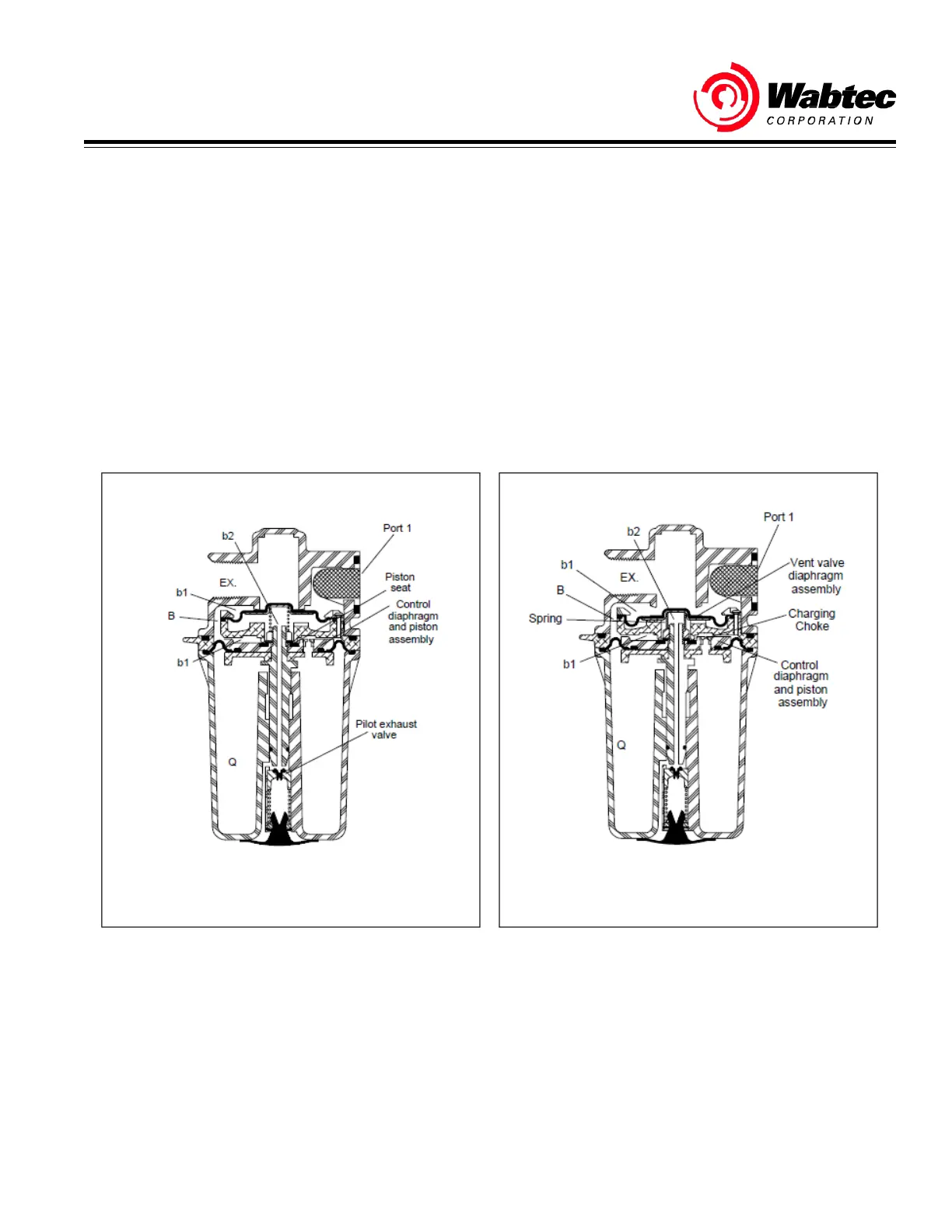
When an emergency rate of brake pipe reduction occurs,
the brake pipe
air
pressure
in cavities b, b1
and
b2 is reduced
rapidly
creating a
differential between the brake pipe
pressure
in cavities b, b1 and b2 and the air pressure in the control
pressure volume
Q. This
causes
the
control diaphragm
and
piston
assembly
to move,
unseating
the piston stem from its
seat
on
the exhaust valve and seating the
piston on
the
piston
seat of the body. The
seating
of the piston
isolates
cavity b2
from cavity b1. Air pressure in cavity b2 is then directed to
exhaust through
the
passage
in the
unseated
piston stem at
the exhaust valve. Cavity b2 is
exhausted quickly
due to its
small
volume.
2.3
EMERGENCY
-
SECOND
STAGE
The rapid exhaust of air pressure from cavity b2 creates a
differential on the non-spring side
of
the
vent
valve
diaphragm
assembly causing
this
assembly
to move
away
from its seat
and connects brake pipe
air from port 1
and
cavities b
and
b1
to exhaust (Port EX). Air pressure in the control pressure
volume Q then flows to atmosphere through the charging
choke of the control piston, cavity b1, passage B, cavity b
and port EX, when the air pressure in the control pressure
volume
Q is vented, the vent
valve diaphragm assembly
and
the control diaphragm and piston
assembly
are returned to
the
Release
Position by the force exerted by the spring.
Figure 2 - Emergency Position - 1st
Stage
Diagrammatic View
Figure 3 - Emergency Position - 2nd
Stage
Diagrammatic View


 To Next Page
 Loading...