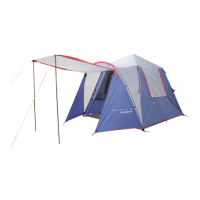
This document provides assembly instructions and important information for the Wanderer Magnitude Tent 6P with Awning, identified by PLU: 594901.
Function Description:
The Wanderer Magnitude Tent 6P with Awning is a portable, temporary shelter designed for outdoor use, accommodating up to 6 people. It features an inner tent for sleeping and a flysheet for weather protection, with the added functionality of an awning created by using the flysheet doors and steel poles. The tent is intended for recreational purposes, offering shelter from the elements during camping or other outdoor activities. It is not designed to be a permanent or semi-permanent structure.
Important Technical Specifications (Derived from Parts List and Setup):
The tent assembly requires a combination of fibreglass and steel poles, along with pegs and ropes for securing.
- Fibreglass Poles:
- Fibreglass Pole A (Black Indicator): 2 units. These are the longest fibreglass poles, used across the crossed pole sleeves of the inner tent.
- Fibreglass Pole B: 2 units. These are used across the parallel pole sleeves of the inner tent.
- Steel Poles:
- Steel Pole C: 2 units. These are used to set up the awning feature.
- Inner Tent: 1 unit. This forms the primary sleeping area.
- Flysheet: 1 unit. This provides external weather protection and includes doors that can be converted into an awning.
- Steel Pegs: 39 units. A significant number of pegs are provided for securing the tent and guy ropes.
- Rope: 2 units. Used for guy ropes to enhance stability.
- Carry Bag: 1 unit. For convenient storage and transport of all tent components.
Usage Features:
The tent is designed for relatively straightforward setup, involving a sequence of steps to erect the inner tent, attach the flysheet, and then secure the entire structure.
- Inner Tent Setup: The process begins by laying out the inner tent flat with the door zipped closed. Fibreglass poles (A and B) are then assembled and inserted into the respective pole sleeves.
- Arch Creation: To form the tent's structure, one person pushes the pole to create an arch, while a second person supports the tent's center, ensuring even arching and proper sleeve placement. Poles are secured to corner pins.
- G-Hooks: G-hooks are attached to the poles to further secure the inner tent structure.
- Flysheet Attachment: The flysheet is placed over the inner tent. Ties on the flysheet are wrapped around the poles to secure it.
- Ground Securing: Pegs are pushed through elastic tape on the flysheet into the ground to anchor the tent.
- Stability: Guy ropes and additional steel pegs are used to secure the assembled tent to the ground, enhancing stability, especially in windy conditions.
- Awning Functionality: Both flysheet doors can be set up using the provided steel poles (Steel Pole C) to create an awning, offering additional shaded or sheltered space.
- Safety Warnings:
- Fire Hazard: Do not set up near open flames. Fabric will burn if in continuous contact with a flame source. Do not use flame or fuel-burning appliances, heaters, candles, or matches inside or under the canopy.
- Site Selection: Ensure the site is free from obstructions (rocks, branches, sharp objects). Avoid overhead power lines and trees with potential for falling branches or lightning strikes.
- Security: The tent must be securely pegged using all provided peg points and guy ropes to ensure stability and prevent damage or injury, especially in windy conditions.
- Frame Handling: Exercise caution to avoid pinching hands or fingers when handling the frame.
- Utility Hooks: Designed for small hanging objects only (max 2kgs). Check hooks before use and do not use if loose.
- Children Safety: Keep children away from the setup area.
- Peg Removal: Always pull on the peg itself, not the tent, to avoid damage.
- Temporary Structure: The tent is a portable, temporary structure, not for permanent or semi-permanent use.
Maintenance Features:
Proper care and storage are emphasized to prolong the tent's lifespan.
- Cleaning: Frame and canopy should be washed with a mild solution of soap and water, then rinsed thoroughly and dried completely. Bleach or solvents should not be used.
- Insecticides/Bug Repellents: Do not spray these directly or near any fabric, as it may damage the water-repellent treatment.
- Storage: Always return the tent to its carry bag after use. Crucially, the tent must be completely dry before storing to prevent mildew and damage. If stored wet, it should be removed from the bag and spread out to dry as soon as possible.
- Condensation: Acknowledges that condensation can occur inside the tent due to temperature differences (cold outside, warm inside) and suggests adequate ventilation to minimize this natural event.
- Pre-use Check: Before first use, it is recommended to check all components and familiarize oneself with the assembly instructions.

 Need help?

 To Next Page
 General