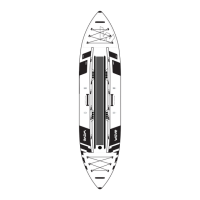
Clean your kayak with mild soap and water and let it dry completely. Make sure that
no sand or gravel remains in the kayak or between the hull and inner chambers as
this cause abrasion or punctures when storing the kayak.
Remove the valve caps on the bottom and side tubes to let the air out of the kayak.
Fold the 2 sides towards the middle, then roll up the kayak starting from the opposite
end to the valve, allowing the remaining air to escape from the valves.
Store your inflatable kayak in a clean and dry place and do not expose it to extreme
cold or heat. Water temperature and weather affect the pressure of inflatable prod-
ucts: in cold weather you may need to add a little air to increase the pressure and in
hot weather you will need to release some air prevent your product from failing due
to over-pressurisation.
The transport handles at both ends are used to carry the kayak and should not be
used to attach the kayak to a vehicle.
Follow this guidance to avoid drowning, paralysis or other serious injury.
1. ALWAYS wear an approved life jacket or Personal Flotation Device (PFD)
2. ALWAYS inform someone of your route, the time and place of your departure
and the scheduled time and place of your arrival.
3. This kayak is not a life-saving device. Use it only under competent supervision.
4. Have a licensed or certified instructor teach you how to paddle. Be sure to
carry a first aid and rescue kit.
5. Read the instruction manual completely before use and keep in a safe place
for future reference.
6. Check your equipment before each use for signs of wear and tear, leaks or
malfunctions.
7. Dress appropriately for weather conditions. Boating in cold water and weather
is very dangerous. Hypothermia can lead to death.
8. Know and follow local safety rules and boating regulations.
9. DO NOT drink alcohol or take drugs that impair your ability to operate the
kayak safely before using this product.
10. DO NOT exceed your paddling ability; be honest with yourself about your
capabilities.
11. DO NOT interfere with entry and exit of the kayak when attaching additional
equipment.
12. DO NOT over-inflate the boat or use a high-pressure compressor to inflate.
13. NEVER paddle in bad weather or dangerous water conditions (e.g. high winds,
rain, high tides, tidal changes etc.)
14. NEVER paddle alone. Minors must use this boat under adult supervision.
15. NEVER leave the kayak in or near water when not in use.
16. NEVER tow from a vehicle.
17. This kayak is NOT suitable for white water rafting or other extreme sports.
18. NEVER smoke in the kayak.


 To Next Page
 Loading...