This document is a service manual for the WEGA R350SH FM/MW/LW 3 Band Receiver, published in January 1981. It provides comprehensive information for the maintenance and repair of the device.
Function Description:
The WEGA R350SH is a 3-band receiver, capable of receiving FM, MW (Medium Wave), and LW (Long Wave) radio signals. It features an integrated audio amplifier section, making it a complete receiver and amplifier unit. The receiver includes a tuner section for radio signal reception and an audio amplifier section for driving speakers. It supports both mono and stereo FM reception, with a separation capability of 40 dB at 1 kHz. The device is designed for home audio use, providing both radio listening and amplification for external audio sources like a phonograph (PHONO) and tape deck (TAPE).
Important Technical Specifications:
General:
- Power Requirements: 220 V / 50 Hz
- Power Consumption: 350 W
- Dimensions (W x H x D): 430 x 100 x 280 mm
- Weight: 7.5 kg
Tuner Section:
- Tuning Range:
- FM: 87.5 - 106 MHz
- AM: 520 - 1605 kHz
- LW: 150 - 350 kHz
- Usable Sensitivity (FM at 40 kHz deviation, 26 dB S/N): 1.5 µV
- Usable Sensitivity (MW with ferrite bar antenna): 250 µV/m
- Usable Sensitivity (LW with ferrite bar antenna): 500 µV/m
- Selectivity (at 300 kHz for FM): 66 dB
- Selectivity (at 9 kHz for AM): 35 dB
- Harmonic Distortion:
- FM Stereo: 1%
- FM Mono: 0.3%
- AM: < 0.5%
- S/N Ratio:
- FM Mono: 70 dB
- AM: 50 dB (50 mV/m)
- Separation (FM): 40 dB (1 kHz)
Audio Amplifier Section:
- Continuous RMS Power (4 Ω, 1 kHz): 2 x 50 W
- Dynamic Power Output (4 Ω, 1 kHz): 2 x 90 W
- Harmonic Distortion (at rated output, 1 kHz): 0.2% (50 W)
- Tone Controls:
- BASS: ±8 dB at 100 Hz
- TREBLE: ±8 dB at 10 kHz
- Speaker Impedance: 4 - 16 Ω
- Inputs:
- PHONO: Sensitivity 2.5 mV, Impedance 50 kΩ
- TAPE: Sensitivity 150 mV, Impedance 50 kΩ
Usage Features:
The receiver provides a user interface with controls for volume, loudness, filter, power, mode (stereo/mono), balance, and tone (bass/treble). It includes inputs for a phonograph and tape deck, allowing it to serve as a central audio hub. Speaker outputs are provided via both terminals and a DIN jack, offering flexibility in connecting speakers. A headphone jack is also available for private listening. The dial scale and pointer facilitate precise tuning to desired radio frequencies.
Maintenance Features:
The manual is structured to support service and repair, including:
- Block Diagram (Section 1): Provides an overview of the device's functional blocks.
- Disassembly (Section 2): Detailed instructions with diagrams for removing the case, bottom cover, and front panel. This section emphasizes following the numerical order for disassembly.
- Dial Cord Stringing (Section 2, Part 4): Specific instructions and diagrams for stringing the dial cord, including preparation, stringing procedure, and dial pointer installation. This is a critical mechanical adjustment for accurate tuning.
- Adjustments (Section 3): Covers FM (mono and stereo) and AM/LW adjustments, outlining required equipment (signal generators, oscilloscope, distortion meter, etc.) and step-by-step procedures for tuning and calibration. Important notes include using non-metallic tools and keeping signal generator output low to prevent overloading.
- Diagrams (Section 4): Includes semiconductor lead layouts and wiring diagrams, essential for component identification and troubleshooting.
- Exploded View (Section 5): Detailed diagrams showing the assembly of mechanical parts, aiding in reassembly and identification of components.
- Parts List (Section 6): Comprehensive lists of mechanical and electrical parts, including resistors, capacitors (mylar, tantalum, electrolytic, ceramic), semiconductors (transistors, diodes, ICs), transformers, coils, filters, switches, jacks, and other miscellaneous components. Critical safety-related components are identified by shading and a "Δ" mark, with a warning to replace them only with original WEGA parts.
The manual also includes tables for various capacitor types (mylar, tantalum, electrolytic, ceramic) and carbon resistors, specifying their ratings and part numbers. This level of detail is invaluable for technicians performing repairs and ensuring the device operates safely and to specification.

 Need help?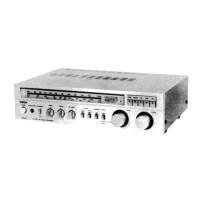

 To Next Page
 General