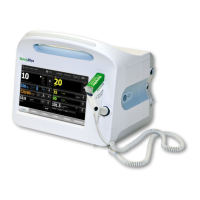
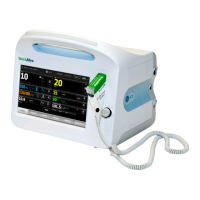
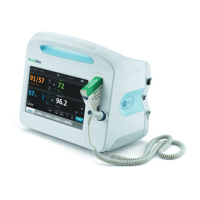
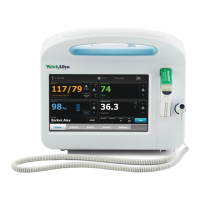
Continuous Monitoring profile
Pulse amplitude
The pulse amplitude bar indicates the pulse beat and shows the relative pulse strength.
More bars illuminate as the detected pulse gets stronger.
Response Mode Control
The Response Mode Control allows you to set the SpO2 measurement time to either
Normal or Fast.
Perfusion Index
Perfusion Index (PI) is an SpO2 feature available only with Masimo-equipped monitors.
PI is a relative reading of pulse strength at the monitoring site. PI display ranges from 0.1
percent (very weak pulse strength) to 20.0 percent (very strong pulse strength). PI is a
relative number and varies between monitoring sites and from patient to patient, as
physiological conditions vary.
During sensor placement, the PI can be used to evaluate the appropriateness of an
application site, looking for the site with the highest PI number. Placing the sensor at the
site with the strongest pulse amplitude (highest PI number) improves performance
during motion. Monitor the trend of the PI for changes in physiological conditions.
SatSeconds™ alarm management
The SatSeconds feature is an SpO2 alarm management system available only with
monitors that are equipped with Nellcor OxiMax Technology.
The SatSeconds feature is the product of the time and magnitude that a patient falls
outside of the SpO2 alarm limits. For example, three points below the alarm limit for 10
seconds equals 30 SatSeconds. An alarm is triggered only when a desaturation event
reaches the SatSeconds limit. The SatSeconds feature is clinician controlled and can be
164
Patient monitoring Welch Allyn Connex
®
Devices


 To Next Page
 Loading...