Spot
TM
Vision Screener–Quick Start Guide
2
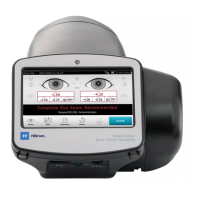
Viewing and understanding the results
All results viewing options are in the Tools menu under Results.
These options include:
• defaulting to a Summary screen
• defaulting to a Detailed Results screen
• hiding recommendations
• hiding screening results
• cylinder convention options
• raw or rounded data
Results that are out-of-range are indicated in red.
Note: Screening results provide an output that is either
in- or out-of-range, accompanied by the appropriate statement
in the device output display (“Screening Complete” or
“Complete Eye Exam Recommended”). The displayed message
is intended to prompt the caregiver to assess whether the
subject should be referred to an eye care specialist for further
evaluation or simply be monitored at future screenings.
1
2
3
4
5
67
8
9
How to screen a subject
Lighting prerequisites
1. Turn off lights, if possible.
2. Close blinds or curtains, if possible.
3. The patient’s back should be positioned to the interfering
light source.
4. Avoid direct light into the patient’s eyes from:
• Ambient light sources
• Exterior light
• Incandescent and halogen lights
Note: Florescent light is the best testing environment,
if options are limited.
Screening
1. Press and release the power button to turn the vision screener
on. Once powered on, the device Home Screen displayed.
2. Once the patient is seated, have the patient close his or her
eyes for 10 to 15 seconds to encourage dilation.
3. Stand approximately 3 feet from the subject with one foot
ahead of the other for stability.
4. Hold the vision screener on an even plane with the patient’s
eyes. Avoid pointing the vision screener too high, which
encourages the patient to look upward.
5. Touch the age range button on the Home screen that
corresponds to the patient you are screening.
6. Touch Go.
7. Keep the vision screener device steady until the screening
wheel appears, indicating the capture process is underway.
8. The Results screen appears at the end of the
screening process.
1 m
3 ft
1. Pupillary distance
2. Pupil size indicator
3. Right eye (OD), Left eye (OS)
4. Complete refraction
SE – Spherical equivalent
DS – Sphere
DC – Cylinder
Axis – Axis
5. Screening result
6. Home
7. Cylinder convention
8. Alignment indicator
9. Degree, horizontal, vertical


 To Next Page
 Loading...