
 Need help?
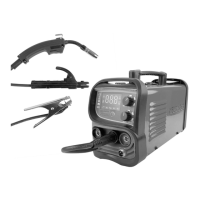
Do you have a question about the WELDINGER ME 130 mini FLUX and is the answer not in the manual?
Details on protecting skin and eyes from arc radiation and using appropriate protective clothing.
Guidelines for safe use regarding moisture, conductive parts, and proper grounding.
Safety measures for handling gas cylinders, preventing falls, and avoiding injury from torch movement.
Ensuring adequate ventilation and safe handling of gas cylinders to prevent health risks.
Measures to prevent fires due to high temperatures and molten metal spatter.
Adherence to trade association regulations and requirements for trained welders.
Explanation of duty cycle (ED) according to EN 60974-1 and factors affecting it.
Guidelines for installing the unit in a dry environment, considering dust and air temperature.
Consideration of electromagnetic interference sources in the surrounding environment.
Specifications for the primary-side mains fuse, recommending 16A or 20A for intensive use.
Recommendations for using proper condition extension cables with correct cross-sections.
Procedures for thorough cleaning and inspection, emphasizing safety and cooling downtime.
Instructions for cleaning internal components using compressed air and vacuum cleaners.
Checking for damaged wires and loose connections as part of regular maintenance.
Outlines the key areas of inspection: visual, electrical, functional, and documentation.
Covers protective conductor resistance, insulation resistance, and leakage current measurements.
Checking safety functions, switches, input devices, and overall unit operation.
Details on what must be included in the test report and labeling requirements.
Details the five-year durability guarantee, including scope, content, and exclusions.
The guarantee applies equally to entrepreneurs and consumers.
The guarantee applies worldwide.
Specifies which WELDINGER products are covered by the five-year warranty.
Defines which components are covered and which are excluded from the warranty.
Grants the right to free repair of damaged parts covered by the warranty.
HuW24 e.K. is entitled to deliver a new device instead of repair.
Details on replacement with equivalent or higher-quality devices if the original is unavailable.
Excludes further claims, especially for damages and consequential damages.
Specifies the five-year warranty period starting from the receipt of goods.
Warranty is in addition to statutory claims for defects and does not limit them.
Process for claiming warranty, assertion, and shipping cost responsibilities.
Details who bears the shipping costs for warranty claims and returns.
Circumstances under which the warranty is excluded, such as improper handling or unauthorized repairs.
Description of the unit's primary switched inverter and how it converts mains voltage.
Highlights benefits like high efficiency, low power consumption, and stable arc.
Identification and explanation of the device's front panel controls and connections.
Steps to connect the MAG torch, set the feed roller, and insert the wire.
Procedure for welding stainless steel, including polarity reversal and setting the correct wire.
How to properly end the MAG flux-cored wire welding process.
Connecting electrode holder and ground cables, and observing polarity for MMA welding.
Selecting MMA mode and setting welding current based on electrode diameter and material thickness.
Steps to end MMA welding, including arc breaking and cooling the unit.
Recommendations for TIG torches and connection to the device and gas supply.
Steps to fit the TIG hosepack, select tungsten, and connect to the device and gas.
Guidelines for setting welding current based on material thickness and position.
Instructions for initiating the TIG welding arc using lift arc ignition.
Steps to end TIG welding, including arc extinguishing and cooling the unit.
Overview of tungsten electrode types, their welding modes, and corresponding electrode colors.
Guidance on maintenance by qualified personnel, safety precautions, and checking power lines.
Identifies low current and high welding speed as common causes for low burn-in.
Lists causes like incorrect polarity, unsuitable gas, or contamination.
Common causes include high welding current, short arc, or incorrect speed.
Troubleshooting steps for issues with the main switch, fan, or mains voltage.
Indicates device overheating or duty cycle exceeded; requires cooling time.
Potential causes include poor earth contact, loose connections, or defective potentiometers.
Troubleshooting for wire feeder issues like incorrect roll insertion or pressure spring problems.
Instructions for proper disposal of electrical equipment and recycling information.
 General
| Brand | WELDINGER |
|---|---|
| Model | ME 130 mini FLUX |
| Category | Welding System |
| Language | English |

 To Next Page