EasyManua.ls Logo

West Marine Lifesling2 - User Manual

West Marine Lifesling2
8 pages
Print Icon
To Next Page IconTo Next Page
Loading...
The keys to effective rescues with
the Lifesling System are:
• Follow and PRACTICE the
recommended Lifesling rescue
techniques as written in this manual
• Before each trip, familiarize crew
on how to use the Lifesling2
• At least two crew persons
should be familiar with boat
handling, basic seamanship
and emergency procedures
• Stay close to the person in the water
• Do not lose sight of the person in
the water
Instruction Manual
Important! Read this manual before installing the Lifesling2;
practical knowledge of the system’s use is essential before
an emergency requires its use. Repack the Lifesling2 to be
assured of proper deployment.
Read This Manual Carefully!
Someone’s life may depend on it. Retrieval of
a person overboard (POB) can be very difficult
especially in rough or cold water.
357634-Lifesling2Manual_v2.qxd 2/21/03 11:10 AM Page 1
Question and Answer IconNeed help?

Do you have a question about the West Marine Lifesling2 and is the answer not in the manual?

Summary

Lifesling2 Overboard Rescue Instructions

Option 1: Circle POB and Deploy

Describes circling the POB while deploying the Lifesling2 astern, similar to picking up a water skier.

Option 2: Pre-planned Approach

Describes initiating a pre-planned maneuver to get back to the POB and throwing the Lifesling2 when close.

Additional Sailboat Lifesling2 Instructions

Additional Powerboat Lifesling2 Instructions

Setting Up The Lifesling2

Retrieval Line Storage

Details proper storage of the Lifesling2 retrieval line for correct deployment.

Hoisting Tackle Instructions

3:1 Block and Tackle Hoisting

Instructions for using a 3:1 block and tackle system for hoisting a person aboard.

5:1 Block and Tackle Hoisting

Instructions for using a 5:1 block and tackle system for hoisting a person aboard.

Overview

The Lifesling2 Overboard Rescue System is a patented device designed for retrieving a person overboard (POB) from the water. It emphasizes the importance of prior practice and familiarity with the system for effective rescues, noting that rescue methods may vary based on vessel size and handling characteristics. The manual stresses the critical need to keep the victim in sight, as a POB can be quickly lost from view in any sea condition. It recommends posting an available crew member to maintain visual contact and minimize distance between the vessel and the POB.

Function Description:

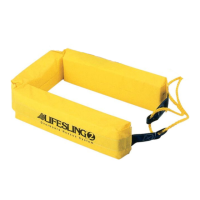
The Lifesling2 is a buoyant sling with built-in 20 lbs of flotation, designed to be placed under the arms of a POB. It is connected to a floating retrieval line, allowing the POB to be pulled alongside the boat. The system is intended to facilitate the retrieval of a POB, especially in challenging conditions like rough or cold water, where direct retrieval can be very difficult. Once the POB is secured in the Lifesling2, the strain on the retrieval line closes the bolsters around them, providing support. The system is not designed for towing a POB behind the boat, as this could pull them under the water.

Usage Features:

General Rescue Principles:

  • Practice is Key: The Lifesling2 procedure may not be effective without prior practice.
  • Crew Familiarity: Before each trip, all crew members should be familiar with how to use the Lifesling2.
  • Skilled Crew: At least two crew persons should be familiar with boat handling, basic seamanship, and emergency procedures.
  • Maintain Proximity and Sight: Stay close to and do not lose sight of the person in the water.

Deployment Options:

The manual outlines two primary options for deploying the Lifesling2:

  1. Option 1 (Circling Maneuver):

    • Action: Immediately circle the POB while deploying the Lifesling2 astern of the vessel, similar to picking up a water skier.
    • Outcome: The Lifesling2 or retrieval line should reach the POB within the first or second circle. Avoid running over the retrieval line or hitting the POB.
    • Recommendation: This method is preferred for single-handed rescues but is also reliable for fully crewed boats due to its simplicity and less precise maneuvering requirements.
  2. Option 2 (Pre-planned Maneuver):

    • Action: Immediately initiate a pre-planned maneuver to return to the POB. Carefully approach 6-10 feet from the POB, keeping the stern and propeller area away. Throw the Lifesling2 when the POB is close by (within 10 feet) to avoid tangles, misses, and delays. Do not throw into the wind.
    • Recommendation: This method may be faster but requires more skill in boat handling. It is not preferred over Option 1 for single-handed pickups or in rough seas.

Post-Deployment Actions:

  • Stop the Boat: Once the POB acquires the Lifesling2, immediately stop the boat (sailboats drop sails, powerboats stop engines).
  • Engine Shutdown: Turn off the engine(s) as soon as the POB has acquired the Lifesling2, as the propeller presents a constant danger while running.
  • Pull Alongside: Pull the POB alongside the boat. The POB may be more comfortable rotating the Lifesling2 180 degrees and floating on their back, but once alongside, ensure they are rotated back to face the retrieval line. Maintain tension on the retrieval line to prevent the POB from slipping out.
  • Assisted Retrieval: Guide the POB to a ladder or swimstep and assist them out of the water. Do not put yourself in dangerous positions or fall in the water; use a harness if necessary.
  • Securing the POB (if unable to board): If the POB cannot get out of the water, lift them as far as possible and tie the retrieval line to a cleat. This secures the POB from immediate drowning danger while preparations for hoisting are made.

Hoisting the POB:

  • Hoisting Tackle: The Lifesling2 is designed to lift the POB using various user-supplied lifting devices.
  • Rigging: Rig a hoisting tackle (optional) or other lifting device with a high enough lifting point above the deck to clear the rail. Attach one end of the tackle to either the retrieval line loop that runs through the two webbing loops of the Lifesling2 or the loop tied three feet from the webbing loops.
  • Practice Hoisting: Determine the proper lifting device for your boat and practice rigging it before an emergency.
  • Calling for Help: If unable to bring the POB aboard, radio or signal for help. Once the person is alongside, they are secured, allowing time to summon assistance.

Additional Sailboat Lifesling2 Instructions:

  • Maneuvers: Practice crew overboard maneuvers (downwind or upwind) to understand the boat's handling, speed, momentum, and windage.
  • Spinnaker/Whisker Pole: If flying a spinnaker, round up immediately, let the spinnaker halyard run free, gather the spinnaker, sheet in the mainsail, and beat back to the POB or use the auxiliary engine. If running with a whisker pole, let the genoa sheet run and beat back or use the auxiliary engine.
  • Auxiliary Power: Avoid using auxiliary power if possible, but it may be necessary in light air, if the boat has no headsail up, or has limited ability to go to weather.
  • Propeller Caution: Before turning on the engine, watch for trailing lines that could foul the propeller.
  • Engine Shutdown: Once the POB reaches the Lifesling2, the engine should be shut off.
  • Retrieval Methods: Ladders can be used if the POB is non-hypothermic and uninjured in calm seas. Be aware of violent stern motion. Block and tackle is slower but more certain, especially for hypothermic or fatigued individuals.
  • Hoisting Rig: A separate 3:1 block and tackle is highly recommended. Alternatively, if the boat has large 2-speed self-tailing winches and a long halyard tail, connect the halyard directly to the figure-eight loop of the Lifesling2 retrieval line, lead it through a lead block to the winch, and hoist. Practice lifting the heaviest person with the weakest person to understand the effort required.

Additional Powerboat Lifesling2 Instructions:

  • Propeller Danger: Always be aware of the propeller(s) when approaching the POB.
  • Engine Shutdown: Turn off the engine(s) before pulling the POB alongside.
  • Anchoring: If the boat is in danger of drifting into shore or other boats, drop anchor before pulling the POB to the boat.
  • Swim Platforms/Ladders: Some boats have swim platforms or ladders, which may work in moderate conditions if the POB is not hypothermic or fatigued. Crew assisting from the swim step should be connected to the boat with harnesses.
  • Swim Platform Motion: Be aware of violent motions of the swim platform in rough seas, as injuries can result from the up-and-down motion.
  • Lifting Devices: The Lifesling2 is designed for use with various user-supplied lifting devices in rough conditions.
  • Superstructure Hoisting: Boats with a superstructure (e.g., flybridge, strong tower) can use a lifting tackle to hoist the victim. A 5:1 block and tackle with large sheaves and 3/8" or thicker line is suggested for ease of handling. Practice and familiarize yourself with this equipment.
  • Commercial Vessels: Larger yachts and commercial vessels can use power-assisted hoists, cranes, or powerblocks.
  • Testing: Do not use methods other than those recommended without thorough testing with someone in open water. The skipper is responsible for determining and testing the appropriate lifting method for their boat.

Maintenance Features:

Setting Up The Lifesling2:

  • Mounting: Mount the Lifesling2 on a rail using the three velcro straps attached to the bag, ensuring the velcro completely overlaps for added strength.
  • Securing Retrieval Line: Tie and seize the nylon-covered end of the polypropylene retrieval line to a strong point on board. Seizing is necessary to prevent knots from coming undone. The retrieval line must be fastened to the boat to be useful.
  • Nylon Cover: Do not remove the nylon cover, as it protects the polypropylene line from sun degradation and weakening. Ensure no part of the retrieval line is exposed to the sun.

Retrieval Line Storage:

  • Correct Packing: The Lifesling2 is like a parachute; it only works when packed correctly.
  • Repacking: While the Lifesling2 comes pre-packed, it is strongly encouraged to remove and re-pack it to understand proper line storage and ensure proper deployment.
  • Repacking Procedure: The nylon-covered end of the line remains outside the case. Stuff the line into the pouch of the bag, starting with the portion nearest the nylon-covered end and finishing with the Lifesling2 end. Stuff (do not coil) the line twelve inches at a time until the Lifesling2 is reached. Place the Lifesling2 into the case with its front bolsters on either side of the stuffed line pouch. Avoid starting at the sling end when stuffing the line or coiling it before stowing, as this can cause jamming.
  • Secure Attachment: Ensure the nylon-covered end of the line is securely tied to a strong point on the boat.
  • Retrieval Line Loop: If the retrieval line loop through the webbing loops of the Lifesling2 needs to be undone (e.g., to adjust size or repair), permanently seize the bowline with stout thread as shown to prevent slipping when re-tied.

Hoisting Tackle Storage:

  • Block and Tackle: If using a block and tackle, "two-block" and fake the line bitter end first into a small storage bag to reduce fouling and ease line running through the blocks.

General Maintenance and Safety:

  • Hypothermia Awareness: Rapid cooling of a POB can lead to confusion, incoordination, weakness, hallucinations, and coma, complicating rescue efforts. Treatment involves drying the victim, passive heat transfer, blankets, immobility, and warming. Avoid liquids, stimulants, alcohol, or hot foods. Assess for injuries and inform emergency facilities.
  • Skipper's Responsibility: The skipper is legally responsible for the safety of people on board. The instructions are suggestions and may not cover every circumstance.
  • Warranty: WEST MARINE warrants the Lifesling2 to be free from defects in material and workmanship for twelve months from retail sale, provided it is used and stored according to directions. The warranty is limited to repair or replacement of parts.

West Marine Lifesling2 Specifications

General IconGeneral
ColorOrange
Line Length125 ft
Includesstorage bag
UsageMan overboard recovery device
TypeMan Overboard Rescue Device