p
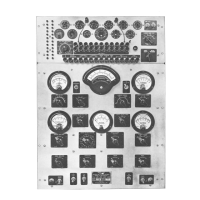
HEATERSUPPLYTOGGLESWITCH:Located at the bot-
tom left side of the panel with its associated green
jewel pilot lamp, this toggle switch disconnects the
device completely from the line supply when in-
dexed to the "Off" position. When in the "On" posi-
tion, the heater transformer is energized and the line
supply voltage is delivered to the Plate Supply
Toggle Switch. After making the heater connections,
the tube can be warming up while the operator is
completing the patching operation by indexing the
Heater Supply toggle switch to the "On" position.
The "Plate Supply" toggle is shorted out on 230 volt
service, therefore, use the "Line Switch" as the "On-
Off" switch for the entire device.
PLATESUPPLYTOGGLESWITCH:
This switch operates
all of the internal d-c power sources and is inopera-
tive if the Heater Supply toggle is in the "Off" posi-
tion. The Plate Supply toggle should always be in
the "Off" position when the operator is changing or
removing patch cords.
SIGNALCALIBRATETOGGLESWITCH:To the right of
the Heater Supply toggle is a momentary type Signal
CaI. toggle switch. A change in power line voltage,
of course, will affect the grid signal and hence it
becomes necessary to check this potential just before
taking Gmreadings. Indexing the Signal Cal. toggle
to the "CaI." position places the grid signal directly
across the Gill meter. Regardless of Gm range se-
lected, the Gmmeter must indicate top mark on this
test. If it does not, the Signal Amplitude Adjuster
should be rotated until top mark is obtained.
Gill READING TOGGLESWITCH: This switch is located
to the left of the Plate Supply switch and is of the
momentary type. It is used to apply the signal volt-
age when the operator is ready to take a Gm read-
ing.
SUPPRESSORPOSNEGTOGGLESWITCH:The
purpose
of this toggle is to allow the operator to select either
a negative potential for suppressor, or a positive
potential for tubes requiring a second anode voltage
such as the oscillator plate in a penta grid converter.
It must be kept in mind that while checking a given
tube only one or the other potential may be used.
No occasion will arise requiring both a negative
suppressor potential and a second anode positive
potential, because in such cases, the suppressor of
the tube is always connected directly to cathode.
To obtain negative suppressor volts index this
toggle, located just to the left of the name plate at
the bottom of the panel, to the NEG position. To
measure the negative potential rotate the Element
Volts switch to the "Neg Supp" position.
LAMPTESTTOGGLESWITCH:
Located to the left of the
rotary Plate I - Plate 2 switch, this toggle provides
a ready means for checking the neon lamp. If a
tube shows no short and there is some doubt as to
the condition of the neon lamp, lift the toggle to its
upper position and if it does not glow replace with
a new lamp.
OPERATION
STEP-BY-STEPTESTING PROCEDURE
GENERAL:Read the paper tag on the f!ont panel of
the instrument. Remove the back cover and insert
the 5U4-G rectifier in the octal socket. Ascertain
whether the 3A4 tube is in place by removing the
shield from the miniature socket. Check to see that
the proper miniature tubes are in their respective
shielded sockets. Screw the neon lamp in the socket
located above the Lamp Test toggle switch. The line
cord can then be brought to the outside of the case
and the back cover replaced.
A toggle switch has been incorporated to facilitate
change over from 115 volt to 230 volt a-c operation.
This switch is located on the shelf jnside the device
between the 8 mfd. condenser and the small signal-
short check transformer.
The toggle is normally set for 115 volt operation.
For 230 volt operation set the switch as indicated
by adjacent markings.
The Plate
Supply toggle is shorted out on 230volt
service, therefore, use the "Line Switch" as the "On-
Off" switch for the entire device.
The instrument is now ready for use and the
Step-by-Step Procedure outlined below should be
read carefully before attempting to check any tubes.
It is suggested that a type 6C4 or any indirectly
heated triode be used to acquaint the operator of
this device with the various controls and their
functions.
AMPLIFIERTUBES:
1. Plug the line cord into a power source having
a frequency of 50-60 cycles and voltage betwee.n
105-125.. Refer to preceding paragraph for 230 volt
lines.
2. Place Heater Supply and Plate Supply toggle
switches in "Off" position.
3. Patch the jumper leads in accordance with the
tube base diagram of the tube to be checked follow-
ing the specific procedures for Cathode, Heater and
Suppressor connections as follows:
A-CATHODE
I-Connect cathode of the tube to any of the
three Cathode jacks in the bottom row when
the Self Bias Resistance control is set to
"Fixed Bias."
II-Connect the tube cathode to the second or
third Cathode jack if Self Bias Resistance
control is set to any value above zero ohms.
-6-


 To Next Page
 Loading...