22.. EElleeccttrrooffoorrmmiinngg ccooppiinnggss ffoorr ccrroowwnnss,, iinnllaayyss aanndd oonnllaayyss
Attaching the AGC
®
shrink-fit tubing:
Push the shrink-fit plastic tubing onto the copper rod
as close to the plaster die as possible (max. 1 mm),
and shrink-fit onto the AGC
®
copper rod with the aid of
an air-blower (beginning at the plaster die!).
Do not hold the duplicate die coated with AGC
®
conductive silver varnish directly over the heat source.
Do not shrink-fit the tubing over an open flame of the
Bunsen burner.
Please note:
!
8
Prepare the parts according to the dental proce-
dures for the AGC
®
technique.
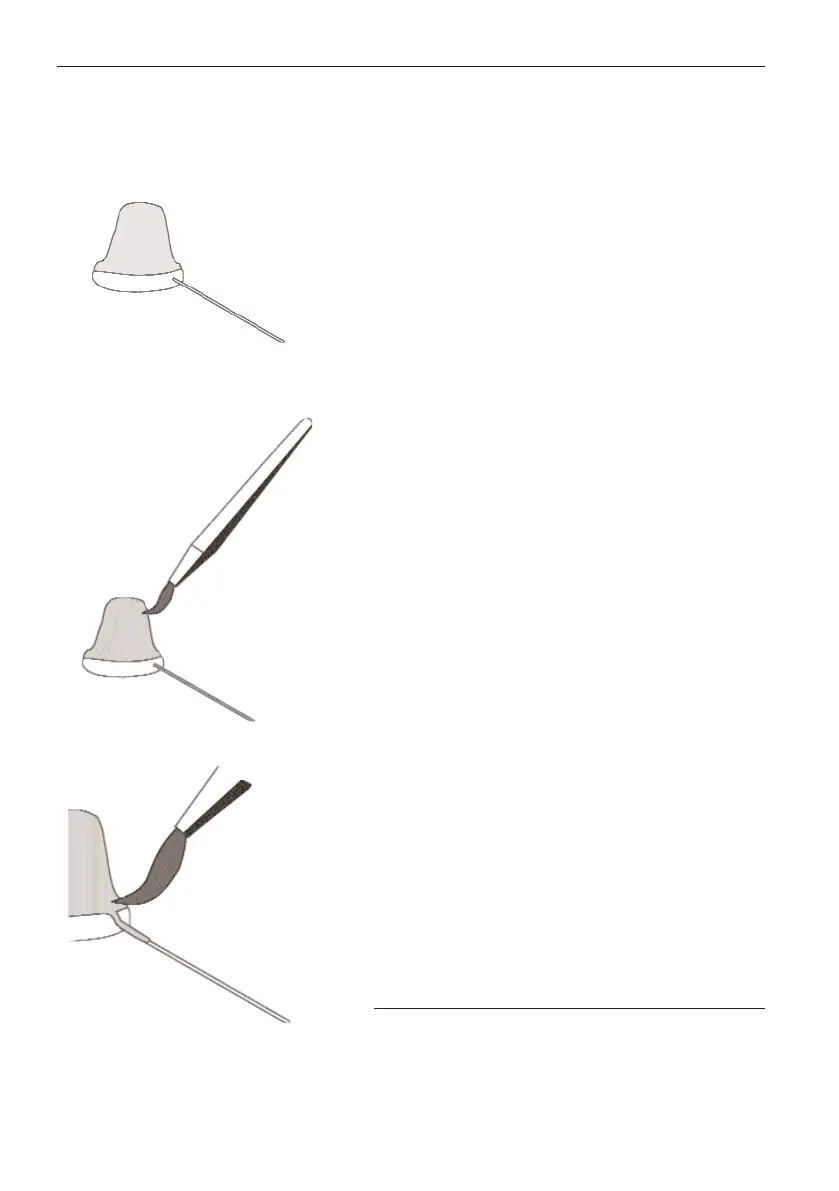
Attaching the AGC
®
copper rod:
Bore a canal of approx. 2 – 3 mm in length in the base
of the duplicate die using a 1.0 mm tungsten carbide
bur, keeping as close to the preparation margin as pos-
sible (approx. 1 mm).
Attach the AGC
®
copper rod with a small amount of
contact adhesive. Make sure that you remove any
excess glue (insulating layer). If any other contact
adhesive is used, make sure this is heat-resistant.
Applying the AGC
®
conductive silver varnish:
The plaster die must be dry and free from dust!
Shake the AGC
®
conductive silver varnish well before use!
Only dilute the AGC
®
conductive silver varnish as and
when necessary, and not too excessively.
Apply AGC
®
conductive silver varnish in a homoge-
neous layer up to the preparation margin.
Apply once only!
Corrections should be made only to very small areas.
Make a conductive silver varnish connection between the
surface to be electroformed and the AGC
®
copper rod, and
apply this approx. 1 cm all the way round. The AGC
®
con-
ductive silver varnish layer must be left to dry at room tem-
perature for 15 minutes, otherwise residue from the orga-
nic binding agent can react with the AGC
®
gold electrolyte.


 To Next Page
 Loading...