WiMo Antennen und Elektronik GmbH
Am Gäxwald 14, D-76863 Herxheim Tel. (07276) 96680 FAX 9668-11
http://www.wimo.com e-mail: info@wimo.com
Tuning
Your Kelemen-Antenna was factory-tuned to the low end of the specified band(s). As all antennas
are influenced by their environment you may have to fine tune your antenna accordingly.
The following steps are recommended:
- To shift the resonance to a higher frequency on all bands increase the size of the loops to the
strain relief on both sides. A few centimetres may well make some difference. Shortening the
leads will rarely be necessary. To lower the resonant frequency on all bands make these loops
smaller.
- To increase the resonant frequency on the lowest band fold back some wire at the egg insulator
and secure it with tie wraps. Shortening of the wire will rarely be required. To decrease the
resonant frequency do the opposite, there will be sufficient extra length of wire.
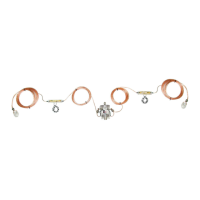
- By changing the shape of the traps you can adjust the resonance on single bands. This is
particularly interesting for multi-band antennas for 3 or more bands.
- Slight squeezing of the traps (slightly oval) will increase the resonant frequency on the
corresponding band and - to a decreasing degree - on the subsequent lower bands.
By careful combination of these three methods you can tune your antenna in its actual place to
your favourite frequencies on each band.
Please note that all wire antennas are influenced by the prevailing weather conditions. In winter
antennas tend to resonate somewhat lower than in summer. Similarly the antenna will be resonant
a few khz lower during rain. Ice loading on cable and traps may also cause deviations.
1. Operation
As already pointed out, the traps of Kelemen-antennas have a high Q with very low loss. This
advantage is partly compensated by a slightly smaller bandwidth in comparison with conventional
traps. Therefore an antenna tuner may be required for operation far off the resonant frequencies.
This may result in very high voltages in the traps and - in extreme cases - even arcing in the
sealing compounds.
For this reason you should not apply the maximal specified power especially when feeding the
2 kw-antenna through a tuner.
There will be no problem running the usual 100 Watt transceivers into a 400 Watt antenna, even if
using a tuner.


 To Next Page
 Loading...