18
Please reference Chamber Plans for more
information on installation.
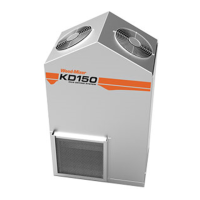
Step 1: Place the dehumidifier at the center of the
long wall with the inlet filter facing the board pile.
Step 2: Connect an appropriate length drain hose.
The drain must have a trap.
Note: The dehumidifier can be elevated to any
reasonable amount to help the drain gravity feed.
The wall opening should be sealed around where
the drain hose extends outside of the chamber.
Never have a oor drain.
Step 3: Place the controller at a convenient point
outside the chamber near the dehumidifier.
Note: Be sure controller is in a space that will not
reach temperatures below freezing.
Step 4: Remove the cover
Step 5: Drill 2 holes in the kiln wall to allow control
cables and separately the sensor wires (inside the
controller) to be carefully routed into the chamber.
Do not route control and sensor wires through the
same hole.
Step 6: Mount the Dry Bulb Temperature Sensor
6 to 12 inches from the wall 4 feet off the floor, at
least 3 ft from kiln unit, away from the blower outlet,
for an accurate reading. See “Wet Bulb & Dry Bulb
Installation” on the next page
Step 7: Remove the right side panel of the
dehumidifier gaining access to the compressor
and terminal strip.
Step 8: Securely connect the control cable to the
dehumidifier.
Step 9: Carefully connect each wire to their
corresponding terminal. Do not stretch or over
stress the cable.
Note: Wire insulation is marked with the corresponding
terminal number.
Step 10: Seal the holes in the kiln wall after wires
are installed to keep moisture from the control box.
Step 11: Install the fans over the lumber see Chamber
Plans as a reference.
Step 12: Install and caulk the vents so that they are
on opposite sides of the fans and at opposite ends
of the kiln.
Note: The vents should be located as shown on the
chamber drawings.
Step 13: With the system switch in OFF position,
plug in the power cable (the special receptacle
for the L53 is supplied by Wood-Mizer).
The unit is now ready for the check out procedure.
Equipment Installation
Wet and Dry Bulb Sensors
Sensor Technology
Every Dehumidification Dry Kiln System
measures and regulates internal kiln
conditions through the use of Dry Bulb and Wet
Bulb Sensor Technology. Each of these sensors
measure different temperatures inside the kiln
chamber and regulate various system functions.
They provide information about the kilns internal
conditions used to determine relative humidity (RH)
and estimated moisture content (EMC). The two
sensors are installed within the kiln chamber and
are connected to the kilns controller. The
information can be managed and utilized by the kiln
operator, and stored for later reference.
Dry Bulb Sensor
This sensor measures the dry bulb
temperature (DBT). The DBT measurement given
by the sensor is the true thermodynamic
temperature inside the kiln. You can set the
desired DBT from the kiln controller. This
setting will control the kilns exhaust vents and
heat, which will be automatically adjusted to
accommodate the desired DBT.
Example: If the DBT falls below the set
parameter the system will turn on the heat. Or if
the DBT rises above the set parameter then the
system will open the vents.
If your DBT is rapidly fluctuating a thermal lag
may be added to the sensor to help stabilize
readings, contact Wood-Mizer for information.


 To Next Page
 Loading...