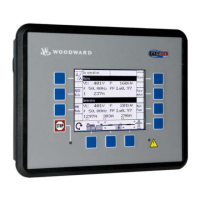
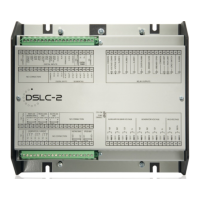
Manual 37443A DSLC-2 - Digital Synchronizer and Load Control
© Woodward Page 131/226
4. Start the generator. Should be operating at rated speed and voltage.
a. Adjust the voltage control intial state from 50 % to 60 %. The generator voltage should in-
crease. If the generator voltage decreases, the voltage bias output connections are reversed.
Please correct and repeat test.
b. Adjust the voltage control initial state from 50 % to 40 %. The generator voltage should de-
crease.
c. This verifies the “Voltage bias” output is connected correctly.
5. Enable Voltage matching (parameter 7513) and set the Voltage window (parameter 4541) for 0.5 %.
a. Synchronizer mode can be phase matching or slip frequency.
6. To test the voltage matching another source must be available for the busbar voltage.
7. With the generator at rated speed and voltage and the busbar energized. Verify the electrical parameters
readings in Menu 7. If the generator or busbar is reading incorrectly, verify wiring and configuration to
correct the problem.
8. Observing the Homepage
a. Generator OK led is “On”
b. Busbar OK led is “On”
c. The generator should be “Red” in color, indicating it is operating
d. The busbar should be “Red” in color indicating it has voltage
e. Synchronizer mode (parameter 4602) should indicate “Off”
9. Place the DSLC-2 into the check mode
a. Synchronizer mode should indicate “Check”
b. DSLC-2 will be driving the speed bias for phase matching or slip
i. Observe “Speed bias” gage
c. DSLC-2 will be driving the voltage bias to get the generator voltage to match the busbar vol-
tage
i. Observe “Voltage bias” gage
d. No breaker closure command will be received
10. Remove the check mode input, synchronizer will go to “Off” mode
11. Use the voltage raise input to increase generator voltage to 3 or 4 % above busbar voltage. This can be
observed on the Homepage meters.
12. Place the DSLC-2 in the check mode and observe how the generator voltage is driven into the voltage
matching window. To adjust the synchronizer soltage control use Menu 1.
a. Voltage synchronizer proportional gain (parameter 4700)
i. Increase the proportional gain to bring the voltage into the matching window faster
b. Voltage synchronizer integral gain (parameter 4701)
i. Decreasing the integral gain will slow down the response and bring the voltage into
the matching window smoother, but will take longer
13. Repeat test until desired results are achieved.
14. Use the voltage lower input to decrease generator voltage to 3 or 4 % below busbar voltage. This can be
observed on the Homepage meters.
a. Verify settings for voltage matching from the high side also work for matching from a lower
voltage
b. If not, use adjustments to get desired results
c. Repeat the high voltage test if adjustments were made
15. Verify that the phasing for L1, L2 and L3 is correct across the generator breaker before placing the
DSLC-2 into the run mode.
Continue with final voltage matching setup.
Final Voltage Matching Setup
1. Set the Voltage low limit (parameter 4536) and Voltage high limit (parameter 4537) setpoints on Menu 4
to the desired values. Voltage adjustments by the synchronizer and var/PF control will not adjust voltage
beyond these limits.
2. If the Voltage high alarm (parameter 7510) or the Voltage low alarm (parameter 7509) is desired when
generator voltage exceeds the above specified limit values, set the alarm setpoints to “Enabled”.
3. If generator voltage exceeds the Voltage high limit and Voltage low limit range and it is desired to oper-
ate the “High Limit” and “Low Limit” relay driver outputs, set the Voltage switch (parameter 7511) set-
point to “Enabled”.
4. If the voltage bias output reaches either end of its operating range, indicating its range of control has


 To Next Page
 Loading...