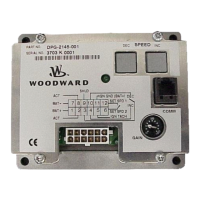
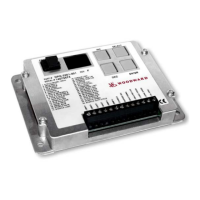
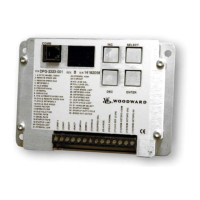
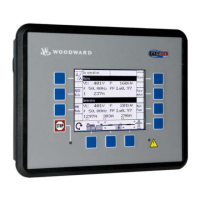
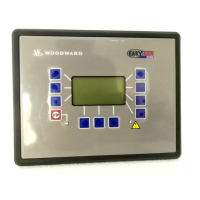
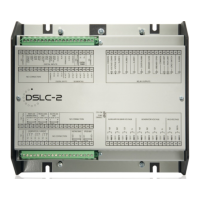
Manual 37443A DSLC-2 - Digital Synchronizer and Load Control
Page 134/226 © Woodward
8. Close the “Load/Unload” input. The generator will ramp the kW using the Unload ramp rate (parameter
4524) until the unit load percentage equals the system load percentage and then enter the isochronous
load sharing mode of operation.
a. Homepage
i. Load control mode (parameter 4603)
1. Loadshare unload
2. Loadshare ramp
3. Loadshare
9. The controlling PID loops are
a. PID frequency trimmer
b. Load share gain (parameter 4522)
c. Load share factor (parameter 4546)
10. If the load sharing is unstable
a. Lower the load share gain
b. If still unstable lower the Frequency trim proportional gain (parameter 5510)
c. When stable verify that the kW is proportional equal on each generator
11. Var sharing
a. If vars are unstable, use Menu 4 and adjust
i. Lower VAR load share gain (parameter 4543)
ii. Lower Voltage trim proportional gain (parameter 5610)
iii. If still unstable see the var/PF control Menu 4
12. If sufficient system load is available, close the “Base Load” input. Follow the integrating base load con-
trol setup in the following section for PID information.The unit should ramp until unit load matches the
Base load reference (parameter 5520) level. The DSLC-2 will also be in var control and will ramp reac-
tive power on to control at the KVAR reference setting (parameter 7723). If the system load is resistive
only, set the kvar reference to 0.0.
13. Open the “Base Load” contact. The unit will ramp back into load sharing and var sharing.
14. Open the “Load/Unload” input. The DSLC-2 control will ramp kW and kvar load to the Unload trip lev-
el (parameter 3125), provide a breaker open command and disconnect the unit from the system.
15. If system transient testing may be done, with load banks or large loads switching on and off, the Load
share gain (parameter 4522) and frequency trim settings may be adjusted, if necessary. If the generator
picks up load too quickly compared to the system, as may occur on a small, fast generators, operating
with large and slower ones, reduce the gain setting. Conversely, if the unit is slow, increase the gain set-
ting.
16. With the unit operating in isochronous parallel, adjust the engine speed setting slightly to cause an error
in load sharing percentage. The load will return to the correct sharing percentage.
This completes the isochronous load sharing adjustments.
Integrating Base Load Control Setup
The DSLC-2 is an integrating base load control. A utility bus or an isolated bus with sufficient capacity is re-
quired to do this setup.
1. When in base load mode, the PID power control will be active.
2. The VAR PF control mode (parameter 7558) should be in the “Disabled” mode.
a. This allows voltage matching but will not be in an active var or power factor mode. The voltage
bias will stay at the value it is at when breaker closure occurs.
b. If tested in the load sharing section, the VAR PF control mode (parameter 7558) can stay in var
control mode.
3. PID power control settings
a. Base load proportional gain (parameter 5513) – Set at 1.00 (default value)
b. Base load integral gain (parameter 5514) – Set at 0.50 (default value)
c. Base load derivative ratio (parameter 5515) – Set at 0.01 (default value)
d. After verification that the speed and voltage bias outputs are operational and the synchronizer
has been tested, we will proceed to close the generator breaker and load the generator in a base
load control mode. This test is common to perform against the utility.


 To Next Page
 Loading...