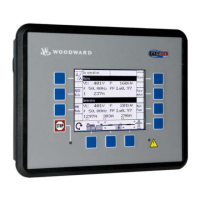
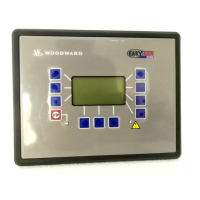
Manual 37443A DSLC-2 - Digital Synchronizer and Load Control
© Woodward Page 135/226
4. Discrete inputs
a. Load / Unload input – Closed
b. Base load input – Closed
c. Run input – Closed
i. This will activate the synchronizer and provide a breaker closure command
5. DSLC-2 Homepage
a. Load control mode – Baseload ramp then just baseload
b. Reactive load mode – Var control
If load instability is observed, it will be necessary to adjust dynamic settings of the load control. Be-
cause the integrating load control operates in cascade with the engine speed control, it may also be
necessary to adjust the dynamics of the speed control to get the desired performance. The first attempt
to get stability will be to reduce the Base load proportional gain (parameter 5513) setpoint. If stability
decreases when proportional gain is decreased, increase Base load integral gain (parameter 5514). If
stability cannot be achieved with DSLC-2 control dynamic adjustments, it will be necessary to adjust
the engine speed control dynamics. Stable engine control is required to proceed.
6. Load will normally lag slightly behind the reference during ramping. If the lag is excessive, increase the
Base load proportional gain (parameter 5513) by increments of 0.5.
7. If a slow hunt is observed during the ramp or if overshoot of the base load setting occurs, decrease the
Base load integral gain (parameter 5514) by a factor of two.
8. Ramp the load up and down by alternately opening and closing the “Load/Unload” input. Be sure to rec-
lose the switch before load drops to the unload trip level or the DSLC-2 control will issue a command to
open the circuit breaker. Adjust base load proportional gain and base load integral gain to get the desired
performance.
9. The Load ramp rate (parameter 4549) and Unload ramp rate (parameter 4524) can be changed to assist
with the stable loading of the generator.
Correct dynamic adjustment may be more easily observed if the Load ramp rate (parameter 4549) set-
point is set somewhat faster than what the final setting will be.
10. In most systems it will not be necessary to change the base load derivative ratio from the default value
of 0.01 seconds. In higher performance systems the load derivative may be increased to increase the rate
of change in speed bias output during a transient.
11. The power control PID is also active when the system has an active MSLC-2.
12. The DSLC-2 will only listen to an MSLC-2 when in isochronous load share mode, the “Base Load” in-
put is closed, the DSLC-2 will control at it’s internal base load and var values.
Remote Load Reference Signal Setup
The analog remote load reference is activated by closing both the “Load Raise” and “Load Lower” inputs. This
will ramp the base load reference from the internal setting in Menu 2 to the remote setting on terminals 83, 84
and 85. This can be used to provide dual base load reference settings. The analog remote load reference input is
configured in Menu 6.1. The value of the remote input is also displayed in Menu 6.1 and on the Homepage. The
analog remote reference can also be configured for a process reference signal.
1. Set in Menu 6.1 the scaling for the analog input remote load reference and configure the related kW val-
ues to the analog input. The current or voltage input can be configured to show the kW value.
a. HW signal (parameter 7711)
i. 0 to5 V
ii. 1 to 5 V
iii. 0 to 10 V
iv. 0 to 20 mA
v. 4 to 20 mA
b. Remote load reference minimum value (parameter 7735)
c. Remote load reference maximum value (parameter 7736)
2. You can monitor the reference value in % and clear defined kW in Menu 6.1 or the Homepage.


 To Next Page
 Loading...