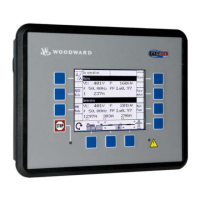
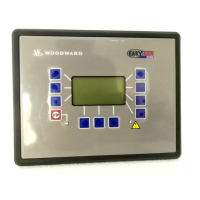
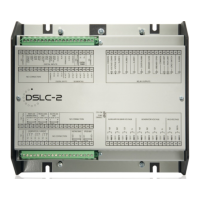
Manual 37443A DSLC-2 - Digital Synchronizer and Load Control
Page 136/226 © Woodward
3. Synchronize, parallel and load the generator to the internal base load reference. Apply the analog signal
to the remote load reference input of the DSLC-2 control. Adjust the remote reference to some level dif-
ferent than base load or use the raise load or lower load contacts to shift the unit load to a different level.
4. Close both the raise load and lower load contacts to select the analog remote load reference input. The
load should ramp to the level specified by the analog input.
5. Raise and lower the analog signal. Load will ramp at the rate of change in reference specified by the
Menu 2 raise rate and lower rate setpoints. Raise rate and lower rate setpoints may be adjusted to
achieve satisfactory performance.
6. Open the raise load and lower load contacts. The load control mode should indicate base load. The load
reference will ramp to the internal base load reference. The raise and lower inputs will now raise and
lower the base load reference.
7. Momentarily open and close the “Load/Unload” switch contacts. The load should ramp to the Base load
reference (parameter 5520) setting.
a. Unload – ramp toward the unload trip level
i. Uses unload ramp rate
b. Load – ramp to the base load refence
i. Uses load ramp rate
This completes the remote load reference setup procedure. Proceed with final load control setup.
Final Load Control Setup
1. Set Menu 2 Load ramp rate (parameter 4549) and Unload ramp rate (parameter 4524)to desired values.
2. Set Raise load rate (parameter 4515) and Lower load rate (parameter 4516) to desired values.
3. Set unload trip and base load setpoints to desired values.
4. Set the high limit PU (pick up) and DO (drop out) setpoints to desired values. The high limit PU setpoint
should be set to limit the load reference even if the alarm and high limit switch are “Disabled”.
5. Set the low load limit and DO setpoints to desired values. The low load limit PU setpoint should be set
to limit the load reference even if the alarm and low limit switch are “Disabled”.
6. If it is desired that the alarm output High load limit alarm is activated (parameter 4608) when load
reaches the high limit PU, set the high load limit alarm setpoint to “Enabled”. The alarm will be auto-
matically cleared when load drops below the high load limit DO switch point.
7. If it is desired that the alarm output Low load limit alarm is activated (parameter 4609) when load reach-
es the low limit PU, set the low load limit alarm setpoint to “Enabled”. The alarm will be automatically
cleared when load increases to above the low load limit DO switch point.
8. If it is desired that the high and low limit switches are active, this controls the “High Limit” and “Low
Limit” relay outputs, set the load limit switches setpoint to “Enabled”.
9. Set the load switch PU and load switch DO setpoints to their desired operating levels or set the Reverse
power trip (parameter 7507), Instant reverse power (parameter 4531), Rev pwr time delay (parameter
4532) and Reverse power level (parameter 4533) to use the load switch output for a reverse power relay.


 To Next Page
 Loading...