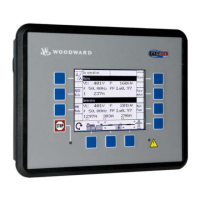
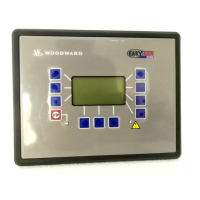
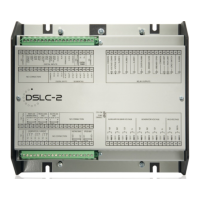
Manual 37443A DSLC-2 - Digital Synchronizer and Load Control
© Woodward Page 157/226
Phase Matching Synchronizing
The phase matching synchronizing mode corrects the frequency and phase of the generator to lock it to the bus
frequency and phase. Phase matching synchronizing can be configured (parameter 5729) in the unit. With activa-
tion of the synchronizer, the DSLC-2 will control the frequency to minimize the frequency difference between
generator and busbar. When the frequency is within the Phase matching df-start (parameter 5506) setting, the
phase relationship is controlled. The speed bias output increases or decreases engine speed while controlling the
slip frequency and phase relationship between the generator and the bus. Proportional and integral gain adjust-
ments are provided to allow stable operation of the automatic synchronizer over a wide range of system dynam-
ics.
Slip Frequency Synchronizing
It is often desirable for the oncoming generator speed to be slightly higher than the bus when the generator break-
er is closed. This assures that power immediately flows out of the generator and into the system. Slip frequency
can be selected using parameter 5729 in Menu 1. The synchronizer automatically controls the generator at the
specified slip frequency (parameter 5502). The speed bias output increases or decreases engine speed while con-
trolling the slip frequency and phase relationship between the generator and the bus. Proportional and integral
gain adjustments are provided to allow stable operation of the automatic synchronizer over a wide range of sys-
tem dynamics.
Permissive Mode / Synch-Check Function
The synch-check function determines when frequency, phase and voltage are within the configured settings for
proper synchronization before issuing a breaker closure command. The speed and voltage bias outputs are not
used to drive the generator into synchronization. The generator can be manually controlled using the load raise /
lower and voltage raise / lower discrete inputs. The generator and bus voltage comparison is made independent of
the voltage matching function being enabled. When all conditions of voltage and phase are met, then the breaker
closure command is given for the GCB close hold time (parameter 3416), then will wait the Reclose delay (para-
meter 4534) time and if the proper synchronization settings are still met, will issue another breaker closure com-
mand.
GCB Maximun Closing Attempts
The synchronizer allows multiple breaker closure attempts to an active or dead bus. The control provides set-
points for the number of close attempts (parameter 3418) and the reclosure delay timing (parameter 4534). The
synchronizer feature has 2 alarms, Reclose limit alarm (parameter 7556) and the Synchronizer timeout alarm (pa-
rameter 7557). These alarms will effect the synchronizer differently between an active or dead bus.
Dead bus closing
If both alarms are disabled, you will receive infinite breaker closure attempts. If one or both alarms are enabled,
when that alarm setting is reached, an alarm is received and no more breaker close attempts will be given. This is
important when you have multiple generator sets attempting to close to a dead bus. The DSLC-2 that receives the
dead bus token, will not pass the dead bus token until it receives an alarm. So having 1 or 2 close attempts is pre-
ferred in a multiple generator set application.
Active bus closing
If both alarms are disabled, you will receive infinite breaker closure attempts. If one or both alarms are enabled,
when that alarm setting is reached, an alarm is received but the synchronizer will keep providing breaker closure
commands until a “CB Aux” feedback is received or the “Run” or “Permissive” input is removed.
Auto Re-Synchronization
The Auto re-synchronization feature (parameter 7514), when enabled, allows the DSLC-2 to attempt to reclose
the breaker if the “CB Aux” feedback is opened and the DSLC-2 still has a “Run” or “Permissive” input closed.
The auto re-synchronizer feature becomes active after a successful breaker closure is received. Then if the break-
er feedback (CB Aux) is opened and the “Run” or “Permissive” input is still closed, the DSLC-2 will attempt to
close the breaker when in the synchronizer specifications. If configured for “Disabled”, no attempt at synchroni-
zation will be made until the “Run” or “Permissive” input is then opened and reclosed. This is active even when a
utility unload command is given and the DSLC-2 opens the breaker. With auto re-synchronization “Enabled”, the
synchronizer will become active.


 To Next Page
 Loading...