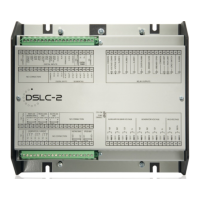
Manual 37443A DSLC-2 - Digital Synchronizer and Load Control
© Woodward Page 163/226
Isochronous Load Sharing On An Isolated Bus
Isochronous load sharing operates all generator sets in a system in the isochronous mode. Load sharing is accom-
plished by software. All DSLC-2 units are connected via Ethernet channel Network A. Load share is possible for
all DSLC-2 units that are in the same segment. Any imbalance in load between units will cause a change to the
regulating software in each unit. While each unit continues to run at isochronous speed, these changes force each
machine to supply a proportional share of power to meet the total load demand on the system.
Base Load On An Isolated Bus
Base load is a method of setting a base or fixed load on a machine operating in parallel with an isolated bus. This
is accomplished by using an isochronous load control and providing a reference at which to control the load. The
governor will force the generator output to increase or decrease until the output of the load sensor is equal to the
reference setting. At this point, the system is in balance. This method can be used only where other generator sets
are producing enough power to meet the change in load demand. This operating mode is ideal for either soft load-
ing additional units into an isochronous system or for unloading a machine.
Base Load
Base load for a system paralleled to an infinite bus or utility is the same as base load in an isolated system. The
advantage of base loading over droop is that when separating from a utility, there is no frequency change. Simply
remove the bias signal on breaking from the utility returns the system to isochronous.
Figure 5-3: Isochronous load sharing


 To Next Page
 Loading...