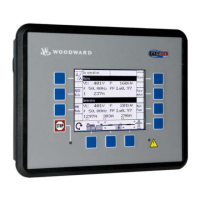
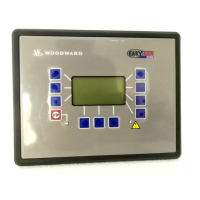
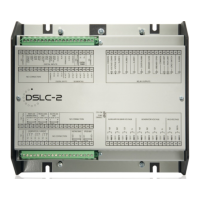
Manual 37443A DSLC-2 - Digital Synchronizer and Load Control
Page 70/226 © Woodward
Process Control
2 0.0 to 100.0 % 0.0 % The Process droop is the load droop desired based on process
The Process filter adjusts the bandwidth of the filter on the
process input. Higher frequency settings result in faster control re-
sponse, but also more response to process noise.
The Process reference is the internal reference for the process
control. The process engineering units are determined by the se-
lection and settings in Menu 6.1.
The Raise reference rate is the rate at which the process refer-
ence is increased when the DI “Load Raise” command is acti-
2 0.01 to 20.00
%/s
0.10 %/s The Lower reference rate is the rate at which the process refer-
ence is decreased when the DI “Load Lower” command is acti-
specifies if the process variable is di-
rect or indirect acting.
Direct: If the process variable increases when generator load in-
creases.
Indirect: If the process variable decreases when generator load
Process Control Monitoring
The Process high limit alarm specifies if the high process limit
alarm is activated.
limit PU
2 0.0 to 150.0 % 75.0 % The Process high limit PU is the process input level where (if
enabled) the “High Limit” relay output is energized and the high
limit alarm is activated.
The Process high limit DO is the process input level where (if
enabled) the “High Limit” relay output is de-energized and the high
limit alarm is deactivated.
The Process low limit alarm specifies if the low process limit alarm
is activated.
The Process low limit PU is the process input level where (if
enabled) the “Low Limit” relay output is energized and the low limit
limit DO
2 0.0 to 150.0 % 50.0 % The Process low limit DO is the process input level where (if
enabled) the “Low Limit” relay output is de-energized and the low
limit alarm is deactivated.
The Process switch specifies if the process high and low limits will
activate the “High Limit” and “Low Limit” relay outputs.
Table 3-14: Parameter – process control


 To Next Page
 Loading...