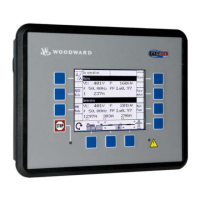
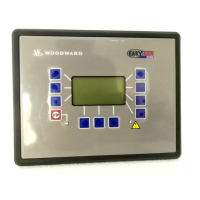
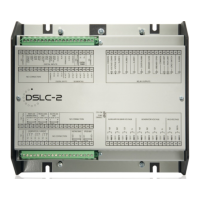
Manual 37443A DSLC-2 - Digital Synchronizer and Load Control
Page 72/226 © Woodward
The derivative ratio identifies the “D” part of the PID controller. By
decreasing this parameter, the stability of the system is increased.
The controller will attempt to slow down the error correction in an
attempt to prevent excessive overshoot or undershoot. Essentially
this is the brake for the process. This portion of the PID loop op-
erates anywhere within the range of the process unlike reset. The
derivative ratio constant must be smaller than the integral
gain constant. Remember the voltage trim PID is active during
var sharing. Setting the derivative ratio to high may cause insta-
bility with the var sharing function.
Not active during synchronization.
PID Var Control
Var/PF proportional gain determines how fast the var/PF control
responds to an error signal between kvar/PF reference and
kvar/PF actual measurement. The gain is set to provide stable
control of kvars or power factor. Lower value to slow response.
PID var control loop is active:
VAR PF control mode (parameter 7558)
• Var control
• PF control
DSLC-2 is operating in
• Base load mode
• Process control mode
•
Var/PF integral gain compensates for delay in the reactive power
control loop. This prevents low frequency overshoot or undershoot
when a change in reactive power occurs. Lower value to slow re-
sponse.
PID var control loop is active:
VAR PF control mode (parameter 7558)
• Var control
• PF control
DSLC-2 is operating in
• Base load mode
• Process control mode
•
Var/PF derivative ratio adjusts the rate of change of the voltage
bias output during a load transient. Lower value to slow response.
PID var control loop is active:
VAR PF control mode (parameter 7558)
• Var control
• PF control
DSLC-2 is operating in
• Base load mode
• Process control mode
•


 To Next Page
 Loading...