4.4.2.5 Synchronization Conguration
For synchronization with two systems please see additionally ╚═▷ “9.5.1 Synchronization
Of System A and System B”.
Phase angle compensation
To determine the phase angle deviation (to be congured with the parameters listed
below) do either of the following:
• When mains voltage can be connected follow the steps in Procedure.
•
When mains voltage cannot be connected but the vector group of the transformer is
known, follow the steps in Procedure
⚙
Determining the phase angle deviation (connected mains voltage)
ᐳ
The mains voltage is connected:
1. ▷
With a phase angle deviation of 0 ° and system B not energized and system A
energized, close the CBA.
▶
This will result in system A and system B being at the same voltage potential.
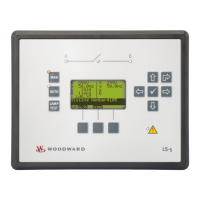
The phase angle deviation will now be displayed on the LS-5 screen (synchronization
angle phi).
2. ▷
Enter the displayed value into parameter 8824.
NOTICE!
Damaged components due to incorrect settings
• Validate the setting in every control unit with a dierential voltage
measurement.
⚙
Calculating the phase angle deviation (known transformer vector group)
ᐳ
The vector group states the phase angle deviation in multiples of 30°. From the vector
group the phase angle deviation can be calculated as an angle between 0° and 360°:
1. ▷
To calculate the resulting value, assume the low voltage side of the
transformer always lags behind the high voltage side (phase angle deviation
α).
Calculate the phase angle deviation as follows:
High voltage side = System
[A]
High voltage side = System
[B]
α < 180° α -α
α > 180° -360° + α 360° -α
Tab. 17: Calculation of the phase angle deviation
167LS-5 v2 Series37650
4 Conguration
4.4 Congure Application


 To Next Page
 Loading...