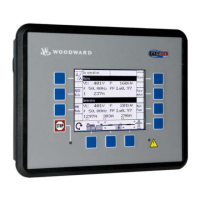
• 5301: Basic Visualization
• 5302: Basic Visualization
• 6003: LS-5 Communication
7.2.2
CANopen Protocol
CANopen is a communication protocol and device prole specication for embedded
systems used in automation. The CANopen standard consists of an addressing scheme,
several small communication protocols and an application layer dened by a device
prole. The communication protocols have support for network management, device
monitoring and communication between nodes, including a simple transport layer for
message segmentation/desegmentation.
Protocol description
If a data protocol is used, a CAN message looks like this:
Byte 1 Byte 2 Byte 3 Byte 4 Byte 5 Byte 6 Byte 7 Byte 8
MUX Data byte Data byte Data byte Data byte Data byte Data byte Internal
The MUX byte is counted up, the meaning of the data byte changes according to the
value of the MUX byte.
In the protocol tables is listed which parameter at which MUX on which position is
transmitted. The meaning of the parameter can be taken by means of the number of the
parameter description ("CANopen Mapping parameter").
Example
Example
MUX Byte 2 Byte 3 Byte 4 Byte 5 Byte 6 Byte 7 Byte 8
1 118 147 Internal
In MUX 1 (byte 1 has got value 1) the value of parameter 118 is included in the byte 2
up to byte 5 (mains voltage 1-2). In byte 6 up to byte 7 the value of parameter 147 is
included (mains frequency). Byte 8 includes internal denitions and shall be ignored.
Data format
The data format of "Signed integer" and "Unsigned integer" is "Little Endian".
UNSIGNED type data has positive integers as values. The range is between 0 and 2
n
-1.
The data is shown by the bit sequence of length n.
Please note that the bit sequence starts on the left with the least
signicant byte.
Example: Value 266 = 10A hex of type UNSIGNED16 is transmitted on the bus in two
octets, rst 0A hex and then 01 hex.
SIGNED type data has integers as values. The range is between -2
n-1
and 2
n-1
-1. The data
is shown by the bit sequence of length n.
299LS-5 v2 Series37650
7 Interfaces And Protocols
7.2 Protocols


 To Next Page
 Loading...