8 | SHARPENING BASICS
SHARPENING BASICS
WHAT EDGE ANGLE AND WHY?
Our recommendations (found in the Sharpening Reference Chart, pg 15)
are based on our extensive testing and driven by three primary factors: 1)
Optimizing the edge angle for the intended purpose of the knife. 2) Optimizing
edge retention for the knife’s purpose. 3) Speed of sharpening process.
WHY IS A CONVEX EDGE SUPERIOR?
Our blade use and sharpness testing have taught us that a convex edge is a
superior edge. The smooth radius edge type does not have “shoulders” like a
flat grind and creates less friction or resistance when cutting. A convex edge
provides more steel behind the edge to support it, so the edge stays sharper
longer. Lastly, our convex method thins the bevel when you sharpen the blade,
while flat ground blades become thicker and thicker as you re-sharpen.
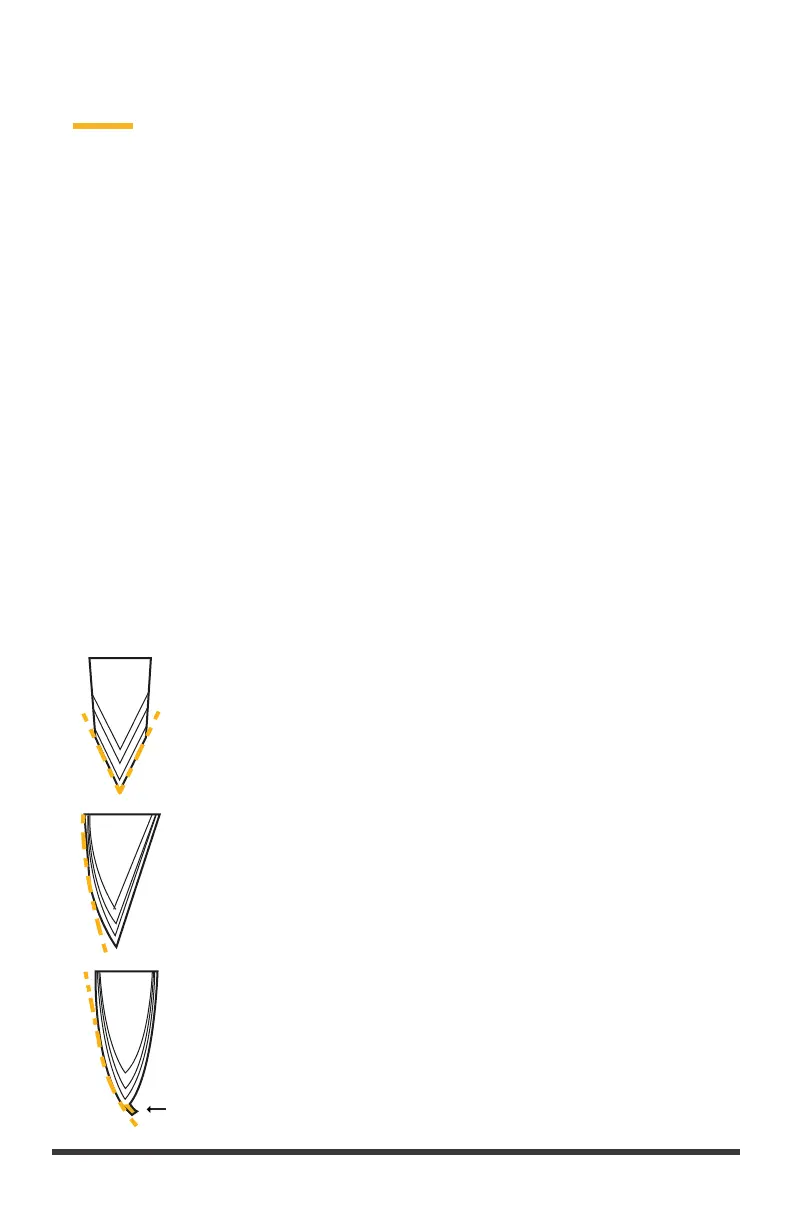
THE SHARPENING PROCESS
Most knives are flat ground from the factory and have a smaller
bevel height or surface area.
FACTORY EDGE
Re-sharpening to a lower angle and a convex grind takes time.
Be patient and ensure you create a burr.
CONVEX GRIND IN PROCESS
Sharpen one side of the knife until a burr is created. Switch to the
other side and create a burr before switching to a finer grit belt.
CONTINUE TO NEXT GRIT
BURR



 To Next Page
 Loading...