Need help?
Do you have a question about the Wrebbit GOLDEN HALL and is the answer not in the manual?
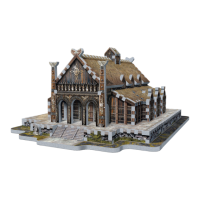
The provided document is an assembly manual for a 3D puzzle, specifically the "GOLDEN HALL" model by Wrebbit3D, consisting of 445 pieces. This manual serves as a comprehensive guide for constructing the puzzle, detailing the step-by-step process through a series of visual aids and piece identification.
The primary function of this product is to provide an engaging and challenging puzzle-building experience, culminating in a three-dimensional model of the "Golden Hall." As a 3D puzzle, it offers a more complex and immersive construction process compared to traditional flat puzzles. The finished model serves as a decorative item or a collectible, showcasing the intricate design and the builder's skill. The puzzle pieces are designed to interlock securely, creating a stable and robust structure without the need for glue. This interlocking mechanism is a key feature, allowing for a satisfying assembly process and a durable final product. The manual itself functions as an instructional tool, breaking down the complex build into manageable stages, ensuring that even intricate sections can be assembled with clarity.
The manual is structured to facilitate a user-friendly assembly experience. Each page corresponds to a specific stage of the build, clearly labeled with "Page X" at the top left. The top right of each page consistently displays "GOLDEN HALL" and "445 pieces," reinforcing the product identity and piece count.
The assembly process begins with foundational elements, as seen on Page 3, which illustrates the initial base structure. Subsequent pages progressively add layers and details to the model. For instance, Page 4 continues to build upon the base, while Page 5 shows further development of the structure. Pages 6, 7, and 8 introduce more complex sections, including walls and architectural features, with Page 6 notably featuring a star icon, possibly indicating a critical or distinctive assembly point.
A crucial usage feature is the detailed identification of individual puzzle pieces. Each piece is assigned a unique alphanumeric code (e.g., A1, B2, K54, J76, S15, R47). This systematic labeling is vital for accurate assembly, allowing users to quickly locate and identify the correct pieces required for each step. The pieces are often grouped together on the pages, indicating that they are used in a particular section or stage of the build. For example, on Page 3, a large collection of 'A' pieces (A1-A11, A21-A81) and 'J' pieces (J1, J11, J21-J30) are shown, along with 'B' pieces (B1-B3, B13, B23, B25-B95) and 'K' pieces (K4, K5, K14, K21, K22, K28, K38, K54-K94). This grouping helps users organize their pieces and understand which sets are relevant for the current page's instructions.
Visual guidance is paramount in this manual. Each page includes a small, shaded image of the model at the top left, depicting the state of the puzzle at the end of that particular assembly stage. This visual reference allows users to compare their progress with the intended outcome, ensuring they are on the right track. For example, on Page 6, the image shows a more developed base with some initial wall structures, while Page 7 shows further additions, including trees and more defined building sections. Page 9 introduces specific labeled sections (A, B, C) within the model's visual, indicating distinct sub-assemblies or areas of focus for that page. This feature is particularly helpful for understanding how smaller sections contribute to the overall structure.
The manual also employs visual cues to highlight specific connections or orientations. On Page 9, for instance, a horizontal line with "A" in the middle and two dots at the ends suggests a connection point or a linear assembly of pieces. Similarly, "B" and "C" are enclosed in circles, likely indicating separate sub-assemblies or sections that need to be completed. Pages 10, 11, and 12 continue this pattern, showing various vertical piece groupings (e.g., A99, A100, B91 on Page 10) and horizontal connection indicators (D and E on Page 11), guiding the user through the construction of walls and roof elements. The small black dots on Page 10, below the piece groupings, might indicate the base or attachment points for these vertical sections.
The progression of the build is clearly demonstrated through the increasing complexity of the model images. Page 13 shows the addition of roof sections and more intricate wall details, while Page 14 focuses on the upper parts of the structure, including gables and decorative elements. Page 15 and Page 16 further refine the roof and upper sections, with Page 15 showing a more complete roof and Page 16 adding final details. The final page, Page 18, presents the completed Golden Hall model from different angles, showcasing the intricate details of the roof and the overall structure, including a small flag or finial on the peak.
The manual's design ensures that users can work through the puzzle at their own pace, with clear visual and textual cues to prevent confusion. The absence of complex written instructions, relying instead on visual diagrams and piece codes, makes the manual accessible to a wide range of users, regardless of language proficiency.
As a 3D puzzle made of foam-backed pieces, the "Golden Hall" model requires minimal maintenance. The primary "maintenance" aspect is during the assembly process itself, ensuring that pieces are handled carefully to prevent damage. The interlocking mechanism, while robust, can be compromised if pieces are bent or forced incorrectly.
Once assembled, the finished model is designed to be self-supporting and durable. To maintain its appearance and structural integrity, it is advisable to:
The Wrebbit3D logo and copyright information ("© 2022 Wrebbit Puzzles Inc.") at the bottom of each page indicate the manufacturer and intellectual property rights, suggesting that replacement parts might be available through the company if any pieces are lost or damaged during assembly. However, the manual itself does not explicitly detail a maintenance schedule or specific repair instructions, as the product is generally considered a one-time assembly item. The robust interlocking design inherently contributes to its low-maintenance nature once built.
 General
| Product Name | Wrebbit GOLDEN HALL |
|---|---|
| Category | Toy |
| Type | 3D Puzzle |
| Difficulty Level | Advanced |
| Recommended Age | 14+ |
| Material | Foam |
| Weight | 2.2 lbs |
| Theme | The Lord of the Rings |
| Model | Golden Hall of Meduseld |

 To Next Page