EasyManua.ls Logo

Yamaha D-85 - Troubleshooting Common Issues; Electrical Troubleshooting; Operational Troubleshooting

Yamaha D-85
36 pages
Print Icon
To Next Page IconTo Next Page
To Previous Page IconTo Previous Page
Loading...
MONAURAL
©
LINE
IN:
L
S
1
'
:
1
;
'
LINE
IN
R
ee
DL
TAPE
RECORDER
©
oo0
HEAD
PHONE
a
oon
1
TO
!
UNF
OUT
L
O
3
P
p
sce
HOODOO
*--------(».9
L
LINE
QUT
R
TAPE
RECORDER
To
dJstie
To
13
Pin
\
YAMAHA
To
11
Pin
^
TONE
CABINET
To
Obtain
Maximum
Enjoyment
from
Your
D-85
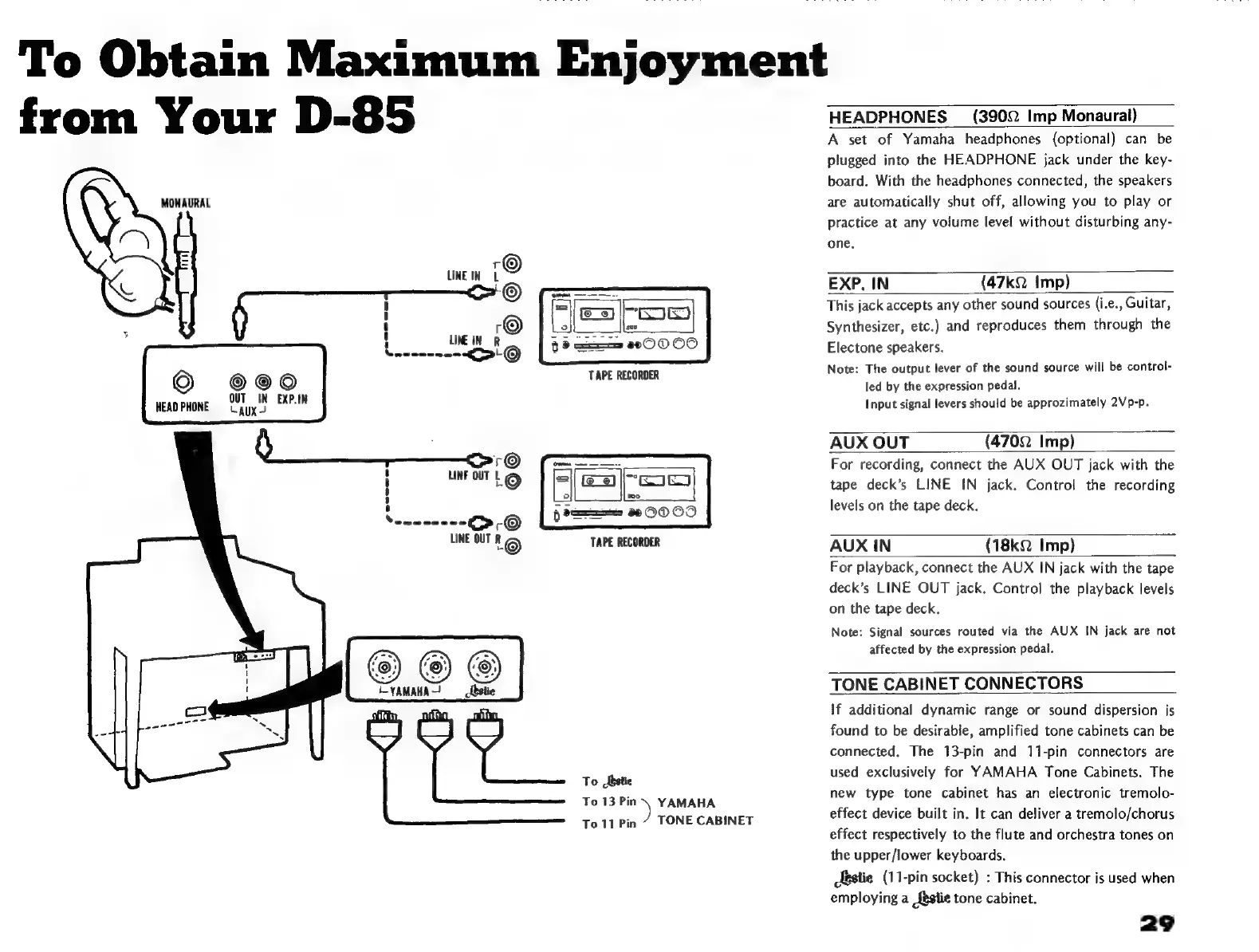
HEADPHONES
(3909
Imp
Monaural)
A
set
of
Yamaha
headphones
(optional)
can
be
plugged
into
the
HEADPHONE
jack
under
the
key-
board.
With
the
headphones
connected,
the
speakers
are
automatically
shut
off,
allowing
you
to
play
or
practice
at
any
volume
level
without
disturbing
any-
one.
EXP.
IN
(47kQ
Imp)
This
jack
accepts
any
other
sound
sources
(i.e.,
Guitar,
Synthesizer,
etc.)
and
reproduces
them
through
the
Electone
speakers.
Note:
The
output
lever
of
the
sound
source
will
be
control-
led
by
the
expression
pedal.
Input
signal
levers
should
be
approzimately
2Vp-p.
AUX
OUT
(4702
Imp)
For
recording,
connect
the
AUX
OUT
jack
with
the
tape
deck’s
LINE
IN
jack.
Control
the
recording
levels
on
the
tape
deck.
AUX
IN
(18kQ
Imp)
For
playback,
connect
the
AUX
IN
jack
with
the
tape
deck’s
LINE
OUT
jack.
Control
the
playback
levels
on
the
tape
deck.
Note:
Signal
sources
routed
via
the
AUX
IN
jack
are
not
affected
by
the
expression
pedal.
TONE
CABINET
CONNECTORS
If
additional
dynamic
range
or
sound
dispersion
is
found
to
be
desirable,
amplified
tone
cabinets
can
be
connected.
The
13-pin
and
11-pin
connectors
are
used
exclusively
for
YAMAHA
Tone
Cabinets.
The
new
type
tone
cabinet
has
an
electronic
tremolo-
effect
device
built
in.
It
can
deliver
a
tremolo/chorus
effect
respectively
to
the
flute
and
orchestra
tones
on
the
upper/lower
keyboards.
estie
(11-pin
socket)
:
This
connector
is
used
when
employing
a
fgslie
tone
cabinet.
29

Related product manuals