Depth-of-field
One property of lenses is that when they are focused, on a certain
subject, not only the subject itself, but all objects in a certain range
in front and in back of the subject will be nearly enough in focus to
appear sharp to the unaided eye. This range is called the depth-of-
field. The depth-of-field of a given lens varies, as follows:
(1) If the aperture is stopped down the depth-of-fled increases; if the
aperture is opened up the depth-of-field decreases.
(2) As distance to the subject increases, depth-of-field increases as
distance to the subject decreases, depth-of-field decreases.
(3) The depth-of-field is greater behind the subject on which the lens is
focused than in front of it; Different lenses have different depth-of-
field limits. A lens of short focal length has greater depth-of-field at
any set distance than a lens of long focal length.
<Depth-of Field Scale> The actual range of depth-of-field can be
checked using the depth of field scale on each lens. For example, when
the 50 mm lenses are focused at a distance of 5 meters and aperture is
set at F16, the depth of field will be the range of distances opposite the
two 16s on the depth of field scale; in this case, objects between about
2.7 meters and infinity will appear in focus.
Specifications
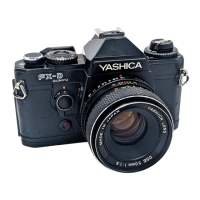
Type: 35 mm focal-plane type AE single-lens reflex camera.
Image size: 24 x 36 mm,
Lens mount: Contax/Yashica mount.4www.butkus.org



 To Next Page
 Loading...