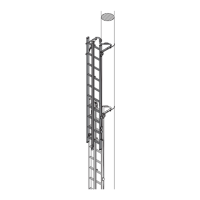
Zarges Skymaster ladder
Skymaster Instructions Created on 12 January 2012 Page 2 of 5
A ladder used for access shall be long enough to protrude sufficiently above the place of landing (at least 1m)
to which it provides access, unless other measures have been taken to ensure a firm handhold.
Every ladder shall be used in such a way that -
(a) a secure handhold and secure support are always available to the user; and
(b) the user can maintain a safe handhold when carrying a load unless, in the case of a step ladder, the
maintenance of a handhold is not practicable when a load is carried, and a risk assessment under regulation 3
of the Management Regulations has demonstrated that the use of a stepladder is justified because of -
(i) the low risk; and
(ii) the short duration of use.
Take special care when working in the vicinity of power cables, hanging lights and similar hazards –
particularly when extending top section.
Never use chairs, boxes, tables and so on to gain extra height.
Never use the ladder in very windy or blustery weather conditions.
Note that the combination ladder is designed to provide access for light maintenance work. Never use it as a
work platform.
Check the ladder’s condition before use. If it shows signs of damage or excessive wear, do not use until
repaired.
Never climb higher than the fifth rung from the top – particularly when the ladder is set up as a free-standing
two-part ladder
Always check the condition of the ladder prior to use.
Perform regular documented inspections.
Angle Safety
To ensure the ladder is at a safe angle, before use check that the white ball
is visible in the window of the ‘inclometer’ on the side of the base section,
75, one metre out for every four metres up. When configured as steps
make sure, too, that the metal locking bars are engaged and horizontal.
Getting Started
Always set up the ladder on a firm, level, and non-slip surface. On soft
ground, stand it on boards to stop its feet sinking in. We recommend the
use of ladder stability devices.
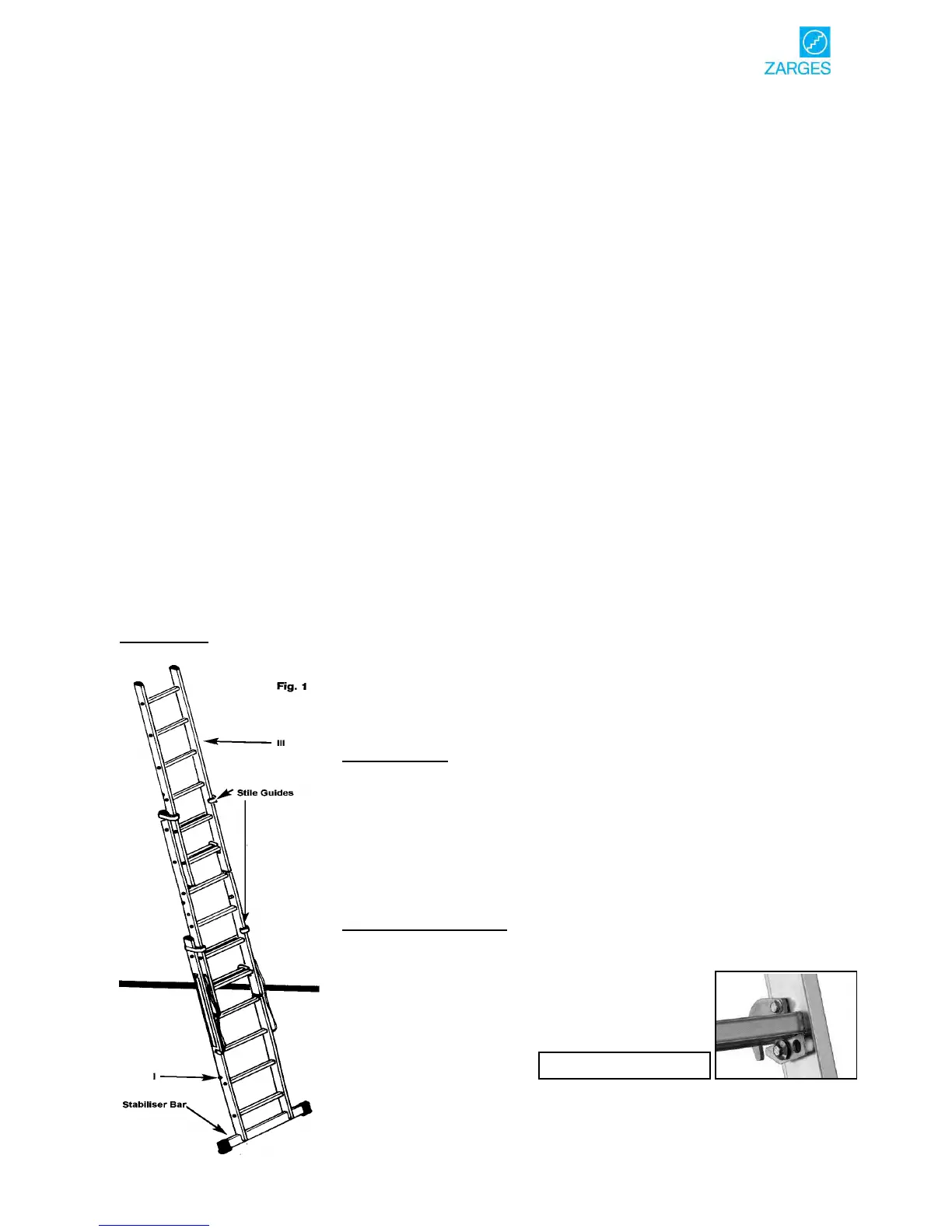
The ladder is made up of three sections – a base section with a stabiliser
bar, a hinged middle section and a top extension piece. These can be set
up in any one of three configurations.
As an extension ladder:
As supplied, the ladder forms a conventional three-part extension ladder.
Lay the ladder flat on the ground and extend it to the
required length, ensuring each section overlaps the
one below by at least two rungs before engaging its
safety catch.
If desired, the extension piece (III) can be completely removed to leave a
two section extension ladder.



 To Next Page
 Loading...