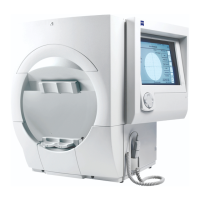
Humphrey Field Analyzer II-
i
series User Manual 2660021145640 A
Testing
5-5
Downward markings indicate that the gaze system could not locate the patient’s gaze: small
downward markings indicate that the system was unable to detect gaze direction; large markings
indicate that the patient blinked while the stimulus was being presented. Minimal deviation of the
markings (depicted as a horizontal line) indicates excellent fixation. Refer to Figure 5.3 for a gaze
graph that displays an example of good fixation. An example of poor fix
ation appears in Figure 5.4.
Large eye deviation
Good, steady fixation
blinks
0
+10
Figure 5.3 Gaze Graph Example: Good Fixation with a Large Number of Blinks
Figure 5.4 Gaze Graph Example: Poor Fixation
Head Tracking (Model 750
i
)
The Head Tracking feature helps maintain proper alignment
of the head and eye relative to the trial
lens holder. As part of the gaze initialization process, the HFA II-
i
analyzes and records the patient’s
eye position. When you activate Head Tracking (turn it ON), the instrument will move the chin rest in
increments of 0.3 mm, readjusting the patient to the original Gaze Track initialization position.
Maintaining proper alignment during testing reduces trial lens scotoma and increases the reliability
and accuracy of test results.
Note: Head Tracking only works when the trial lens holder is in use and Gaze Tracking has been
initialized successfully. Head Tracking is necessary only when a trial lens is used. To turn Head
Tracking off during a test, press FIXATION to access the Change Fixation Monitoring screen. Head
tracking is turned off only for the length of the current test.
It is possible in certain situations for the Head T
r
acking feature to “lose
its place”. The most common reason for this is a sudden shift of the
eye or re
positioning of the head. A patient whose head does not move
with the chin rest will cause the Head Tracking alert to beep. A pop-up
window will appear giving you the opportunity to continue or
discontinue using Head Tracking. The HFA II-
i
continues testing while
the message is on the screen. You should re-instruct your patient at
this point. Make sure that the chin rest supports the patient’s head.
This will ensure that the patient’s head moves with the chin rest.


 To Next Page
 Loading...