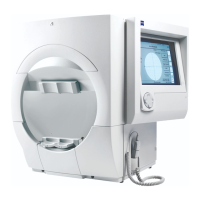
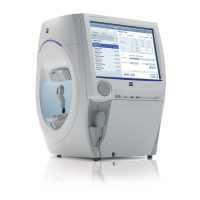
Humphrey Field Analyzer II-
i
series User Manual 2660021145640 A
Short-Wavelength Automated Perimetry (SWAP)
9-1
(9) Short-Wavelength Automated
Perimetry (SWAP)
Introduction to Short-Wavelength Automated Perimetry 9-1
SITA-SWAP Testing 9-3
Printing Out SITA-SWAP Results 9-8
SITA-SWAP Case Studies 9-10
Licensing SITA-SWAP on Your HFA 9-14
SWAP References 9-15
Introduction to Short-Wavelength Automated Perimetry
Short-Wavelength Automated Perimetry, or SWAP, is also known as Blue-Yellow perimetry. SWAP
differs from standard automated static perimetry in that blue light is used as the stimulus, and
yellow light is used for the background illumination. SWAP is still a static threshold perimetry test in
which standard Goldmann stimuli are presented in the standard way.
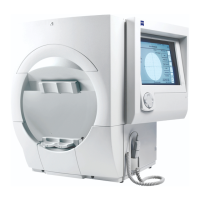
SITA-SWAP is a unique threshold testing strategy specifically designed to incorporate the efficiency
of
SITA testing into SWAP. This strategy is available as a licensed option on the HFA II-
i
(Models 745
i
and 750
i
) and HFA II (Models 745 and 750). SITA-SWAP is available only for use with the 24-2
Threshold test pattern. SITA-SWAP testing usually takes between three and six minutes to complete.
SITA-SWAP has its own normative database and the STATPAC analyses for SITA-SWAP are presented
in the traditional Single Field Analysis style, providing all the advantages of the STATPAC statistical
analysis.
After reading this chapter, you will be able to answer the following questions:
• Which patients should be tested using SWAP?
• What test pattern can be run with SITA-SWAP?
• What additional steps are required to set up a SITA-SWAP test?
• Why is the Size V stimulus used for SITA-SWAP testing?
• How long does the patient need to adapt to the yellow
background illumination before performing a SWAP test?
• What printouts are available for SWAP results?
• How do I license SITA-SWAP testing on my HFA?
Advantages of Testing with SWAP
In several published longitudinal studies, SWAP
has performed much better than
standard computerized perimetry in the early detection of glaucomatous change.
Working independently, researchers from University of California Davis, and
University of California San Diego found that SWAP identified early glaucomatous visual
field defects years before they could be detected using standard white-on-white perimetry. In
separate work, the Davis and San Diego teams also found that SWAP detected progression in
glaucomatous field loss significantly earlier than did white-on-white perimetry. Other papers have
found SWAP to be superior in managing ocular hypertensives and in detecting neurological disease.
References to these publications are provided at the end of this chapter.


 To Next Page
 Loading...