EasyManua.ls Logo

Zenith D952X - Page 14

Zenith D952X
56 pages
Print Icon
To Next Page IconTo Next Page
To Previous Page IconTo Previous Page
Loading...
Chassis
4WDR50X,
(X1),
Chassis
5WDR50X,
(XI
)
Model
D583
Micro
Reverse
Micro
Reverse
Volts
AGC
Voltage
Volts
AGC
Voltage
Input
at
Test
Point
"C"
Input
at
Test
Point
"C'
0
1.50
0
.016
25
1.48
25
.012
100
1.36
100
-.037
200
1.20
200
-.124
500
1.04
500
-.312
1K
*0.96
1K
*-.470
5K
0.92
5K
-.710
50
K
0.60
50K
-3.49
100K
0.49
100K
-4.55
Chassis
15WDR50Z1
Chassis
15WDR51
Micro
Reverse
Micro
Reverse
Volts
AGC
Voltage
Volts
AGC
Voltage
Input
at
Test
Point
"C"
Input
at
Test
Point
"C'
0
1.34
0
5.00
25
1.23
25
4.20
100
0.91
100
2.80
200
0.82
200
2.40
500
0.73
500
1.70
1K
*0.70
1K
*1.10
5K
0.58
5K
0.05
50
K
0.10
50K
-2.40
100K
0.06
100K
-3.20
12
SECTION
TWO
FM/MX/AM
ALIGNMENT
AND
GENERAL
INFORMATION
THEORY
From
time
to
time
Zenith
includes
the
use
of
new
components
and
circuit
applications
in
product
design.
Theory
and
explanation
of
such
components
and
circuits
is
included
in
various
manuals.
Refer
to
the
index
for
further
information.
MULTIPLEX
ALIGNMENT
These
receivers
have
been
properly
aligned
at
the
factory
and
will
not
require
further
adjustment.
As
a
result,
it
is
not
recommended
that
any
attempt
be
made
to
alter
the
multiplex
stages.
However,
should
any
major
components
in
these
circuits
require
replacement
or
should
anyone
tamper
with
the
multiplex
adjustments
then,
of
course,
realignment
will
be
necessary.
MUTING
CONTROL
A
muting
control
(some
models),
which
supplies
a
reverse
bias
voltage
to
the
base
of
the
19KHz
amplifier,
is
factory
adjusted,
and
should
not
require
readjustment.
However,
if
the
receiver
is
operated
in
an
extremely
noisy
area,
there
is
a
possibility
that
there
may
be
noise
bursts
of
sufficient
magnitude
to
overcome
this
mute
voltage
...
when
this
occurs,
the
Stereo
phonic
FM
Indicator
will
light
up.
To
further
cut
off
the
19KHz
amplifier,
carefully
rotate
the
muting
control
in
a
clockwise
direction.
This
should
only
be
done
when
a
stereo
signal
is
on
the
air
since
the
mute
control
must
only
be
advanced
to
a
point
where
the
Stereo
Indicator
does
not
light
up
on
noise,
but
is
should
not
be
advanced
to
a
point
where
the
desired
stereo
signal
is
cut
off.
ANTENNAS
FOR
STEREO
FM
Due
to
the
characteristics
of
the
stereo
FM
system,
it
will
require
more
signal
for
proper
performance
than
does
monau
ral
FM.
As
a
result,
it
may
be
necessary
to
operate
the
stereo
FM
receiver
with
an
external
antenna.
The
necessity
for
an
external
antenna
will
be
determined
by
the
signal
conditions
at
each
individual
installation.
EXTERNAL
FM
ANTENNA
If
the
receiver
is
operated
in
an
area
of
either
low
signal
strength,
high
noise,
or
where
multipath
(FM
ghosts)
signals
are
present,
a
good
external
FM
antenna
will
be
required.
The
necessity
of
an
external
antenna
as
a
result
of
weak
signal
or
noise,
will
be
quite
evident
since
the
set
will
not
limit,
and/or
noise
will
be
quite
evident.
It
is
extremely
difficult
to
determine
if
multipath
(FM
ghosts)
signals
are
present,
however,
should
the
program
material
be
distorted,
the
best
manner
to
decide
if
multipath
signals
are
the
cause
of
the
problem,
is
to
connect
an
external
FM
antenna
to
the
receiver.
Usually
a
TV
antenna
may
be
available
for
trial,
but
even
then
the
results
can
be
misleading,
since
many
TV
antennas
are
of
low
gain
on
FM
frequencies.
Reduction
of
multipath
distor
tion
under
high
signal
conditions
may
be
accomplished
by
relocation
of
the
receivers
antenna
system.
FM
CABINET
ANTENNA
Certain
models
contain
an
FM
antenna
built
into
the
cabinet.
This
antenna
is
a
folded
dipole
cut
to
the
desired
frequency,
and
is
attached
to
the
internal
periphery
of
the
cabinet.
The
following
models
use
line
cord
antennas:
D583,
D587,
C590
D593,
D715,
D901,
D902,
D903,
and
D904.
SIGNAL
STRENGTH
CHART
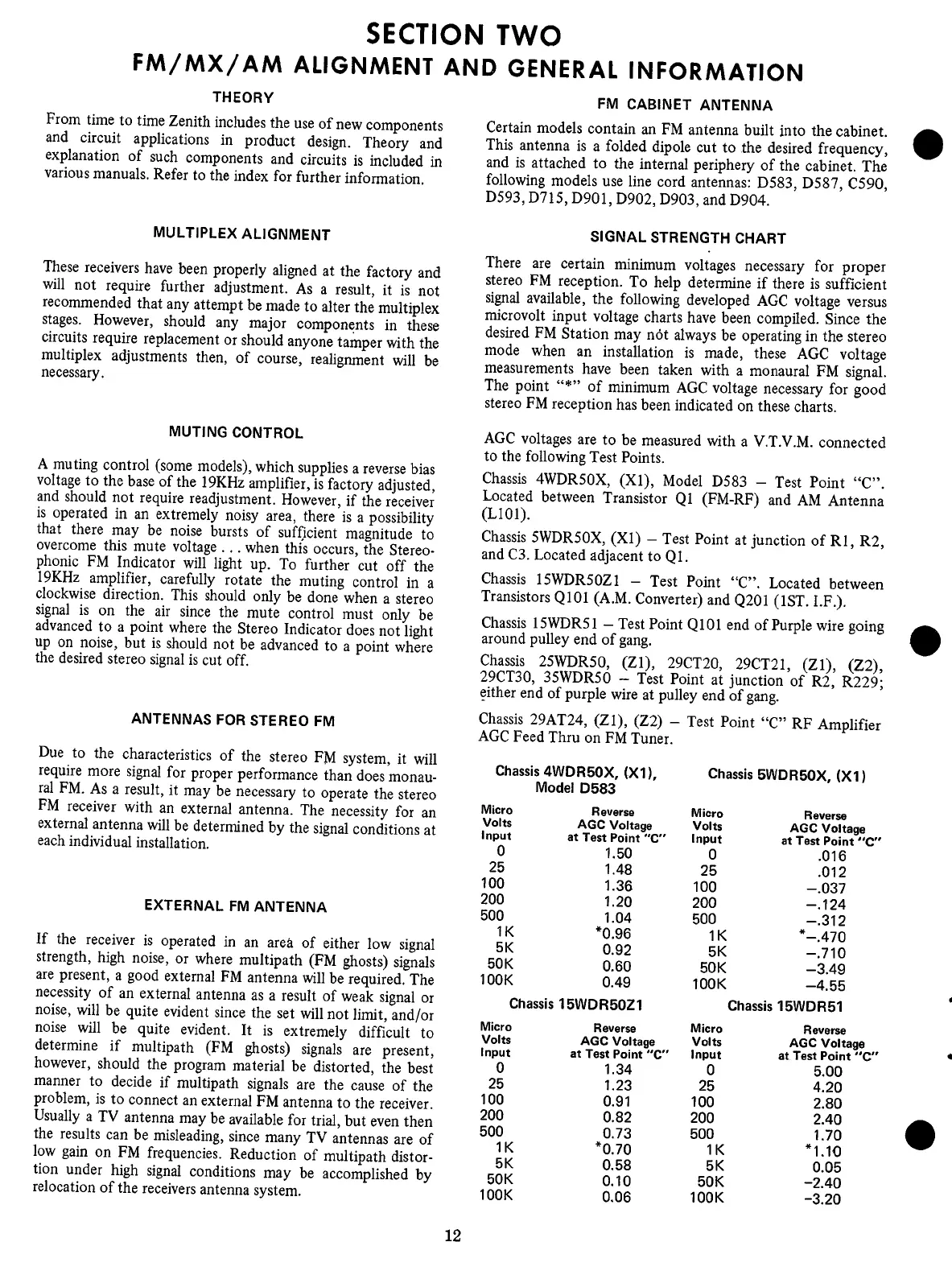
There
are
certain
minimum
voltages
necessary
for
proper
stereo
FM
reception.
To
help
determine
if
there
is
sufficient
signal
available,
the
following
developed
AGC
voltage
versus
microvolt
input
voltage
charts
have
been
compiled.
Since
the
desired
FM
Station
may
not
always
be
operating
in
the
stereo
mode
when
an
installation
is
made,
these
AGC
voltage
measurements
have
been
taken
with
a
monaural
FM
signal.
The
point
of
minimum
AGC
voltage
necessary
for
good
stereo
FM
reception
has
been
indicated
on
these
charts.
AGC
voltages
are
to
be
measured
with
a
V.T.V.M.
connected
to
the
following
Test
Points.
Chassis
4WDR50X,
(XI),
Model
D583
-
Test
Point
C
.
Located
between
Transistor
QI
(FM-RF)
and
AM
Antenna
(L101).
Chassis
5WDR50X,
(XI)
Test
Point
at
junction
of
Rl,
R2,
and
C3.
Located
adjacent
to
QI.
Chassis
15WDR50Z1
Test
Point
€t
C
.
Located
between
Transistors
Q101
(A.M.
Converter)
and
Q201
(1ST.
I.F.).
Chassis
15WDR51
Test
Point
Q101
end
of
Purple
wire
going
around
pulley
end
of
gang.
Chassis
25WDR50,
(Zl),
29CT20,
29CT21,
(Zl),
(Z2),
29CT30,
35WDR5O
-
Test
Point
at
junction
of
R2,
R229;
either
end
of
purple
wire
at
pulley
end
of
gang.
Chassis
29AT24,
(Zl),
(Z2)
-
Test
Point
C
RF
Amplifier
AGC
Feed
Thru
on
FM
Tuner.

Related product manuals