EasyManua.ls Logo

Zenith J584W - Page 28

Zenith J584W
80 pages
Print Icon
To Next Page IconTo Next Page
To Previous Page IconTo Previous Page
Loading...
26
Figure
1
1B
illustrates
the
basic
concept
of
a
Phase
Locked
Loop
(PLL).
A
Voltage
Controlled
Oscillator
(VCO)
is
tuned
to
a
given
free
running
frequency.
A
portion
of
the
VCO
output
is
fed
back
to
a
phase
detector,
which
also
receives
an
external
signal
(19kHz
in
this
case).
These
signals
are
com
pared
for
frequency
and
phase.
Any
difference
is
fed
to
a
filter,
the
output
of
which
will
be
a
correction
voltage
ap
plied
to
the
VCO.
This
voltage
keeps
the
VCO
output
on
frequency
and
in
phase
with
the
input
signal.
Proper
adjustment
of
the
VCO
is
made
by
connecting
a
fre
quency
counter
to
test
point
"M"
(pin
10
of
IC301)
and
adjusting
R302
for
19kHz.
In
an
emergency,
if
a
frequency
counter
is
not
available,
you
might
try
the
following:
tune
in
a
station
broadcasting
stereo
and
adjust
R302
until
the
stereo
indicator
turns
on,
then
adjust
control
R302
to
the
center
of
the
turn-on
range.
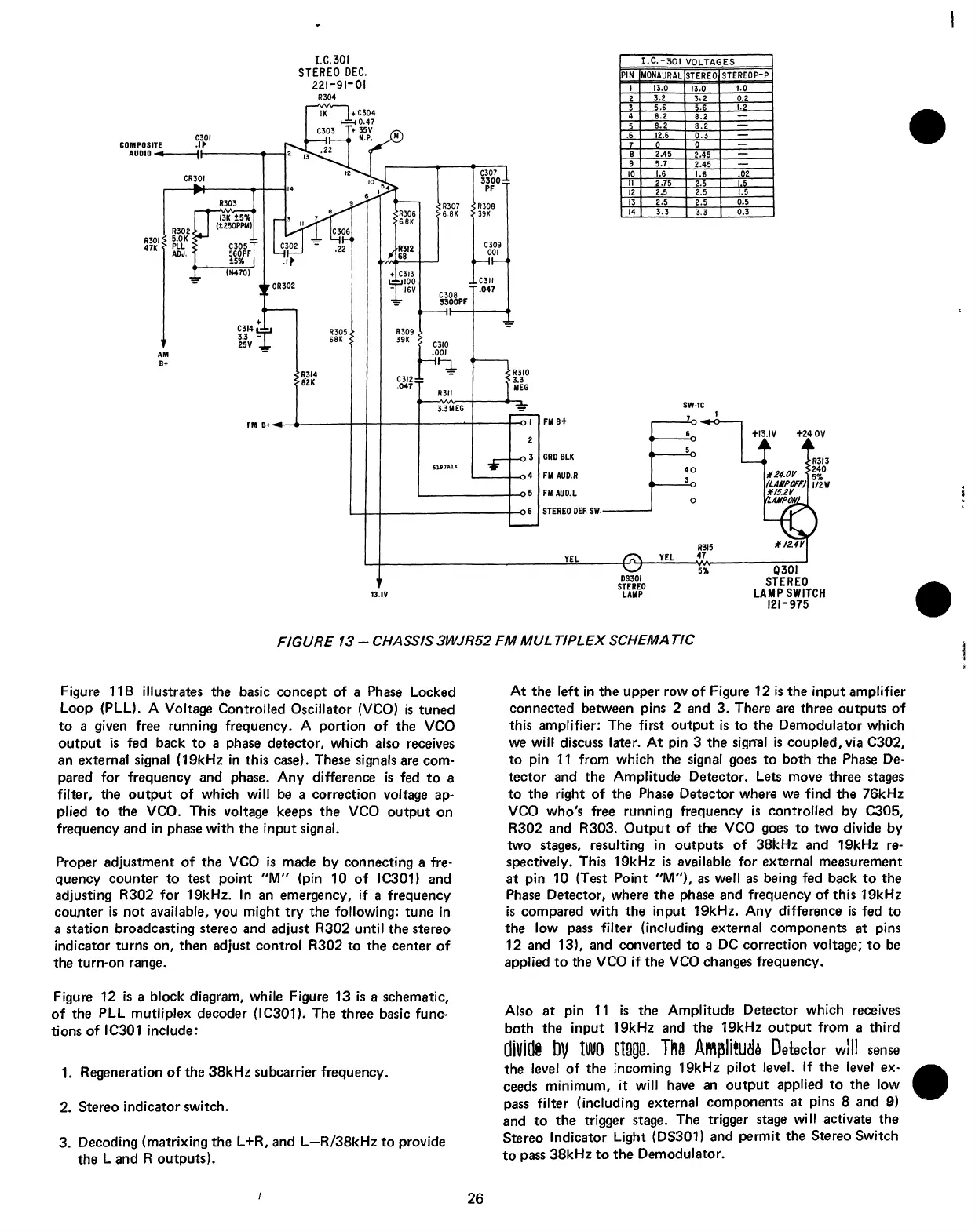
Figure
12
is
a
block
diagram,
while
Figure
13
is
a
schematic,
of
the
PLL
mutliplex
decoder
(IC301
).
The
three
basic
func
tions
of
IC301
include:
1.
Regeneration
of
the
38kHz
subcarrier
frequency.
2.
Stereo
indicator
switch.
3.
Decoding
(matrixing
the
L+R,
and
L
R/38kHz
to
provide
the
L
and
R
outputs).
At
the
left
in
the
upper
row
of
Figure
12
is
the
input
amplifier
connected
between
pins
2
and
3.
There
are
three
outputs
of
this
amplifier;
The
first
output
is
to
the
Demodulator
which
we
will
discuss
later.
At
pin
3
the
signal
is
coupled,
via
C302,
to
pin
11
from
which
the
signal
goes
to
both
the
Phase
De
tector
and
the
Amplitude
Detector.
Lets
move
three
stages
to
the
right
of
the
Phase
Detector
where
we
find
the
76kHz
VCO
who's
free
running
frequency
is
controlled
by
C305,
R302
and
R303.
Output
of
the
VCO
goes
to
two
divide
by
two
stages,
resulting
in
outputs
of
38kHz
and
19kHz
re
spectively.
This
19kHz
is
available
for
external
measurement
at
pin
10
(Test
Point
"M"),
as
well
as
being
fed
back
to
the
Phase
Detector,
where
the
phase
and
frequency
of
this
19kHz
is
compared
with
the
input
19kHz.
Any
difference
is
fed
to
the
low
pass
filter
(including
external
components
at
pins
12
and
13),
and
converted
to
a
DC
correction
voltage;
to
be
applied
to
the
VCO
if
the
VCO
changes
frequency.
Also
at
pin
11
is
the
Amplitude
Detector
which
receives
both
the
input
19kHz
and
the
19kHz
output
from
a
third
divide
by
two
stage.
The
Amplitude
Detector
will
sense
the
level
of
the
incoming
19kHz
pilot
level.
If
the
level
ex
ceeds
minimum,
it
will
have
an
output
applied
to
the
low
I
pass
filter
(including
external
components
at
pins
8
and
9)
and
to
the
trigger
stage.
The
trigger
stage
will
activate
the
Stereo
Indicator
Light
(DS301)
and
permit
the
Stereo
Switch
to
pass
38kHz
to
the
Demodulator.
FIGURE
13
-
CHASSIS
3WJR52
FM
MUL
TIP
LEX
SCHEMA
TIC