EasyManua.ls Logo

Zenith J584W - Page 40

Zenith J584W
80 pages
Print Icon
To Next Page IconTo Next Page
To Previous Page IconTo Previous Page
Loading...
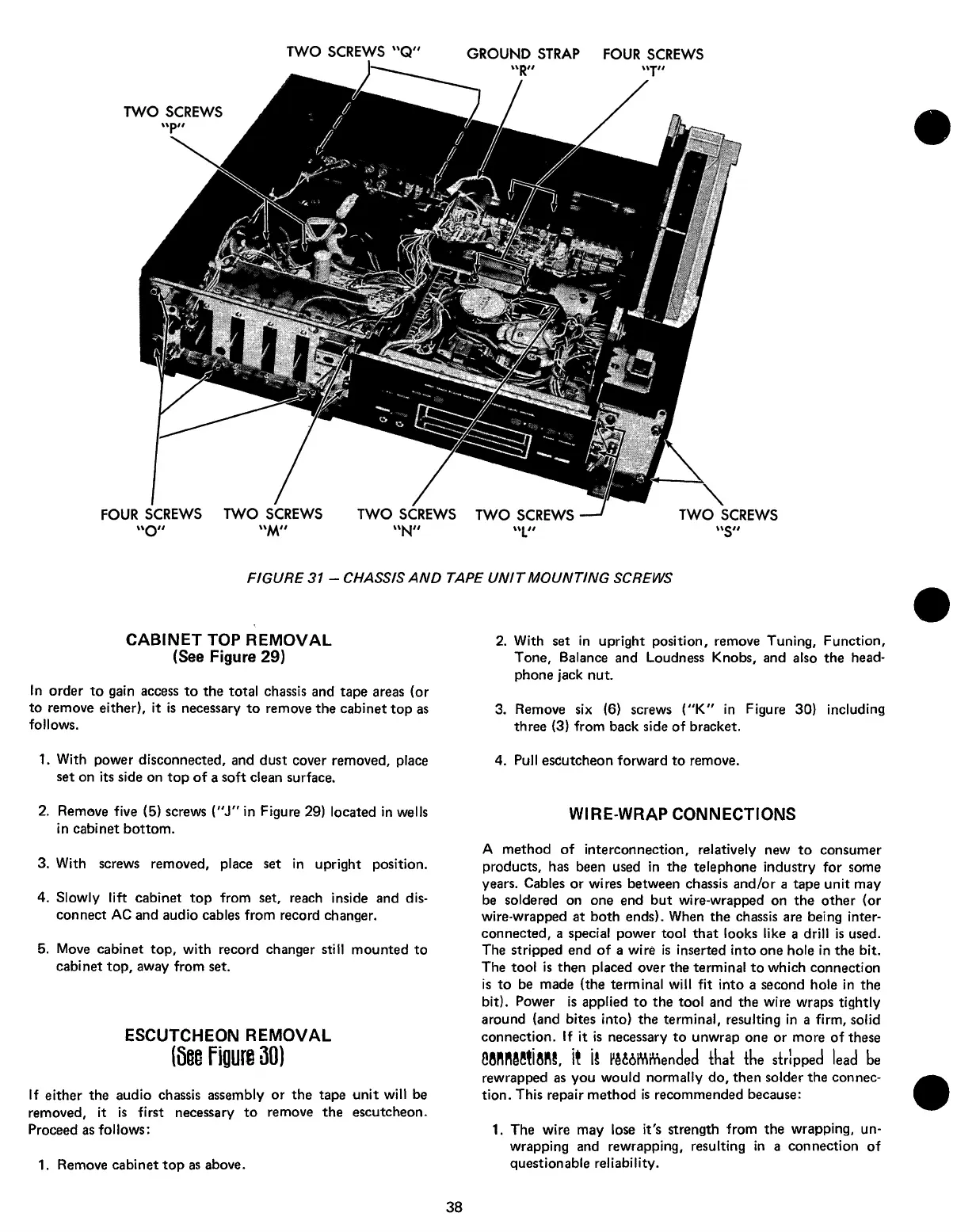
FIGURE
31
-
CHASSIS
AND
TAPE
UNIT
MOUNTING
SCREWS
CABINET
TOP
REMOVAL
(See
Figure
29)
In
order
to
gain
access
to
the
total
chassis
and
tape
areas
(or
to
remove
either),
it
is
necessary
to
remove
the
cabinet
top
as
follows.
1.
With
power
disconnected,
and
dust
cover
removed,
place
set
on
its
side
on
top
of
a
soft
clean
surface.
2.
Remove
five
(5)
screws
("J"
in
Figure
29)
located
in
wells
in
cabinet
bottom.
3.
With
screws
removed,
place
set
in
upright
position.
4.
Slowly
lift
cabinet
top
from
set,
reach
inside
and
dis
connect
AC
and
audio
cables
from
record
changer.
5.
Move
cabinet
top,
with
record
changer
still
mounted
to
cabinet
top,
away
from
set.
ESCUTCHEON
REMOVAL
(See
Figure
30)
If
either
the
audio
chassis
assembly
or
the
tape
unit
will
be
removed,
it
is
first
necessary
to
remove
the
escutcheon.
Proceed
as
follows:
1.
Remove
cabinet
top
as
above.
2.
With
set
in
upright
position,
remove
Tuning,
Function,
Tone,
Balance
and
Loudness
Knobs,
and
also
the
head
phone
jack
nut.
3.
Remove
six
(6)
screws
("K"
in
Figure
30)
including
three
(3)
from
back
side
of
bracket.
4.
Pull
escutcheon
forward
to
remove.
WIRE-WRAP
CONNECTIONS
A
method
of
interconnection,
relatively
new
to
consumer
products,
has
been
used
in
the
telephone
industry
for
some
years.
Cables
or
wires
between
chassis
and/or
a
tape
unit
may
be
soldered
on
one
end
but
wire-wrapped
on
the
other
(or
wire-wrapped
at
both
ends).
When
the
chassis
are
being
inter
connected,
a
special
power
tool
that
looks
like
a
drill
is
used.
The
stripped
end
of
a
wire
is
inserted
into
one
hole
in
the
bit.
The
tool
is
then
placed
over
the
terminal
to
which
connection
is
to
be
made
(the
terminal
will
fit
into
a
second
hole
in
the
bit).
Power
is
applied
to
the
tool
and
the
wire
wraps
tightly
around
(and
bites
into)
the
terminal,
resulting
in
a
firm,
solid
connection.
If
it
is
necessary
to
unwrap
one
or
more
of
these
eflHMfitiftRS,
it
is
PWdMWended
that
ike
stripped
lead
be
rewrapped
as
you
would
normally
do,
then
solder
the
connec
tion.
This
repair
method
is
recommended
because:
1.
The
wire
may
lose
it's
strength
from
the
wrapping,
un
wrapping
and
rewrapping,
resulting
in
a
connection
of
questionable
reliability.
38