EasyManua.ls Logo

Zenith Y504B - Page 12

Zenith Y504B
88 pages
Print Icon
To Next Page IconTo Next Page
To Previous Page IconTo Previous Page
Loading...
GENERAL
INFORMATION
MULTIPLEX
THEORY
For
all
theory
regarding
the
operation
of
the
multiplex
circuits,
refer
to
service
manuals
HF-
14
and
HF-
14
Supplement.
EXTENSION
SPEAKER
SYSTEMS
It
is
recommended
that
only
Zenith
extension
speakers
be
used
in
conjunction
with
Zenith
receivers.
However,
if
the
technician
should
desire
to
use
other
speakers
it
is
imperative
the
total
impedance
be
not
less
than
that
impedance
indicated
on
the
back
of
each
receiver
adjacent
to
the
speaker
terminal
board.
MUTING
CONTROL
The
muting
control
is
factory
adjusted,
and
should
not
require
readjustment.
However,
if
the
receiver
is
oper
ated
in
an
extremely
noisy
area,
there
is
a
possibility
that
there
may
be
noise
bursts
of
sufficient
magnitude
to
overcome
this
mute
voltage
...
when
this
occurs,
the
Stereophonic
FM
Indicator
will
light
up.
To
further
cut
off
the
19KC
amplifier,
carefully
rotate
the
muting
control
to
cut
off
the
light.
This
should
only
be
done
when
a
stereo
signal
is
on
the
air
since
the
mute
control
must
only
be
advanced
to
a
point
where
the
Stereo
Indi
cator
does
not
light
up
on
noise,
but
it
should
not
be
advanced
to
a
point
where
the
desired
stereo
signal
is
cut
off.
MULTIPLEX
ALIGNMENT
These
receivers
have
been
properly
aligned
at
the
factory
and
will
not
require
further
adjustment.
As
a
result,
it
is
not
recommended
that
any
attempt
be
made
to
alter
the
multiplex
stages.
However,
should
any
ma
jor
components
in
these
circuits
require
replacement
or
should
anyone
tamper
with
the
multiplex
adjustments
then,
of
course,
realignment
will
be
necessary.
Zenith
has
designed
and
manufactured
an
SPTE-1
Multiplex
Generator
that
can
be
used
to
properly
align
the
multiplex
portion
of
these
receivers.
The
multiplex
alignment
procedure
is
included
in
later
pages
of
this
manual.
The
SPTE-1
Multiplex
Generator
is
available
at
your
Zenith
Distributor.
ANTENNAS
FOR
STEREO
FM
Due
to
the
characteristics
of
the
stereo
FM
system,
it
will
require
more
signal
for
proper
performance
than
does
monaural
FM.
As
a
result,
it
may
be
necessary
to
operate
the
stereo
FM'receiver
with
an
external
antenna.
The
necessity
for
an
external
antenna
will
be
deter
mined
by
the
signal
conditions
at
each
individual
in-
stallation.
EXTERNAL
FM
ANTENNA
If
the
receiver
is
operated
in
an
area
of
either
low
sig
nal
strength,
high
noise,
or
where
multipath
(FM
ghosts)
signals
are
present,
a
good
external
FM
antenna
will
be
required.
The
necessity
of
an
external
antenna
as
a
result
of
weak
signal
or
noise,
will
be
quite
evident
since
the
set
will
not
limit,
and/or
noise
will
be
quite
evident.
It
is
extremely
difficult
to
determine
if
multi
path
(FM
ghosts)
signals
are
present,
however,
should
the
program
material
be
distorted,
the
best
manner
to
decide
if
multipath
signals
are
the
cause
of
the
problem,
is
to
connect
an
external
FM
antenna
to
the
receiver.
Usually
a
TV
antenna
may
be
available
for
trial,
but
even
then
the
results
can
be
misleading,
since
many
TV
antennas
are
of
low
gain
on
FM
frequencies.
12
AUTOMATIC
FREQUENCY
CONTROL
AFC
These
receivers
feature
an
automatic
frequency
con
trol
which
automatically
keeps
your
receiver
on
the
exact
station
frequency
when
you
are
tuned
to
an
FM
station.
To
utilize
this
feature
tune
the
receiver
as
i
A
n
^^
ucted
and
tllen
move
the
selector
or
mode
switch
to
AFC
position.
When
the
desired
FM
station
is
a
weak
station,
adja
cent
in
frequency
to
a
strong
station,
the
AFC
may
pull
the
tuning
into
the
stronger
station.
Under
these
conditions,
place
the
switch
in
FM
position
and
tune
the
receiver
as
instructed.
FM
CABINET
ANTENNA
All
console
models
contain
an
FM
antenna
built
into
the
cabinet.
This
antenna
consists
of
a
Folded
Dipole
cut
to
the
desired
frequency,
and
attached
to
the
inter
nal
periphery
of
the
cabinet.
SIGNAL
STRENGTH
CHART
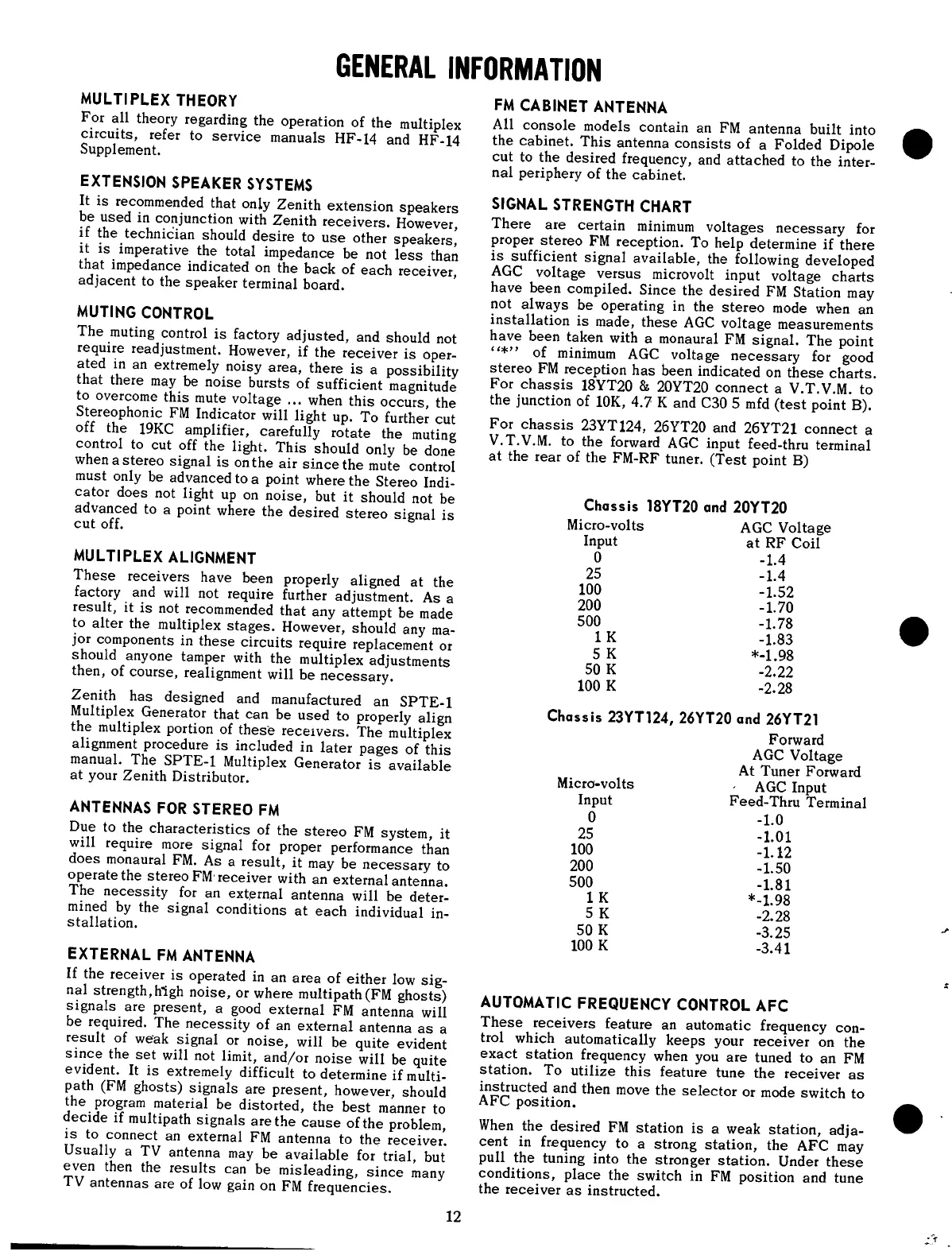
There
are
certain
minimum
voltages
necessary
for
proper
stereo
FM
reception.
To
help
determine
if
there
is
sufficient
signal
available,
the
following
developed
AGC
voltage
versus
microvolt
input
voltage
charts
have
been
compiled.
Since
the
desired
FM
Station
may
not
always
be
operating
in
the
stereo
mode
when
an
installation
is
made,
these
AGC
voltage
measurements
have
been
taken
with
a
monaural
FM
signal.
The
point
*
of
minimum
AGC
voltage
necessary
for
good
stereo
FM
reception
has
been
indicated
on
these
charts.
For
chassis
18YT20
&
20YT20
connect
a
V.T.V.M.
to
the
junction
of
10K,
4.7
K
and
C30
5
mfd
(test
point
B).
For
chassis
23YT124,
26YT20
and
26YT21
connect
a
V.T.V.M.
to
the
forward
AGC
input
feed-thru
terminal
at
the
rear
of
the
FM-RF
tuner.
(Test
point
B)
Chassis
18YT20
and
20YT20
Micro-volts
AGC
Voltage
Input
at
RF
Coil
0
-1.4
25
-1.4
100
-1.52
200
-1.70
500
-1.78
1
K
-1.83
5
K
*-1.98
50
K
-2.22
100
K
-2.28
Chassis
23YT124,
26YT20
and
26YT21
Forward
AGC
Voltage
At
Tuner
Forward
Micro-volts
AGC
Input
Input
Feed-Thru
Terminal
0
-1.0
25
-1.01
100
-1.12
200
-1.50
500
-1.81
1
K
*-1.98
5
K
-2.28
50
K
-3.25
100
K
-3.41

Related product manuals