EasyManua.ls Logo

Zenith Y504B - Page 19

Zenith Y504B
88 pages
Print Icon
To Next Page IconTo Next Page
To Previous Page IconTo Previous Page
Loading...
MULTIPLEX
ALIGNMENT
PROCEDURE
CHASSIS
23YT124,
26YT20
AND
26YT21
Using
the
Zenith
FM
multiplex
signal
generator,
the
multiplex
portion
of
Zenith
or
any
FM
multiplex
re
ceiver
can
be
aligned,
but
first
before
any
attempt
is
made
to
do
this
it
is
necessary
that
the
technician
be
certain
that
the
RF,
IF,
and
ratio
detector
alignment
is
correct,
and
that
the
receiver
operates
normally
on
monaural
signals.
to
obtain
S
curve
symmetry
indicates
it
is
most
neces
sary
to
adjust
for
maximum
gain
and
at
the
same
time
maintain
linearity
and
symmetry.
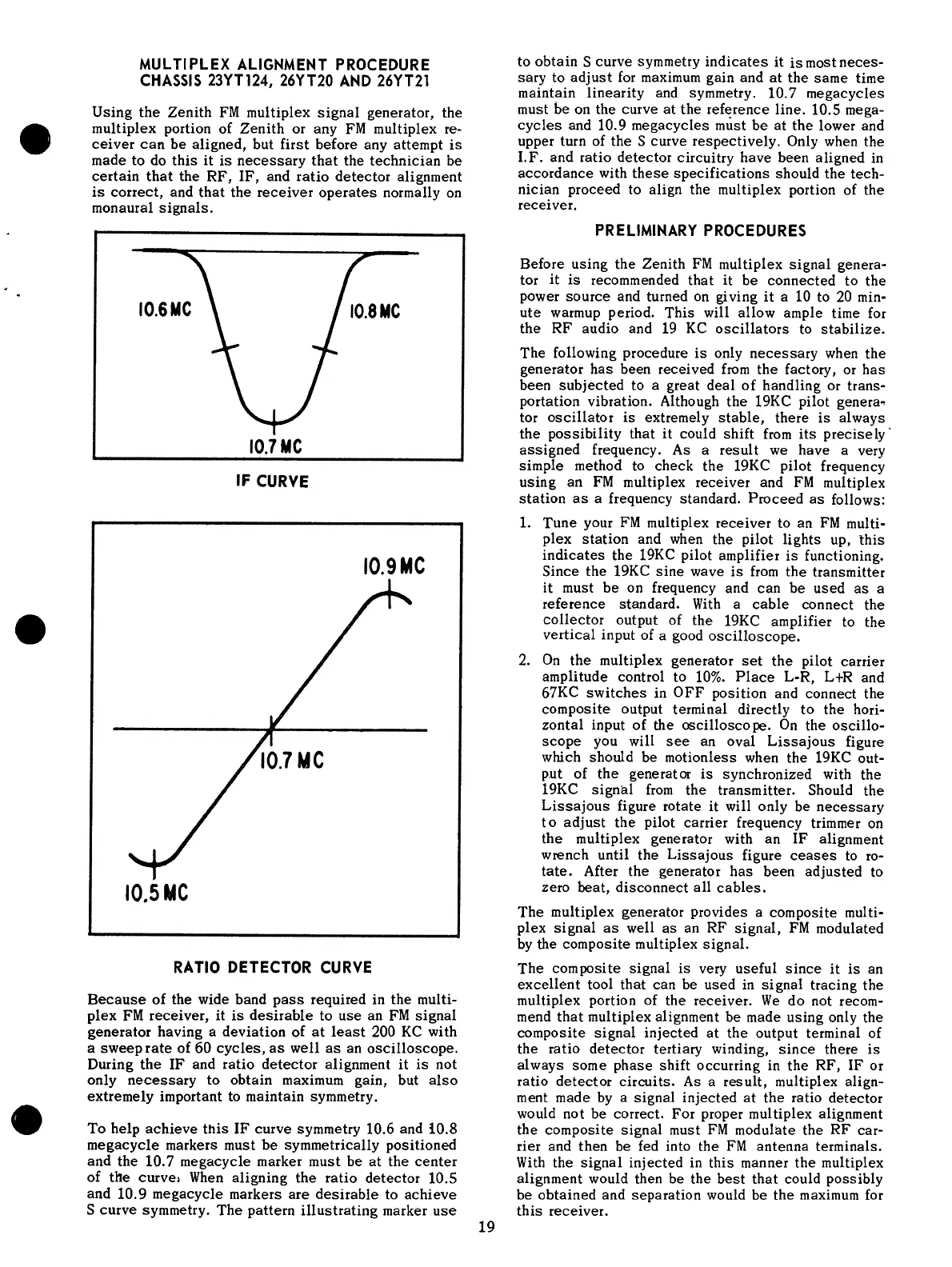
10.7
megacycles
must
be
on
the
curve
at
the
reference
line.
10.5
mega
cycles
and
10.9
megacycles
must
be
at
the
lower
and
upper
turn
of
the
S
curve
respectively.
Only
when
the
I.
F.
and
ratio
detector
circuitry
have
been
aligned
in
accordance
with
these
specifications
should
the
tech
nician
proceed
to
align
the
multiplex
portion
of
the
receiver.
PRELIMINARY
PROCEDURES
Before
using
the
Zenith
FM
multiplex
signal
genera
tor
it
is
recommended
that
it
be
connected
to
the
power
source
and
turned
on
giving
it
a
10
to
20
min
ute
warmup
period.
This
will
allow
ample
time
for
the
RF
audio
and
19
KC
oscillators
to
stabilize.
The
following
procedure
is
only
necessary
when
the
generator
has
been
received
from
the
factory,
or
has
been
subjected
to
a
great
deal
of
handling
or
trans
portation
vibration.
Although
the
19KC
pilot
genera-*
tor
oscillator
is
extremely
stable,
there
is
always
the
possibility
that
it
could
shift
from
its
precisely'
assigned
frequency.
As
a
result
we
have
a
very
simple
method
to
check
the
19KC
pilot
frequency
using
an
FM
multiplex
receiver
and
FM
multiplex
station
as
a
frequency
standard.
Proceed
as
follows:
1.
Tune
your
FM
multiplex
receiver
to
an
FM
multi
plex
station
and
when
the
pilot
lights
up,
this
indicates
the
19KC
pilot
amplifier
is
functioning.
Since
the
19KC
sine
wave
is
from
the
transmitter
it
must
be
on
frequency
and
can
be
used
as
a
reference
standard.
With
a
cable
connect
the
collector
output
of
the
19KC
amplifier
to
the
vertical
input
of
a
good
oscilloscope.
2.
On
the
multiplex
generator
set
the
pilot
carrier
amplitude
control
to
10%.
Place
L-R,
L+R
and
67KC
switches
in
OFF
position
and
connect
the
composite
output
terminal
directly
to
the
hori
zontal
input
of
the
oscilloscope.
On
the
oscillo
scope
you
will
see
an
oval
Lissajous
figure
which
should
be
motionless
when
the
19KC
out
put
of
the
generator
is
synchronized
with
the
19KC
signal
from
the
transmitter.
Should
the
Lissajous
figure
rotate
it
will
only
be
necessary
to
adjust
the
pilot
carrier
frequency
trimmer
on
the
multiplex
generator
with
an
IF
alignment
wrench
until
the
Lissajous
figure
ceases
to
ro
tate.
After
the
generator
has
been
adjusted
to
zero
beat,
disconnect
all
cables.
The
multiplex
generator
provides
a
composite
multi
plex
signal
as
well
as
an
RF
signal,
FM
modulated
by
the
composite
multiplex
signal.
The
composite
signal
is
very
useful
since
it
is
an
excellent
tool
that
can
be
used
in
signal
tracing
the
multiplex
portion
of
the
receiver.
We
do
not
recom
mend
that
multiplex
alignment
be
made
using
only
the
composite
signal
injected
at
the
output
terminal
of
the
ratio
detector
tertiary
winding,
since
there
is
always
some
phase
shift
occurring
in
the
RF,
IF
or
ratio
detector
circuits.
As
a
result,
multiplex
align
ment
made
by
a
signal
injected
at
the
ratio
detector
would
not
be
correct.
For
proper
multiplex
alignment
the
composite
signal
must
FM
modulate
the
RF
car
rier
and
then
be
fed
into
the
FM
antenna
terminals.
With
the
signal
injected
in
this
manner
the
multiplex
alignment
would
then
be
the
best
that
could
possibly
be
obtained
and
separation
would
be
the
maximum
for
this
receiver.
RATIO
DETECTOR
CURVE
Because
of
the
wide
band
pass
required
in
the
multi
plex
FM
receiver,
it
is
desirable
to
use
an
FM
signal
generator
having
a
deviation
of
at
least
200
KC
with
a
sweep
rate
of
60
cycles,
as
well
as
an
oscilloscope.
During
the
IF
and
ratio
detector
alignment
it
is
not
only
necessary
to
obtain
maximum
gain,
but
also
extremely
important
to
maintain
symmetry.
To
help
achieve
this
IF
curve
symmetry
10.6
and
10.8
megacycle
markers
must
be
symmetrically
positioned
and
the
10.7
megacycle
marker
must
be
at
the
center
of
the
curve;
When
aligning
the
ratio
detector
10.5
and
10.9
megacycle
markers
are
desirable
to
achieve
S
curve
symmetry.
The
pattern
illustrating
marker
use

Related product manuals