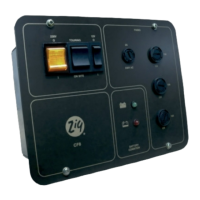
Do not connect your car at this stage.
If you are wiring a boat or motorised caravan, connect No.1 to Earth, and No.2 to the
engine battery.
A 25 amp line fuse must be fitted in the positive line (No.2 on C.F.8) as near to the battery
as possible.
At this stage a suitable position for the auxiliary battery should be chosen. This should be
ventilated to the outside at the battery top and bottom levels and in boats should be kept
well away from liquid gas containers. The battery should be mounted so that it cannot tip
over and the surface beneath it should be protected from corrosion due to accidental
spillage. Connect the battery using 2.5mm
2
(50/0.25) cable to the C.F.8 fitting the in-line
25 amp fuse (supplied) in the positive cable as near as possible to the battery.
Battery positive (via fuse) to No.4 terminal block on C.F.8.
Negative to No.3 terminal block on C.F.8.
Never use crocodile clips to connect the battery, these deteriorate quickly and are a fire
risk. Always use proper terminals and screws and smear the connections with petroleum
jelly.
Before making any further connections temporarily remove the in-line fuse from its holder.
For motorised and boats remove the other in-line fuse as well.
7
Figure 3: 12S Plug (Rear View)
7. NOTE: The enclosure is not designed to be sealed; the gaps at the corners are
intentional and are there to aid heat dissipation from the Transformer.
Mains Electricity:
The Zig Charging and Distribution units are designed to run on 220 to 240 volt AC.
mains electricity. NEVER CONNECT TO A D.C. SUPPLY.
In remote parts of Europe and the whole of the U.S.A., the supply is 110 volt A.C. The
unit will not charge from the mains with this supply, although no harm will be done if it is
connected to 110 volts. The 12 volt equipment will, of course, work normally, including
charging from the car. Note that where the supply is at the low end i.e. 220 volts,
efficiency in mains charging will be reduced.
The C.F.8 has been specially designed to operate safely on mains electricity in a
caravan or boat. It is protected by a double pole mains switch, double wound mains
transformer and fuses. It will remain safe even if the polarity of the mains is reversed.
THIS DOES NOT APPLY TO OTHER MAINS EQUIPMENT IN THE CARAVAN OR
BOAT. If you wish to fit extra mains appliances in the Caravan or Boat, you must
consult a qualified electrician also the use of an Earth Leakage Circuit Breaker is
strongly recommended for your own safety; remember mains voltage can be fatal.
Using the C.F.8 in boats
The unit is suitable for use in Motor cruisers, Motor Sailers and smaller boats,
particularly when they are moored for long periods in marinas where mains electricity is
available and it is undesirable to run the engines for long periods. The instructions for
caravans apply in all cases except where references are made to connecting the car
and 7 pin sockets, etc. It is particularly important in marine use that all switches are
placed in the OFF position before the battery is disconnected, as this eliminates the risk
of sparks.
4


 To Next Page
 Loading...