Non-Sound Decoder MX600 - MX638 and Sound Decoder MX640 - MX659 Page 43
For sound collections; see first page of this chapter
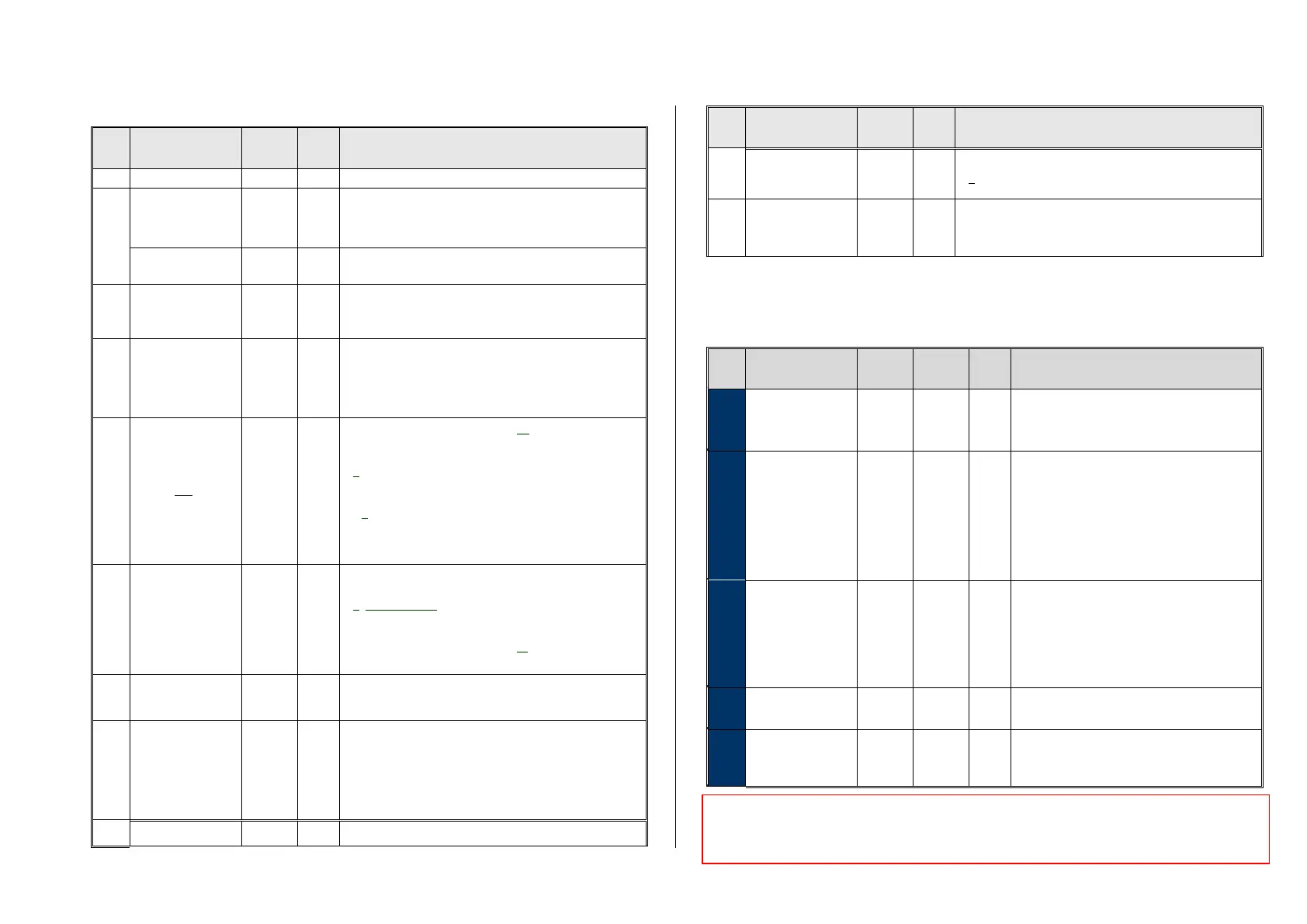
The default value “64” results in the (mathematically) high-
est possible distortion-free playback volume; but values of up
to 100 may nonetheless be practical.
Recommended: #266 = 40…90
Maximum volume the sound can be raised to (does not have
to be the same value as in CV #266)
Defines function key for volume decrease; lowers volume as
long as key is pressed; about 10 steps/sec, down to 0.
ATTENTION: This changes CV #266.
Defines function key for volume increase; raises volume as
long as key is pressed; about 10 steps/sec, to the maximum
defined in CV #395.
ATTENTION: This changes CV #266; can be used as a sub-
stitute for a mute key.
ON/OFF key for
engine and random
sound
Defines the function key (by default F8) that turns the engine
sound (chuffs, boiling, blow-offs, brake squeals...) as well as
the random sound (compressor, coal shoveling...) ON or OFF.
= 8: F8 key switches driving sound ON or OFF.
Note: this is the default key for ZIMO original sound projects;
OEM projects (i.e. ROCO) often use other settings. Most of-
ten 1 for the F1 key.
= 1…28: ON/OFF key for F1…F28.
= 255: engine and random sounds are always ON. (If not,
change CV #313!).
ON/OFF key for
function sound
Function key assigned as ON/OFF key of function sounds
(i.e. F2 – whistle, F6 – bell etc.).
= 0: does not mean that F0 is assigned for this task but rather
that the function sounds are always active.
= (#310), if the same value is entered here as in CV #310, the
key defined in #310 turns all sound ON/OFF.
= 1 ... 28: Separate ON/OFF key for function sound.
See chapter 5.5 “Basic steam engine settings”.
(does not belong in this chapter, despite the correct number sequence)
This CV assigns a function key with which the driving sounds
can be faded in and out, i.e. when the train disappears behind
scenery. F8 is used by default, which is already the sound
on/off key but now does so softly.
= 0: No mute key or mute function.
= 1…28: Selected function key F1…F28 as mute key.
= 101…128: Assigned function key with inverted action.
Time in tenths of a second for sound fading in/out when mute
button is pressed. Total range is 25 seconds.
= 0 (to 10): minimum time setting of 1 sec.
= 11…255: longer “fade” times
To reduce the driving sound volume (E.g. Diesel motor with
related sounds such as turbo charger) compared to the func-
tion sounds.
The following CV’s can be programmed both “normal” (i.e. CV #... = ...) and “incremental”. “In-
cremental programming” is especially useful when the proper value cannot be calculated in advance
and must be determined by trial, which is often the case with sound parameters.
The “Lead CV” in each case is the first of a group of 3 CV’s, which are edited and displayed together
on a ZIMO MX31/MX32 cab during the “incremental programming” procedure.
The brake squeal should start when the speed
drops below a specific speed step. It will be auto-
matically stopped at speed 0 (based on back-EMF
results).
Minimum driving time
before brake squeals
The brake squeal is to be suppressed when an
engine is driven for a short time only, which is
usually a shunting run and often without any cars
(in reality it is mostly the cars that are squealing
not the engine itself!).
Note: Brake squeal sounds can also be assigned
to a function key (see allocation procedure CV
#300 = …), with which the brake squeal can be
started or stopped manually!
Brake squeals-order
Reed configuration
Bit0 - Reed1 activates braking squeal
Bit1 - Reed2 activates braking squeal
Bit2 - Reed3 activates braking squeal
Bit3 - Reed4 activates braking squeal
Bit7 - 0 = key defined in CV308 suppresses
braking squeal of Reed inputs if this key is ON
1 = key defined in CV308 activates braking
squeal independent of Reed inputs
0 = no key defined. Reed inputs always active.
1-28 = key F1 to F28.
Bit 4 – inverts the polarity of Reed input 1
Bit 3 – inverts the polarity of Reed input 2
Bit 2 – inverts the polarity of Reed input 3
Bit 5 – inverts the polarity of Reed input 4
NOTE: If a decoder comes with a potentiometer for volume control (mostly on large-scale
decoders), the pot meter should NOT be fully opened if full volume is not really desired (Loss of
sound quality if pot meter is fully open and at the same time the volume is heavily reduced by
CV’s!).



 To Next Page