Need help?
Do you have a question about the zoomion Gravity 150 EQ and is the answer not in the manual?
Lists all accessories provided with the telescope for easier identification and use.
Explains how the telescope aperture, mirrors, and focuser work together to provide a focused image.
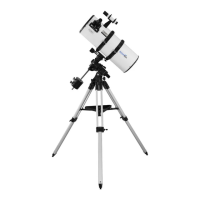
Details the step-by-step process for assembling the tripod, mount, counterweight, and optical tube.
Guides users on how to align the finderscope with the main telescope for precise targeting of celestial objects.
Details how to observe the Moon, highlighting surface features and best viewing conditions.
Explains what can be seen of Jupiter, including bands and moons, making it a beginner-friendly target.
Describes observing Saturn's rings, including the Cassini's division, even at moderate magnifications.
Explains how to calculate telescope magnification using focal lengths of the telescope and eyepieces.
Details the function and impact of Barlow lenses and erecting lenses on magnification and image orientation.
Provides a table showing suitable accessory combinations for different celestial viewing targets.
Warns against observing the Sun without proper filters due to severe eye injury risk.
Addresses problems with achieving focus and suggests checking eyepiece and object type.
Explains that mirrored images are caused by the diagonal mirror and can be corrected with an erecting lens.
Discusses how atmospheric conditions and high magnification can affect image brightness and clarity.
Covers compatibility with other eyepieces and tips for basic astrophotography with a smartphone.
Explains that stars appear as points and emphasizes the absolute necessity of solar filters for sun observation.
Addresses scenarios where no image is visible, suggesting checks for dust caps and observing conditions.
 General
| Type | Reflector |
|---|---|
| Aperture | 150 mm |
| Focal Length | 750 mm |
| Focal Ratio | f/5 |
| Mount Type | Equatorial |
| Optical Design | Newtonian |
| Finderscope | 6x30 |
| Eyepieces Included | 10mm, 25mm |


 To Next Page