6
IP ROUTING PROTOCOL OPERATION
IP Routing Protocol
Overview
Routers select an appropriate path through a network for an IP packet according
to the destination address of the packet. Each router on the path receives the
packet and forwards it to the next router. The last router in the path submits the
packet to the destination host.
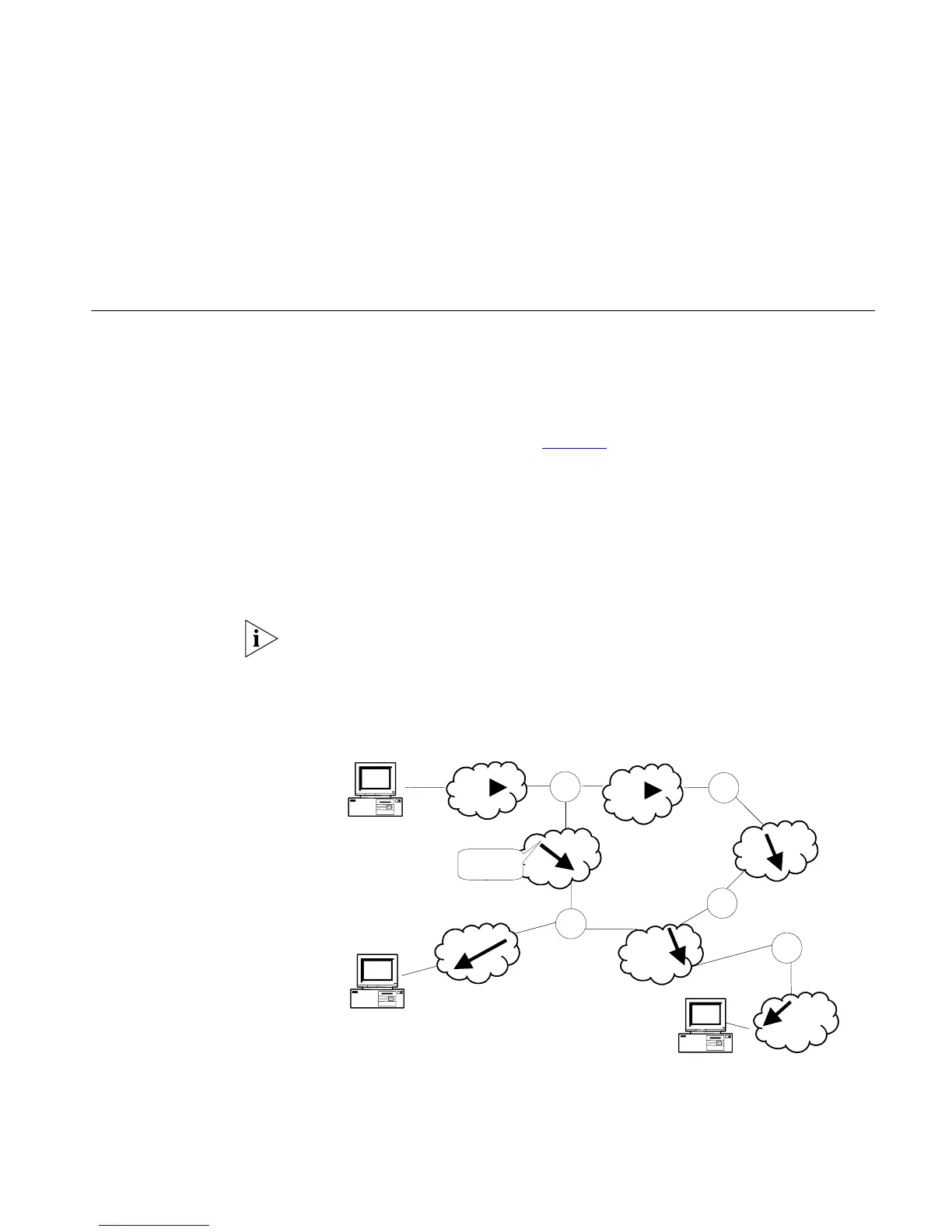
In a network, the router regards a path for sending a packet as a logical route unit,
and calls it a hop. For example, in
Figure 28, a packet sent from Host A to Host C
goes through 3 networks and 2 routers and the packet is transmitted through two
hops (represented by the bold arrows) and route segments. Therefore, when a
node is connected to another node across a network, there is a hop between
these two nodes and these two nodes are considered adjacent in the Internet.
Adjacent routers are two routers connected to the same network. The number of
route segments between a router and hosts in the same network is zero. A router
can be connected to any physical link that constitutes a route segment for routing
packets through the network.
When the Switch 5500G-EI runs a routing protocol, it can perform router
functions. In this guide, a router and its icon represent either a generic router or a
Switch 5500G-EI running routing protocols.
Figure 28 About hops
Networks can be different sizes, so the segment lengths between two different
pairs of routers can also be different.
A
Route
segment
B
C
A
R
R
Route
segment
R
R
R
A



 To Next Page