Need help?
Do you have a question about the 3M 8050501 and is the answer not in the manual?
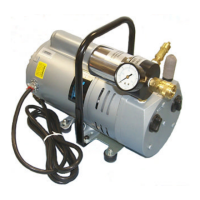
The 3M Ambient Air Pump, Model 8050501, is an electrically driven rotary air pump designed to supply fresh, clean air to a continuous flow supplied air respirator. Its primary function is to draw air from a non-contaminated atmosphere, filter it, and deliver it to a respirator user. The pump is oil-less and features rotary carbon vanes, ensuring that it does not produce carbon monoxide, oil vapors, oil mist, or moisture. This design is crucial for maintaining the quality of breathing air supplied to the user.
The pump's core function involves drawing ambient air through a porous plastic intake muffler, which serves to protect the pump from dust and dirt particles. After passing through the pump, the air is further filtered through an activated charcoal filter at the outlet. This activated charcoal filter is specifically designed to remove tastes and odors from the breathing air, ensuring that the air supplied to the respirator is clean and palatable.
It is critical that the atmosphere from which the air is drawn is clean and free of any carbon monoxide or other toxic gases or vapors. The pump itself does not remove these contaminants, nor does it supply oxygen. Therefore, proper placement of the inlet muffler in a clean, breathable air location is paramount for user safety. The Ambient Air Pump is capable of supplying a maximum air flow rate of ten (10) SCFM of breathing air to one worker or a maximum supply pressure of fifteen (15) psig. It is designed for use only with MSHA/NIOSH approved respirators that operate at pressures less than fifteen (15) PSIG. Users must ensure that the pump's outlet pressure, as measured by the pressure gauge, is maintained above the minimum pressure setting required by their specific respirator. Failure to comply with the respirator manufacturer's requirements will void MSHA/NIOSH approvals and could lead to serious injury or death.
The pump is not to be operated in explosive or corrosive atmospheres, nor where it can be exposed to any liquid or dusty material. If used outdoors, it must be protected from the elements. The device is equipped with a thermal overload protector that turns off the current in case of electrical overloads, preventing damage.
The Ambient Air Pump is designed for straightforward assembly and operation. Upon unpacking, the pressure gauge needs to be assembled to the gauge port on the pump's filter manifold. Teflon tape is recommended for sealing the gauge threads to prevent excessive tightening. The aluminum filter can should be unscrewed to check that the filter element is properly screwed into the filter manifold, hand-tightening only to avoid damage. Before operation, users must verify that the pressure relief valve, filter can, pressure gauge, and outlet coupling are assembled tightly to prevent air leakage.
To operate, the pump is plugged into a 115 VAC grounded electrical outlet fused at 15 amps. It features a toggle switch and a 10-foot grounded cord with a standard three-prong plug. For extended reach, a 15-amp, 3-wire grounded extension cord up to 30 meters (100 feet) can be used, with a minimum 12-gauge recommended, especially for continuous operation. The pump operates on its four rubber mounts and does not require bolting down, though it can be mounted on a wall or ceiling as long as the shaft center line is horizontal.
Before entering a contaminated work area, the respirator user must ensure all steps are completed, including analyzing the atmosphere at the air inlet and pump location to confirm it is not contaminated or explosive. The pump's inlet muffler must always be in a clean, uncontaminated location. If a clean location is not immediately available, extension hoses can be used to position the inlet muffler up to 100 feet away. For greater distances, rigid, smooth bore plastic piping with an internal diameter of not less than 1.5 inches can be installed, following good engineering practices.
The air pressure can be adjusted via the pressure relief valve. Loosening the locknut and adjusting the top sleeve allows for pressure changes (clockwise to increase, counter-clockwise to decrease). The locknut must be re-tightened after adjustment. It is crucial not to adjust the pressure relief valve to exceed 15 PSIG maximum, as this will damage the pump and void the warranty. Before donning the respirator, air should be purged through the respirator and hose assembly for a few minutes to eliminate any odors or tastes. After working, the respirator should be removed outside the contaminated area, the pump turned off, and the air supply hose disconnected.
Regular inspection and replacement of the intake muffler and outlet filters are essential for maintaining the pump's performance and ensuring clean breathing air. Initial inspection is suggested at 100 hours of operation, with subsequent frequency determined by the user. Dirty filters can decrease unit performance, reduce vane life, and lead to contaminated breathing air. The outlet filter (P/N 80496) should be replaced at least every 200 hours, and the inlet muffler (P/N 80515) at least every 500 hours, or sooner if necessary. It is explicitly warned against attempting to clean these filters with solvents or cleaning solutions, as this can contaminate breathing air and cause serious injury or death.
Should excessive dirt, sand, foreign particles, moisture, or oil enter the pump, the carbon vanes may become sluggish, and the pump's performance will deteriorate. This can also occur if the pump remains idle in a humid environment, leading to rust film buildup. In such cases, the pump should be flushed using Loctite ODC - Free Cleaner & Degreaser (P/N 22355). Kerosene or other combustible liquids or vapors must never be used for flushing due to explosion and toxicity risks.
Flushing involves removing all muffler and filter elements, as well as inlet and outlet end cap assemblies. Two 3/8" NPT pipe nipples, at least 4" long, are inserted into the ports. With the pump running in a well-ventilated area, safety solvent is sprayed directly into the inlet port for 5-10 seconds. The inlet port is then plugged for 20-30 seconds before releasing the vacuum. This procedure is repeated three or four times. After flushing, the pump should run for several minutes until all traces of solvent are gone and no odors are noticeable. The pump is then reassembled with a new outlet filter. It is critical to run the pump for a sufficient time to purge all traces of the solvent before replacing filters, reconnecting the air supply hose, and using the respirator.
The carbon vanes, which are self-adjusting, are expected to last between 5,000 and 15,000 hours. A Vane Kit (P/N 80522) is available for replacement. Disassembly for vane replacement requires disconnecting the unit from electrical power and venting all air lines to remove pressure. The process involves removing end cap assemblies, muffler box bolts, and the end plate to access the vanes. The direction of the bevel edge on the vanes must be noted for correct reinstallation. After cleaning the body and rotor slots, and checking for scoring, the new vanes are inserted, and the unit is reassembled, torquing bolts to specified values. The pump should be run for several minutes before connecting the respirator hose. This oil-less pump does not require lubrication, as its motor bearings are grease-packed and sealed.
 General
| Model Number | 8050501 |
|---|---|
| Brand | 3M |
| Category | Water Pump |
| Voltage | 120V |
| Power | 1/2 HP |
| Flow Rate | 10 GPM |
| Maximum Pressure | 60 PSI |
| Inlet Size | 1 inch |
| Outlet Size | 1 inch |

 To Next Page