The a-TroniX AX series inverter is a high-quality device designed to convert solar energy into alternating current and store energy in a battery. It can be used to optimize self-consumption, store energy in the battery for later use, or feed excess energy into the public grid. The inverter's operating mode is determined by the available PV energy and user preferences.
Function Description:
The inverter supports various operating modes:
- Own consumption (with PV power): Prioritizes local load consumption, then battery charging, and finally exports excess energy to the grid.
- Own consumption (without PV power): If no PV power is available, the battery discharges for local loads first. If the battery capacity is insufficient, the grid supplies power. The battery charges when excess electricity from other generation sources is detected.
- Feed-in priority: Prioritizes local load consumption, then feeds into the public grid. Redundant current charges the battery.
- Time use force: Prioritizes battery discharge, then local load, then mains (when discharging). When charging, it prioritizes battery, then local load, then mains. This mode is suitable for areas with varying electricity prices (peak and trough). Users can charge the battery during off-peak hours. Charging and discharging times are flexible, and charging from the mains can be optionally selected.
- Backup mode: When the grid is off, the system supplies emergency power from the PV system or battery to power household loads (battery is required in EPS mode).
The inverter features advanced DSP control technology and utilizes the latest high-efficiency power components. It includes advanced anti-islanding solutions and boasts an IP65 protection level, making it suitable for outdoor use. The transformerless design incorporates both software and hardware protection for enhanced safety and reliability. It also offers export limitation capabilities (CT/Meter/DRM0/ESTOP) and power factor control. The user-friendly human-machine interface (HMI) includes LED status indicators and an LCD display for technical data, navigated by four touch buttons. PC remote control is also available.
Important Technical Specifications:
The AX series includes models: AX3.0kW-1ph, AX3.7kW-1ph, AX4.6kW-1ph, AX5.0kW-1ph, AX6.0kW-1ph.
- Max. recommended DC power: Ranges from 4500W (AX3.0kW) to 9000W (AX6.0kW).
- Max. DC voltage: 600V.
- Nominal DC operating voltage: 360V.
- Max. input current (input A / input B): 16/16A.
- Max. short-circuit current (input A / input B): 20/20A.
- MPPT voltage range: 80-550V.
- Switch-on voltage: 100V.
- Number of MPP trackers: 2.
- Strings per MPP tracker: 1.
- DC switch: Optional.
Battery:
- Battery type: LFP.
- Battery voltage range: 80-480V.
- Recommended battery voltage: 300Vdc.
- Max. charging current: 40A.
- Max. discharge current: 40A.
- Communication interfaces: CAN/RS485.
- Reverse polarity protection: Yes.
- Operating temperature: -10°C to +50°C.
- Storage temperature: -20°C to +50°C.
- AC rated power: Ranges from 3000VA (AX3.0kW) to 6000VA (AX6.0kW).
- Max. AC apparent power: Ranges from 3300VA (AX3.0kW) to 6600VA (AX6.0kW).
- Nominal mains voltage: 220/230/240V (range 180 to 270V).
- Nominal mains frequency: 50/60Hz, ±5Hz.
- AC rated current: Ranges from 13.6A (AX3.0kW) to 27.3A (AX6.0kW).
- Max. AC current: Ranges from 15.0A (AX3.0kW) to 30A (AX6.0kW).
- AC inrush current: 9.6A@50us.
- Max. output residual current: 130A@10us.
- Displacement power factor: 0.8 leading to 0.8 lagging.
- Total harmonic distortion (THDi, nominal power): <3%@ rated power.
- Max. AC input power: Ranges from 6000VA (AX3.0kW) to 12000VA (AX6.0kW).
- Max. AC input current: Ranges from 27.3A (AX3.0kW) to 54.5A (AX6.0kW).
EPS Output (WITH BATTERY):
- Max. EPS power: Ranges from 3000VA (AX3.0kW) to 6000VA (AX6.0kW).
- EPS rated voltage/frequency: 220/230/240VAC, 50/60Hz.
- EPS peak power (60s): Ranges from 3600W (AX3.0kW) to 7200W (AX6.0kW).
- Max. EPS current: Ranges from 13.6A (AX3.0kW) to 27.3A (AX6.0kW).
- Switch time: <20ms.
- Total harmonic distortion (THDv, linear load): <2%@ rated power.
Efficiency, Safety and Protection:
- MPPT efficiency: 99.90%.
- Euro efficiency: Ranges from 95.26% (AX3.0kW) to 96.33% (AX6.0kW).
- MPPT efficiency: Ranges from 97.01% (AX3.0kW) to 97.08% (AX6.0kW).
- Max. battery charging efficiency (PV to BAT) (@full load): 98.50%.
- Max. battery discharge efficiency (BAT to AC) (@full load): 97.00%.
- Standby consumption: <10W.
- Security: EN 62109-1/ EN 62109-2.
- EMC: IEC EN 61000-6-1/ IEC EN 61000-6-2/ IEC EN 61000-6-3/IEC EN 61000-6-4.
- Certification: G99 / EN50549-1/ CEI 0-21 / VDE-AR-N 4105 and so on.
General Data:
- Dimensions (W x H x D): 434418185 mm.
- Net weight: 22 kg.
- Cooling concept: Natural.
- Inverter topology: Non-Isolated.
- Communication: WiFi / LAN / 4G /GPRS (optional), DRM, USB, CT.
- LCD display: LCD, app, website.
- Ingress protection: IP65 (for outdoor use).
- Protective Class: Class I.
- Operating temperature range: -25°C to +60°C (derating at +45°C).
- Humidity: 0% ~ 100% (non-condensing).
- Altitude: <2000m.
- Storage temperature: -40°C to +70°C.
- Noise emission (typical): <35dB.
- Over voltage category: III (AC), II (DC).
Usage Features:
- Installation: Requires careful selection of installation location, avoiding direct sunlight, highly flammable materials, explosive areas, direct cool air, and proximity to TV antennas. The location should be below 2000m altitude, have good ventilation, and ambient temperature between -25°C and +60°C. The wall slope should be within +5°. The wall must be solid brick/concrete or equivalent, or reinforced if necessary. Avoid direct sunlight, rain, and snow during installation and operation. Minimum clearances of 300mm are required on all sides (left, right, top, bottom, front).
- Electrical Connection:
- PV Connection (for hybrid only): Supports connection of 2 PV module strings. Open circuit voltage must be less than 600V, and operating voltage within the MPPT range. An external DC switch is recommended if not built-in. PV modules should be of the same type, performance, specifications, orientation, and tilt angle.
- Battery Connection: Use 8 AWG wire.
- AC Connection: Designed for single-phase grids (220/230/240V, 50/60Hz). A micro-breaker for max output overcurrent protection must be installed between the inverter and the grid.
- Ground Connection: A grounding screw is provided.
- Communication Device Installation (Optional): Supports WiFi, LAN, 4G, RS485, and Meter for monitoring.
- BMS Connection: Communication interface with the battery is RS485 or CAN via an RJ45 connector.
- DRM (Demand Response Mode): Supports DRM0 function for operating disconnection devices. Other DRM functions are under development.
- COM (Communication): ESTOP for emergency stop, Generator for connecting and starting a generator, CAN for external debugging.
- EPS Connection: Can be wired internally (using the inverter's bypass) or externally (using an external contactor) for emergency loads.
- Operation: The control panel features an LCD screen displaying inverter information, an indicator LED (Red for fault, Blue for battery connection, Green for normal operation), and function keys (Up, Down, OK, Return) for navigation and setting adjustments.
- Start-up: Ensure inverter is fixed, all wiring (DC, AC, meter, battery, external EPS contactor) is complete. Turn on PV/DC switch, AC breaker, EPS breaker, and battery breaker. Enter settings (default password '0000'), select START/STOP to start. Country code is set to local default on first start-up. Time can be set via inverter or APP. Internal bypass relay is closed by default. EPS function is off by default.
- Switch-off: Enter settings, select START/STOP to stop. Turn off PV/DC switch, AC breaker, EPS breaker, and battery breaker. Wait 5 minutes before opening the upper lid for repairs.
Maintenance Features:
- Troubleshooting: The manual provides an alarm list with error codes and corresponding solutions. If an error message appears, record it and refer to the provided solutions. If no error is displayed, check the installation environment (clean, dry, ventilated), DC input breakers, cable sizing, connection integrity, configuration settings, and communication cable status. Contact customer service with system details and serial number if issues persist.
- Safety Check: A safety check must be performed at least every 12 months by a qualified technician. Data should be recorded in an equipment log. If the device malfunctions or fails any tests, it must be repaired.
- Maintenance Checklist: Regular examination and maintenance by a responsible person are required.
- Periodically check and clean cooling fins for dust/dirt accumulation.
- At least every 6 months, check inverter indicators and display for normal operation.
- At least every 6 months, check input and output cables for damage or aging.
- At least every 6 months, clean inverter panels and check for safety.
Decommissioning:
- Dismantling: Disconnect the inverter from DC (hybrid only) and AC output. Wait 5 minutes for complete de-energization. Disconnect communication and optional cables. Remove the inverter from its holder, and the bracket if necessary.
- Packaging: Use original packaging if possible. If not available, use equivalent packaging suitable for loads over 30kg, with a carrying handle, and fully closable.
- Storage and Transportation: Store in a dry place with ambient temperature between -40°C and +70°C. Do not stack more than 4 boxes. Dispose of the inverter and associated components according to local waste disposal regulations, delivering to suitable disposal locations.

 Need help?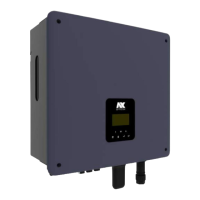

 To Next Page
 General