This document is a user's manual for the AcalaQuell water filter system, which includes various models such as Smart, Luna, Mini, Advanced, and Grande. The AcalaQuell system is designed to provide high-quality, great-tasting drinking water by purifying and enhancing tap water. It aims to offer safety from contamination and improve the taste of water through a multi-stage filtration process.
Function Description:
The AcalaQuell water filter system operates on the principle of gravity filtration, making it an easy-to-use solution for producing purified water anywhere, anytime. The system incorporates several components to achieve its filtration and enhancement goals:
-
Ceramic Filter: This is the initial stage of filtration, responsible for removing larger particles and sediments from the water. It acts as a pre-filter, preventing the main filter cartridge from clogging prematurely. The ceramic filter's percolation time, which determines the overall filtration speed, ranges from 30 to 60 minutes per liter, depending on its condition and the filling level.
-
Filter Cartridge: This is a core component of the system, containing a high-performance active carbon filter and an ion exchanger. The active carbon filter is designed to reduce bad tastes and smells, as well as various undesirable toxic substances found in tap water. The ion exchanger works to reduce unwanted lime, nitrates, and poisonous heavy metals. To maintain hygiene and prevent contamination, parts of the cartridge are impregnated with silver, which does not leach into the drinking water.
-
Optional Lime Filter: For areas with hard water, an optional lime filter can be integrated into the system. This filter specifically targets and reduces limescale, further improving water quality and taste.
-
Mineral Stones: After filtration, mineral stones are added to the drinking water tank. These stones release basic trace elements back into the water, which are beneficial for health and enhance the taste. The amount of mineral stones used can be adjusted to control the desired taste of the water.
-
ReNaWa® and Pi Technology: The AcalaQuell system utilizes ReNaWa® technology (renatured water) and Pi technology (back to the origin), developed in Japan and Germany. These technologies aim to create "living water" that supports health and well-being.
The system is designed to be environmentally friendly, reducing the need for plastic bottles and thereby contributing to less waste and reduced energy consumption.
Usage Features:
The AcalaQuell system is designed for straightforward assembly and daily use.
- Assembly: The manual provides detailed instructions for assembling the system, including identifying all components (lid, ceramic filter, upper tank, optional lime filter, cartridge hanger, filter cartridge, mineral stones, drinking water tank, magnetic outlet, and base). It emphasizes cleaning all holders and parts with mild soap, except for the filters and mineral stones, which should only be rinsed with clean water. Disposable gloves or well-cleaned hands are recommended for assembly to maintain hygiene.
- Tap Installation: The tap is installed on the drinking water container using two sealing rings, one on the inside and one on the outside, to ensure a watertight seal.
- Filter Preparation: Before insertion, the filter cartridge must be watered and vented by submerging it in water for about 20 minutes. The ceramic filter should also be rinsed until all air is gone.
- Initial Use: The first three fillings of the drinking water container (approximately 5/8/10 liters, depending on the model) should be discarded or used for plants. This initial flushing helps to remove any dust or loose materials from the cartridge that may have accumulated during transport.
- Mineral Stone Preparation: Mineral stones should be boiled for a few minutes with a pinch of salt, then rinsed under running water and allowed to cool before being placed at the bottom of the glass tank. The amount of stones can be adjusted to achieve the desired taste.
- Filling: The upper tank is filled with tap water using a suitable vessel. It's important to monitor the system during filtration; if the drinking water tank is more than half full, the upper tank should not be completely filled to prevent overflow.
- Taste Control: Users can control the taste of their water by adjusting the amount of mineral stones used, as more stones result in a spicier taste.
Maintenance Features:
Regular maintenance is crucial to ensure the optimal performance and longevity of the AcalaQuell water filter system.
- Placement: The system should not be exposed to direct sunlight; a darker location is preferable.
- Daily Usage: To maintain optimal function, it is recommended to filter at least 6 liters of water per day. The system functions best when filtering 6 to 10 liters daily.
- Tank Cleaning: The water tanks should be cleaned regularly. The upper tank should be cleaned about once a month, and the lower tank about once every two months, to prevent deposits. A mild cleaning agent can be used for the tanks, but not for the filter cartridge, lime filter, ceramic filter, or mineral stones.
- Lime Scale Removal: Lime scale can be removed from the tanks using lemon juice and a soft cloth, followed by rinsing with clean water. Abrasive cleaning agents, scouring pads, or paper towels should be avoided, especially on plastic parts, to prevent scratches. A soft cloth should be used for drying.
- Mineral Stone Maintenance: The mineral stones should be boiled for a few minutes in untreated salt each month.
- Ceramic Filter Cleaning: The ceramic filter can be washed with water and rubbed with a clean sponge if it accumulates deposits, becomes discolored, or shows reduced water flow. For stubborn sediments, the firm, rough side of a new household sponge or suitable abrasive paper can be used. When cleaning, ensure to rub with an even, light pressure to avoid erosion of the ceramic, ideally under running water.
- Filter Cartridge Replacement: The filter cartridges should be changed every 4 months. In cases of particularly contaminated water or high utilization, replacement every 3 months is recommended.
- Mineral Stone Replacement: 2-3 pieces of mineral stones should be replaced with new ones every 2 months.
- Ceramic Filter Replacement: The ceramic filter should be changed after one year, or sooner if holes appear in its wall, indicating unfiltered water is passing through.
- Lime Filter Refilling: The lime filter filling typically lasts 2-6 weeks.
- Absence:
- For short absences (up to 3 days), if the water tastes unusual upon return, the system should be emptied and refilled until the good taste returns.
- For absences longer than 3 days, all water should be removed from the system. The filter cartridge and lime filter should be stored in a dark, cool place (above 5 degrees Celsius), kept moist and well-packed to prevent germ growth. The ceramic filter and stones should be stored dry and airy.
- When resuming use after an absence of more than 3 days, the filter should be treated as new, involving at least 16 liters of flushing.
- For absences longer than 2 weeks, it is recommended to replace the cartridge with a new one and the limescale filter.
- Troubleshooting: The manual provides solutions for common issues such as water not flowing from the filling tank, water running unfiltered into the storage tank, water leaking from the drinking water tank, or unusual smell/taste. Solutions include cleaning filters, venting air, checking seals, ensuring correct capacity, and adjusting mineral stone usage.
- Algae Growth: If a green film forms on the ceramic filter or tanks, it indicates high nitrates in the water or exposure to light. Solutions include making the filter darker (e.g., covering it with a dark cloth), cleaning the system thoroughly, boiling mineral stones with natural salt, and changing the filter if the film is visible in the cartridge.
The manual emphasizes that regular component changes are essential to maintain optimum performance and water quality.

 Need help?
 General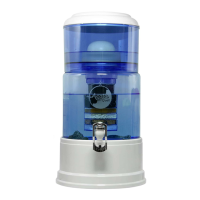

 To Next Page