3
SPEAKER WIRE
The amount of wire you’re going to need will of
course vary with speaker placement (which we
cover next). But we’re covering the subject of
wire now because it’s something you may have
to go out and obtain along with whatever tools
you don’t already have.
What kind to use
We recommend using inexpensive, multi-stranded
“
zip-cord” for amplifier-to-speaker connections.
Also called lamp cord, it’s sold in pre-packed
rolls and in bulk displays at hardware, lighting
and home improvement stores. Zip-cord’s outside
covering (insulation) can be transparent, black,
brown, white, etc. Color doesn’t matter. Wire-
thickness does. For in-wall and in-ceiling, a good
quality wire should be used so the outside plastic
covering won’t crack and break down over time.
Selecting the proper gauge
Wire is measured in “gauges.” For no particularly
good reason, the bigger the number, the smaller
the wire. For example, 18-gauge is thinner than
14-gauge.
The gauge of wire you need is determined by the
distance between your amplifier/receiver and
the speakers. Use the following chart as a guide:
Length Minimum Gauge
Less than 10 ft. 18
10 to 50 ft. 16
Over 50 ft. 14
If in doubt, be safe and get a smaller gauge
(i.e. thicker wire). Using too thin a gauge over
a long distance can compromise sound quality.
And besides, there isn’t a vast cost difference
between gauges, anyway.
How much to buy
Basically, more than you think you need. As we
noted earlier, a discussion of lengths is sort of
premature until you’ve decided on exact place-
ment, so you may want to skip to Section B on
“Where to put your speakers.” But if you
have a rough idea of the distance from your
amplifier to the speakers, here are a few tips:
• Because of the complicated paths which are
often required to route wires, you’ll definitely
need more than the amount derived from
simple measurements.
• Professional installers often use the following
rule of thumb: “As the crow flies” amp to
speaker distance TIMES FIVE. That allows
enough for both speaker paths plus a very
healthy margin for unplanned detours.
Remember the electrician’s favorite adage:
“You can always cut off extra wire, but
they don’t stretch worth a darn.”
use a more powerful amplifier if you take
some simple precautions, which we cover on
page 7 (“Taking care of your new
Acoustech speakers”).
A more serious consideration is whether or
not you intend to power more than one set of
speakers with the same amplifier or receiver. If
you intend to hook speakers to both “A” and
“B” receiver outputs and then play both sets of
speakers at the same time, you should read the
section starting on page 7 of this manual
(“More on amplifiers and impedances”),
to avoid potential problems.
B
VARIOUS USES
Acoustech Stereo Ceiling Speakers can be
used for background music, as a primary
listening system or as built-in rear surround
speakers in an audio/video home theater.
Background music
If you just want low-volume background
music to float through a room, placement for
best acoustics is not particularly critical. You
can pretty well ignore all our diagrams and tips
on imaging and other acoustical matters. Just
put your speaker where it’s convenient and non-
intrusive to room decor. You can even place the
speaker in an adjoining room, such as a living
room that flows into a formal dining room, or in
a kitchen and breakfast nook.
Surround sound
Acoustech Stereo Ceiling Speakers make excellent
surround sound speakers. They can be mounted
in any of the positions shown in Drawings 2
and 3, especially from the ceiling.
OTHER ACOUSTIC
CONSIDERATIONS
For best fidelity, there are several other factors
to keep in mind before you start actual installation.
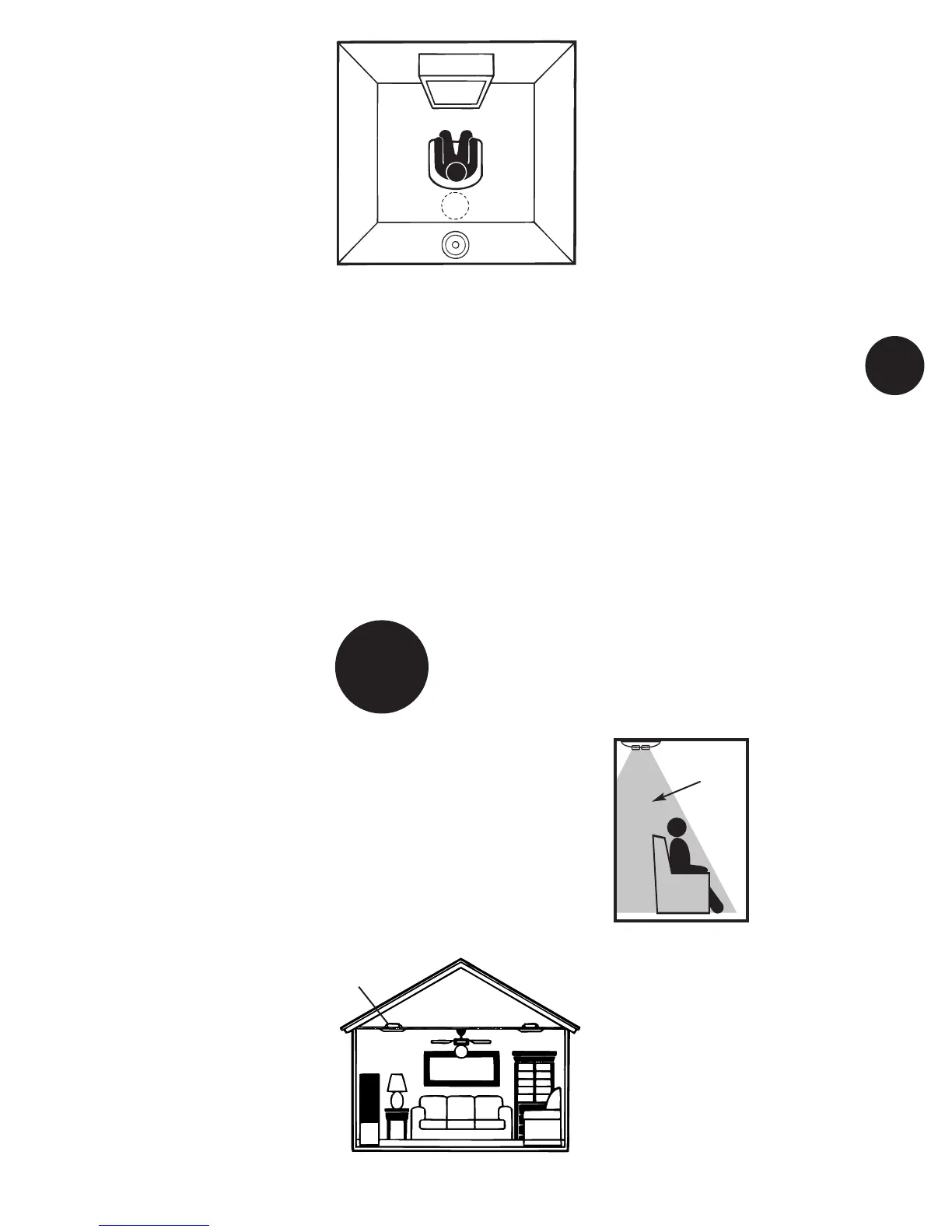
Acoustech ceiling speakers may be
used for rear surround sound chan-
nels by placing them (1) behind or (2)
in the ceiling, just behind the viewer.
DRAWING 2
DRA
WING 3
Open
Attic
Acoustech
Speaker
Standard Room
1
2
DRAWING 4
Cone of
Coverage
AMPLIFIER CONSIDERATIONS
Virtually any receiver, power amplifier or inte-
grated amplifier can be used with your Acoustech
Stereo Ceiling Speaker. Although Acoustech
speakers are rated for high power
, it’s OK to
WHERE TO PUT
YOUR SPEAKERS
Since these are primarily used in ceiling applica-
tions, we highly recommend installing in an open
attic space. If you need to go into the ceiling of a
first floor room (in a two story house), we rec
-
ommend the use of a professional installer.
Placement can make all the difference in how
your Acoustech speaker systems sound – and
how easy they are to install. There are at least
Vertical placement
Treble frequencies are
quite directional. While
the dome tweeters in
Acoustech HT-8C
speakers are designed
to disperse high fre-
quencies over a wide
area, they will give you
the best sound when
positioned so that they
cover the listening
three “WHERE’S” and a “HOW” to factor into
your layout:
• HOW you intend to use your speakers
• WHERE they’ll sound best (acoustic
c
onsiderations)
• WHERE it’s possible to install them
(ceiling surfaces)
• WHERE they can be installed that makes it
easy to get wire to them without remodeling
your entire house.
area in a cone of coverage as shown in Drawing
4. Of course, if the speakers are being installed in
an area where listeners usually stand up (such as
a kitchen or hallway), they are best suited for ceil-
ing mount (see Drawing 3).
Corners and reflections
When a speaker is placed close to the corner
of a room, bass frequencies are emphasized.
Treble is emphasized when it reflects back from
reflective surfaces such as large windows. Con-
versely
, highs tend to be muffled by soft surfaces
such as drapes, rugs, upholstered furniture, car-
peted steps and even textured fabric wall paper.


 To Next Page
 Loading...