
 Need help?
Do you have a question about the Acuity Brands eldoLED POWERdrive 50U-M4Z0X and is the answer not in the manual?
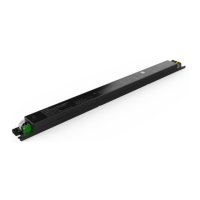
The eldoLED POWERdrive 50W DMX LED driver family is designed for powering LED light engines in various lighting applications. These drivers offer a comprehensive set of features for electrical design, DMX wiring, driver protection, mechanical installation, and configuration, ensuring reliable and flexible operation.
The POWERdrive LED driver is an intelligent constant current LED driver with four constant-current LED outputs. It is specifically engineered to power LED light engines, providing independent control for each output. The cumulative output power across all four LED outputs is limited to 50W, allowing for flexible distribution of power across different LED loads. The driver supports LED loads with a forward voltage up to 55V and allows for output current programming in 1mA steps between 150mA and 1400mA for each LED output.
The driver is fully programmable, supporting high-speed multi-channel (color) lighting applications. It integrates traditional LED driver settings such as drive current, minimum dimming level, and dimming curve, alongside advanced configurable parameters for enhanced functionality. These parameters can be accessed through FluxTool software or set at the eldoLED factory.
The DMX control interface is electrically isolated from the Class 2 LED outputs and mains input, which enhances the driver's robustness against surge events and accidental mis-wiring. The driver is designed to meet UL Class 2 requirements, with each LED output adhering to specific voltage, current, and power limits.
The POWERdrive LED driver offers extensive configurability to adapt to diverse lighting scenarios. Its LED outputs can be programmed for independent control, grouping, or disabling, with 1 to 4 DMX addresses visible to the DMX network based on the programming.
For DMX wiring, the driver supports daisy-chain connections within a DMX network. Each driver represents one "unit load" on the DMX bus, with the DMX standard allowing up to 32 unit loads per bus. The DMX IN and DMX OUT connections for the luminaire are critical for trouble-free operation, requiring separate connections for DMX +, DMX -, and DMX SHIELD conductors. The DMX protocol operates over an RS-485 physical layer at 250kbaud, necessitating DMX-compliant cables with specific operating characteristics, such as a twisted pair with low capacitance and a nominal characteristic impedance of 120Ω.
Remote mounting applications are supported, allowing the LED driver to be located away from the luminaire. However, the distance between the driver and the LED light engine(s) should not exceed 100m (384ft) to manage voltage drop in the cables. Limiting the voltage drop to about 1V between the LED driver and the LED load is recommended for optimal efficiency.
The driver's startup and fail modes are fully configurable. In the absence of a DMX signal, the driver's behavior can be defined, including retaining the last intensity levels or defaulting to predefined scenes. This ensures predictable operation even when the DMX signal is lost.
Group Scaling allows LED outputs to be set as "active" or "inactive." This feature is particularly useful in applications where only a subset of LED outputs is connected to an LED load, ensuring optimal driver performance by deactivating unused outputs.
Interpolation methods—Off, Video, Colour, White, and Glow—provide various levels of smoothness for fades between setpoint changes. Higher interpolation levels result in smoother transitions at the cost of a slight delay in reaching the setpoints.
Power Scaling is an advanced feature designed to prevent the overpower protection circuit from triggering, which would otherwise result in a loss of light. By enabling Power Scaling, the driver can gracefully scale back the output current to all LED outputs while maintaining the proper drive current ratio, ensuring consistent color accuracy and allowing the driver to operate close to its maximum output power rating regardless of the number of active LED outputs.
DMX network settings provide granular control over the mapping between DMX channels and LED outputs, network channel count, and network resolution. This flexibility allows multiple LED outputs to be tied to the same DMX address for synchronized dimming or mapped to separate addresses for independent control. The network resolution can be set to 8-bit (256 steps) or 16-bit (65536 steps) for finer control.
The POWERdrive LED driver incorporates several protection mechanisms to ensure longevity and prevent damage during operation. These include thermal protection, open protection, short protection, overload protection, and reverse polarity protection.
Thermal protection monitors the internal LED driver temperature. If it exceeds a preset limit, the output current is gracefully scaled back. If the temperature continues to rise, the driver will shut down and restart once the temperature drops below the threshold. An external 47kΩ NTC thermistor can also be connected to monitor the temperature of the LED light engine, preventing overheating by decreasing the output current if the NTC temperature exceeds a specified throttling temperature.
Open protection turns off all LED outputs if an open circuit is detected on any output, with the driver automatically attempting a restart every 400ms. Short protection similarly turns off all LED outputs upon detecting a short circuit, with automatic restarts every 400ms. Overload protection monitors the cumulative load across all LED outputs and gracefully scales down the output current if the cumulative load exceeds the maximum output power rating. Reverse polarity protection prevents current delivery if the LED load polarity is reversed, protecting the LED load from damage.
For troubleshooting, it is recommended to use a handheld DMX/RDM device. The process involves isolating the driver/fixture from the network, validating the driver's function and settings, and then validating the DMX network. This includes verifying correct programming of group scaling, network start address, network channel count, and channel mapping using FluxTool. If the driver does not respond to DMX input, further steps involve isolating the driver from the LED load, verifying the LED load's operation and proper connection (correct polarity, no cross-connected/shared outputs, forward voltage below 55V), and then retesting. If issues persist, consulting the eldoLED Driver Troubleshooting Guidelines document is advised.
The driver's lifetime is optimized by ensuring the case temperature (Tc max) remains below the specified maximum allowable temperature under all operating conditions of the luminaire, contributing to a reliable lifetime of 50,000 hours. The drivers are also designed to meet Class A sound pressure levels, minimizing acoustic impact. Proper grounding of the driver, including mounting it to the luminaire body, is essential for proper EMC and safety performance.
 General
| Input Voltage | 120-277 VAC |
|---|---|
| Output Voltage | 2-55VDC |
| Output Power | 50W |
| Operating Temperature | -20°C to +50°C |
| Power Factor | >0.9 |
| Dimming | 0-10V, DALI |
| Protection | Overvoltage, short circuit, over temperature |
| Certifications | UL, CE, ENEC |

 To Next Page