IN-DEPTH LOOK AT THE MORPH FUNCTION.
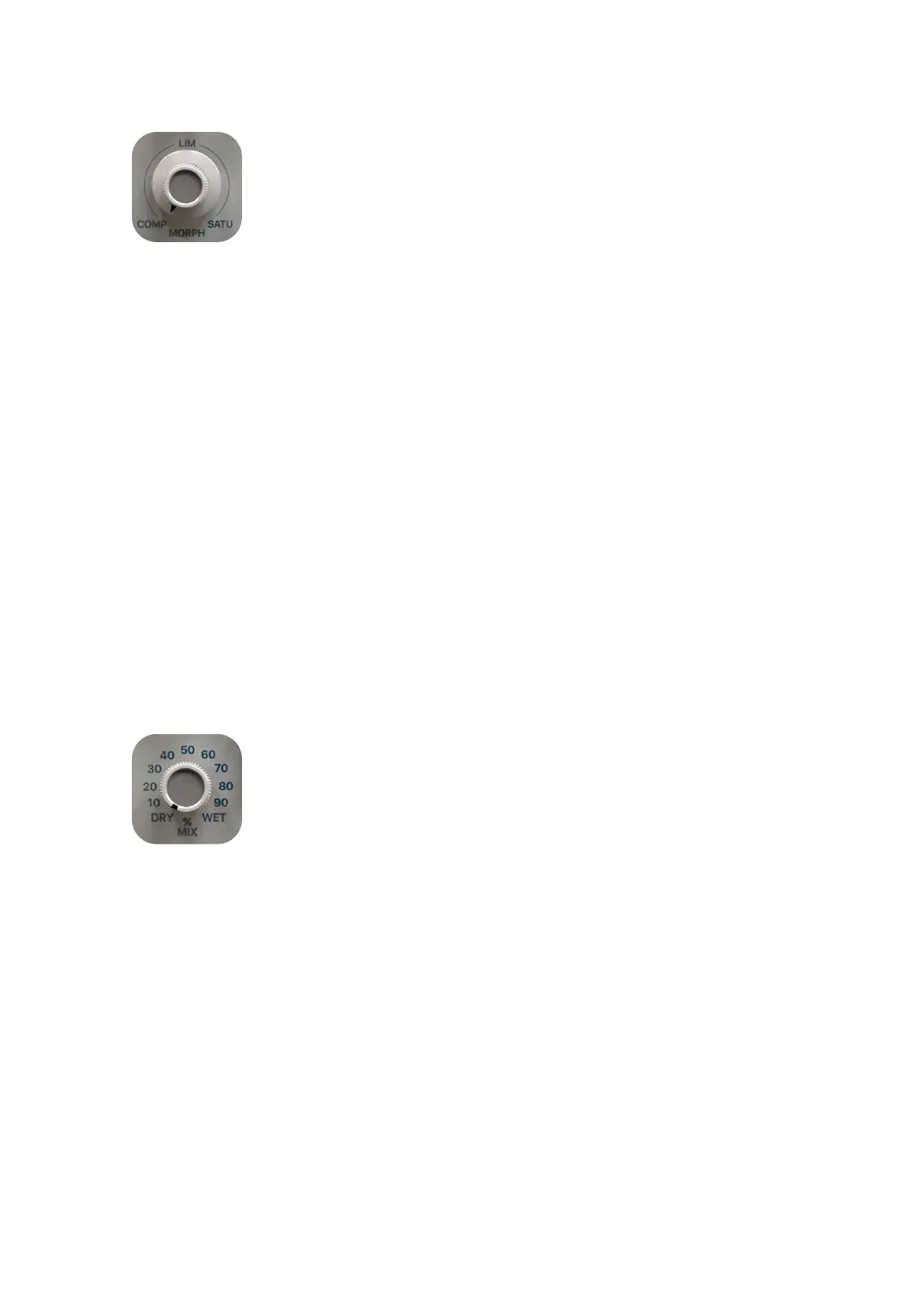
This control allows for a continuous action of further deformation of the detector’s attack
and release curves. In the first half of the run, they deform the attack curves arriving at
an attack time of zero length; in the second half, they bend the release curves coming
at a release time of zero length. Interestingly, the deformation of the attack and release
curves maintains the previous proportions (including not only the shape but also the
balance of the HOLD control).
Notably, in the first part, the type of linking of the stereo channels input to the detector
also changes from a linked mode to an unlinked mode in the middle position. This is
useful for creating an ideal limiter ( the detector channels must be completely indepen-
dent). So in the lower settings, we will have a perfect compressor with stereo link chan-
nels active; in the middle, we will have an ideal limiter.
In the second part of the run, however, the release handling changes until we arrive at an
ideal saturator (where both the attack and release times of the detector are zero). Some
clippers and hardware saturators have a release tending toward zero but perfectly zero-
ed out, and Tiger succeeds in recreating this type of experience.
INSIGHT INTO NEW YORK COMPRESSION (MIX PARAMETER).
In audio, New York compression is a sound processing effect that aims to replicate the
sound of recordings from the New York City recording rooms of the 1960s and 1970s.
To make the audio signal more consistent and controllable, compression is used to re-
duce the dynamics of the signal, putting it in parallel with the unprocessed signal to
make it less obvious and more balanced.


 To Next Page
 Loading...